The way out is a different length than the way back, and no map will admit it. The map says the trail is four miles and the map means it. Four miles out, four miles back, eight miles, a number, a clean thing. The map has never once walked itself. The map does not know about the fourth mile of the way back, the one that is a mile and a half at least, possibly two, a mile that has learned to stretch.
You start the return in good order. That is the trap of it. You turn around at the lake or the pass or the wet ledge where you ate the wet sandwich, and you feel fine, better than fine, you feel accomplished, and the first mile back goes by like the first mile out went by, easy, the legs still holding an opinion of themselves. The body has not yet sent the bill. It sends the bill later, and it sends it all at once, sometime in the third mile, when the accomplishment has worn off and the novelty is used up and there is nothing left to look at because you already looked at all of it on the way out.
That is part of why the way back is longer. The way out, everything is new. Every bend shows you something you have not seen and the newness pulls you along, the trail unspooling into country you don’t know yet, and curiosity does half the walking for you. The way back, you have spent all that. You know every bend. You know there is a root there, and a wet place there, and a long dull stretch through the black spruce that was fine the first time and is now simply a corridor you have to get through. Recognition is a heavier fuel than curiosity. You are walking through your own morning, in reverse, and it has gone stale.
And the body has been editing itself the whole day. This is the true reason, under the others. On the way out you were a fresh machine. On the way back the machine has miles in it. The legs have a specific tiredness, not pain exactly, a kind of deep report from the thighs that they are aware of every step now and would like it known. The feet have their own news, which I will not go fully into except to say that things that were dry are not dry, and a wet sock walked eight miles is a slow argument you cannot win, only finish. The clothes have damped through with the day’s sweat and the day’s weather and they hang heavier and cling where they did not cling this morning. And the snacks are gone. You budgeted the snacks for the out and did not think hard about the back, and now the bag has one crushed granola bar in it that you are saving, that you keep deciding not to eat yet, that becomes over the last two miles a small object of enormous importance.
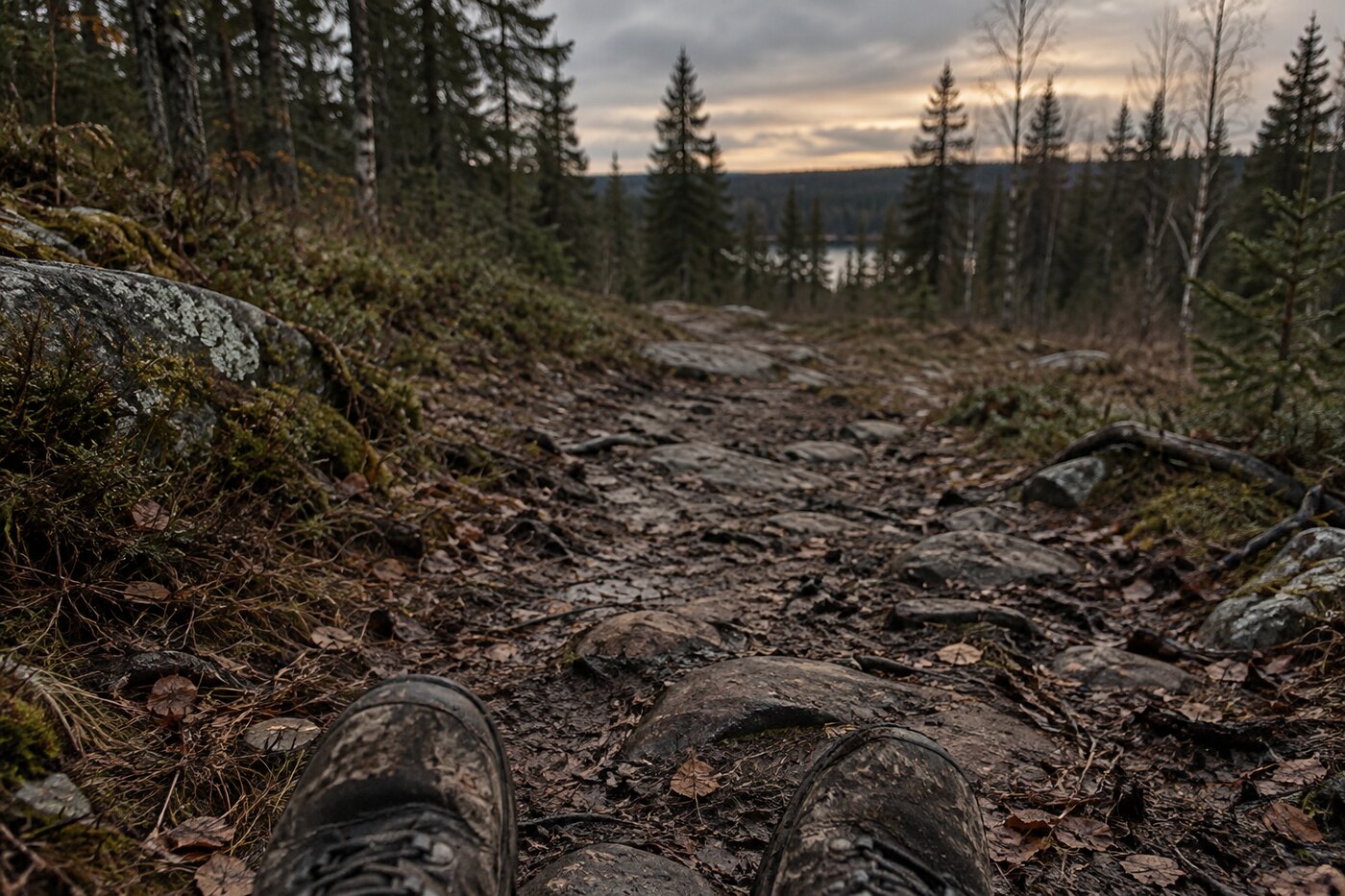
The standards drop, and this is not a failure, it is a feature, it is the body being sensible. On the way out you stepped around the mud. You picked the dry line, you rock-hopped the wet places, you kept the boots clean because there was a whole day ahead and no reason to be wet early. On the way back you walk straight through. The mud is just ground now. The wet place is just a place. You have stopped negotiating with the trail because you no longer have the surplus to negotiate with, and there is a plain relief in it, in giving up the small vanities, in letting the boots do what boots are for and just going through. The mud closes over the welt and you do not care. That is the return teaching you the thing the way out couldn’t, which is that most of the fussing was optional.
The light goes, of course. The light always goes, and it goes faster than you planned because you planned in the morning when there seemed to be so much of it. You come to depend, in the last hour, on the light the way you depend on the snacks, rationing your confidence against how much of it is left, and it is never enough, it drains out of the sky at the exact rate that makes you walk a little faster than is comfortable. The trees go flat and dark. The trail ahead stops being a thing you can read and becomes a paler suggestion between darker walls of spruce. You are watching your feet more and the country less. The country was the point this morning. Now the point is your feet and the pale line and the truck, which you cannot see, which is out there at the trailhead being the only thing in the world you want.
The last mile is the one that has learned to stretch. You know this trail. You know how long the last mile is. And yet you come around what should be the last bend and there is another bend, and then the trail does that thing where it seems to be delivering you, the trees thinning, a brightness ahead — and it is not the trailhead, it is just a clearing, and the trail dives back into the spruce for another quarter mile that the map swears does not exist. The destination this morning felt like the goal. It was not the goal. It was the halfway point, the turnaround, the place where the trip was exactly half over and the tired half had not started, and the body had not been consulted about any of it.
I got to the truck in the last real light, the kind you can still just see by if you don’t ask much of it. I sat down on the tailgate and did not take the boots off right away. In the door pocket was the crushed granola bar, the one I had saved the whole way back and never eaten, and I took it out and looked at it and set it on the seat. Still saving it. The mud on the boots had dried on the drive-out side and was wet on the trail side, one boot half of each, and it was drying in a line across the toe as I sat there, going pale at the edges while the middle stayed dark.