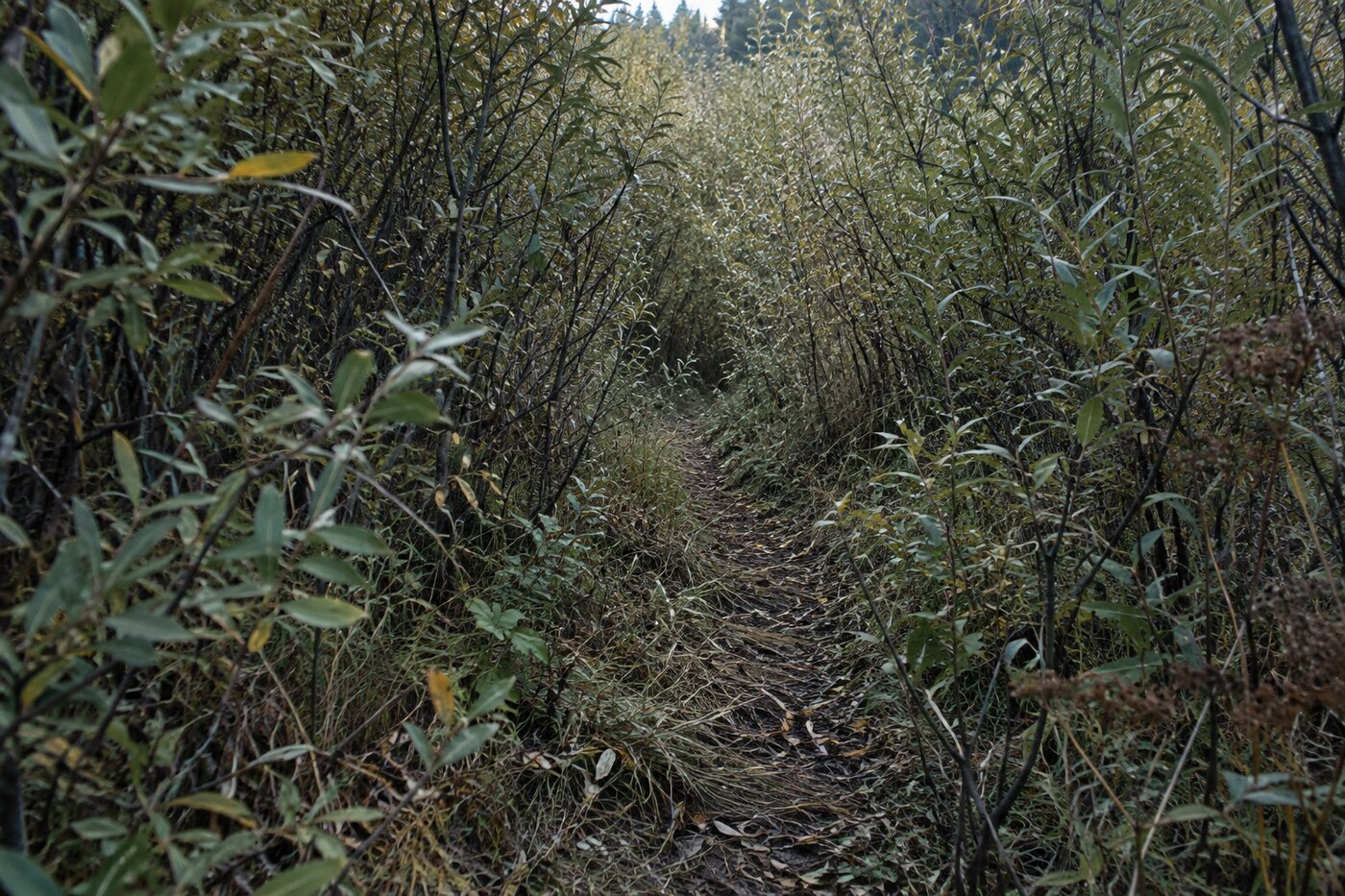
The trail was fine right up until it wasn’t, which is the only way a trail ever ends. There is no sign. Nobody comes out and stakes a little marker that says the agreement dissolves here. It just thins. You are walking on a clear line of packed dirt, boot-wide, honest, and then you notice you have been paying more attention than you were an hour ago, and then you notice you are choosing where to step, and then you notice you are in the willows and the line is gone and you cannot say exactly when it went.
A trail is not a thing. That is what the willows teach you, standing in them. A trail is an agreement. It is a vote taken by feet, over years, that this is the way, and the vote has to be renewed constantly or it lapses. Enough boots and hooves come through and the tread holds, packed down below the reach of the plants, a public decision written in dirt. But let the traffic drop below some number — let a season go by, let people find a better line, let the reason for the trail dry up — and the willows move in, because willows are always waiting, willows are the second most patient thing in the country after the rock, and they close the vote. The path was only ever a path while enough feet agreed. The feet stopped coming. The agreement lapsed. I was standing in the retraction.
The tread does not vanish all at once. It degrades in stages and you can read them if you slow down. First the packed dirt goes to a scuff, a place where the ground is merely disturbed, no longer a groove. Then the scuff goes to a suggestion, a faint corridor where the brush is a little shorter, a little thinner, where something used to keep it down. Then even the suggestion breaks up into pieces — a clear yard, then nothing, then maybe another clear yard off to the left that might be the trail or might be a game trail or might be the place a moose bedded down last week and pressed the willow flat. You start following those. That is the mistake and also the only option. You follow the flattenings because they are the only evidence going, and half of them are the trail’s cousins, animal paths that will lead you confidently to a wallow and abandon you there.
I stopped where the last honest piece of tread ran out. You do stop. The body stops on its own, some old part of it that does not like the willows closing over the head, and you stand there with the brush at your chest and your shoulders and you do the arithmetic. The willows here were the head-high kind, the kind you don’t see over, gray-green and springy, growing so close that pushing through them is less like walking and more like swimming, a breaststroke through wood. When you are in them you cannot see your feet. You cannot see the ground you are voting on. You feel it, through the boots — is this packed, is this the old tread still down there under the growth, or is this just the soft ground of everywhere. Sometimes you feel it and it is packed and your heart does a small stupid glad thing, the tread is still down there, the vote is only buried not gone. Sometimes you feel it and it is nothing, is just dirt and root, is the country with no opinion about where you go.
I pushed on longer than I should have, on faith, which is the word for navigation when the ground has stopped cooperating. Faith and a compass bearing and the shape of the land, that far ridge, the sound of the creek down to the right that I knew I had to keep down to the right. The willows took my hat once and I had to back up and get it. They found the gap at my collar and put a handful of their small dry leaves down my neck. A branch loaded with the day’s rain let go over my shoulder and I wore it. This is what the willows do to you, and it is not cruelty, it is just the plant being a plant in the place it won, and me being a man in a place that had un-agreed to have me.
There is a moment in the middle of a willow stand where you have to decide something real, which is whether this is still the way or whether you are now just moving through brush in a direction. Those are different things and they feel almost identical from the inside. I stood in it and could not honestly say which one I was doing. The tread had voted itself out from under me. I had the bearing. I had the ridge. I did not have the trail, and I was not going to get it back by wanting it.
I went with the ridge. You go with the biggest thing you can still see, because the biggest thing is the thing that will not lie to you, and a ridge is bigger than a trail and much older and it does not depend on anyone’s feet to stay where it is. I quartered toward it through the last of the willows, swimming, the branches raking, and came out the top side onto open shale where the growth thins because the ground gives it nothing, and there was no trail there either, but there was a place to stand and see.
Below me the willow stand ran on green-gray and unbroken, no line through it, nothing, the whole width of the draw filled in and healed over. Somewhere down in it was the tread I had lost, still packed, still down there under the growth, holding the shape of every foot that had ever agreed on it, and no way from up here to see where.