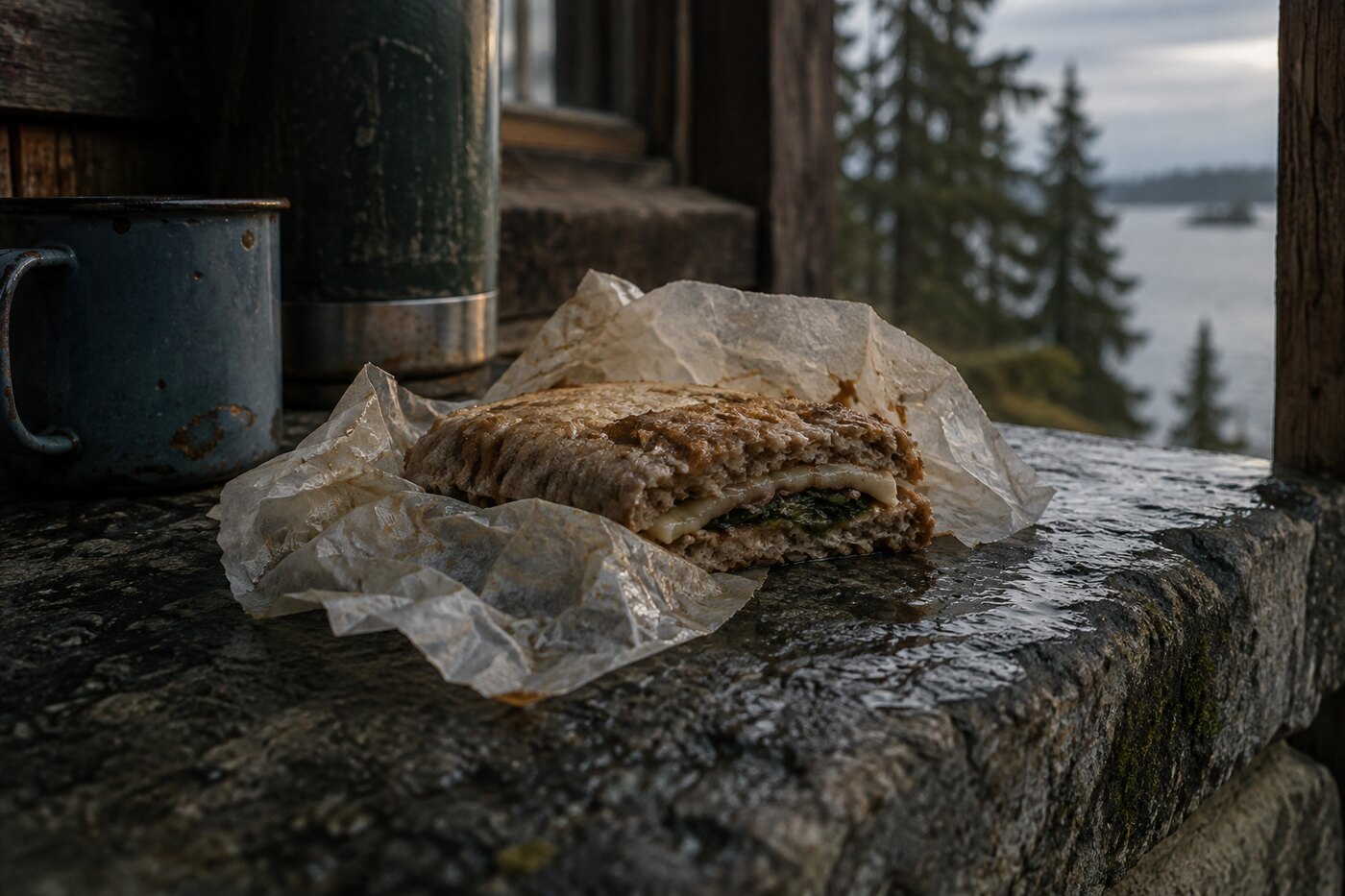
The sandwich was a good sandwich when it went into the pack. I want that on the record. Two slices of the dense brown bread, the kind with the seeds that get in your teeth, and between them a decent thickness of cheddar and a smear of mustard and three folds of ham, and I wrapped it in wax paper the way you do and I was, for about four minutes, a person who had planned ahead.
Then it went in the top of the pack, and the pack went on my back, and somewhere in the first hour the water bottle worked its cap loose. Not all the way. A cap does not need to come all the way loose to ruin an afternoon. It needs to weep, a slow bottle-sweat down into the fabric, and the pack drinks it up and holds it against everything soft, and the softest thing in the pack, softer even than the fleece, was the sandwich.
I did not know any of this at the time. This is the part the trip does not tell you while it’s happening. You feel warm and capable and you walk out to the turnaround, which for me that day was a granite ledge above the creek where the water comes down in a set of steps and you can sit and let the sound do something to the inside of your head. I got there and I was proud of myself in the low animal way you are proud of yourself for walking uphill, and I took off the pack and reached in for lunch.
The wax paper had gone translucent. That was the first sign, the paper turned from waxy white to a wet vellum you could nearly see the ham through. I peeled it back and the sandwich did not so much unwrap as get revealed, the way a thing under a sheet gets revealed. It had flattened. The weight of the pack had pressed it and the water had softened it and the two effects together had produced something that was no longer architecturally a sandwich. The bread had gone from bread to a substance. It had the density of clay and the color, in the wet spots, of a bruise. The seeds still held their shape. The seeds hold their shape through anything; they will outlast us.
Here is the distinction I want to make, because it is the whole thing. The sandwich was not ruined. Ruined is a word for food you throw away. This sandwich was reclassified. It had dropped a grade, from lunch to calories, from a thing you look forward to down to a thing you deal with, and the drop had happened in transit without my consent, the way the outdoors reclassifies everything eventually, given weather and time and a loose cap. Reality had gotten to my sandwich. It does that. You leave the house with a plan and a sandwich and the world edits both.
I ate it. Of course I ate it. This is not a story about the noble decision to eat it, because there was no decision. I was four miles out and four miles from the truck and I had walked uphill to get here and I was going to have to walk uphill in a different direction to get back, and hunger is not a committee. Hunger does not weigh the wax paper’s translucence or note the bruise color of the bread. Hunger looks at the object and says that is food and closes the discussion. So I ate a wet sandwich on a wet ledge over a loud creek, and I will tell you honestly that the first bite was bad and the fourth bite was fine, because that is also how the body works — it is embarrassed for about three bites and then it gets over itself and gets to the business of being fed.
It was cold and it was dense and where the water had really gotten in it had a slick quality, the bread gone to paste against the roof of the mouth, and the mustard had spread everywhere so that the whole thing tasted faintly of the one loud flavor. The cheese held up. Cheese is built for this. Ham held up. It was the bread that had given its dignity, the bread that had gone from a structure to a filler, and I ate the bread too because leaving it would have been a statement and I did not have the standing to make statements. I was a wet man eating a wet lunch. You do not get to be fussy in that chair.
The sound of the creek did what it does. My feet, which I have not mentioned, were also wet, but that is a different piece of paperwork. I sat and ate the whole thing down to the last dense corner and I felt, when it was gone, the specific flat contentment of a body that has been given fuel it did not enjoy. That is a real feeling and it has no name and it is one of the things you actually go out there for, though no one puts it on a poster.
I balled up the wax paper. It would not ball up properly, being wet; it clumped instead, a soft translucent wad that held the shape of my fist and did not spring back. I put it in the side pocket of the pack, the mesh one, and it sat there dark against the mesh, and a little water pressed out of it and ran down the outside of the pack, one thin line, and beaded at the bottom seam where the fabric was already dark from the leaking bottle, and hung there, not falling.