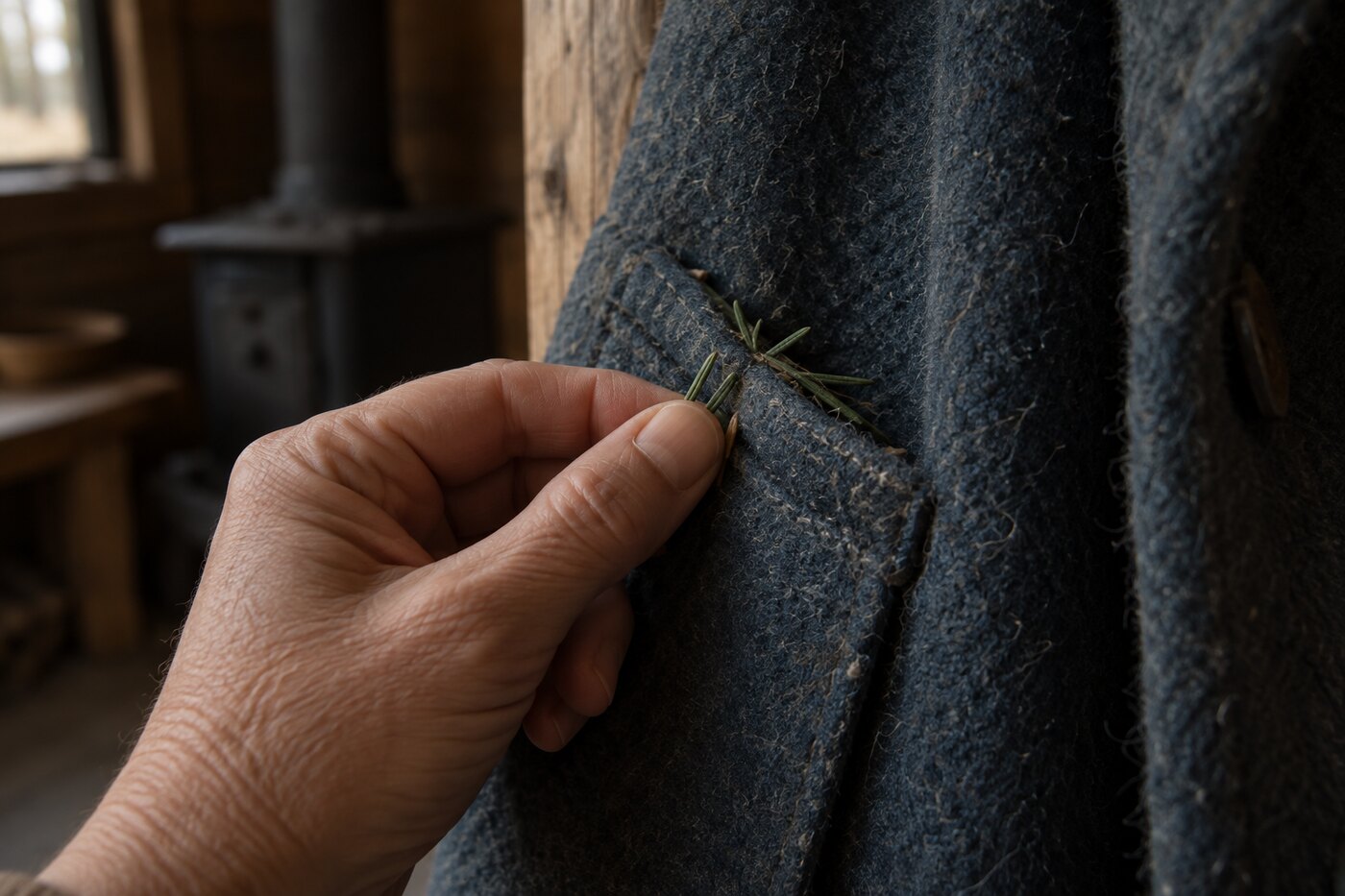
The needles turned up on a Tuesday, which is to say four days after the trip and three days after I thought the trip was over. I had my hand in the coat pocket looking for the truck key and I found instead a small crime scene of spruce.
They were the short kind. Spruce needles are short and square in cross-section — you can roll one between finger and thumb and feel that it isn’t flat like a fir needle, it has corners, it rolls with a faint reluctance. These were dry now and gone from green to a brownish green, the color a spruce needle turns when it has been off the tree long enough to give up on it. There were maybe a dozen loose in the bottom of the pocket, among the lint and one bent paper match, and there were more than that, I would learn, worked into the seam.
I had cleaned the boots. That was the thing. I had made a point of the boots. You come back from three days out and the boots are the obvious evidence, caked to the welt, and you take them off on the step and knock them together and the trip falls off in clods — the black creek mud, the paler trail dust, a fine gravel that gets down into the tread and has to be dug out with a stick. I did all that. I did it Saturday on the back step in the cold and I felt, doing it, the small satisfaction of erasing something. The boots were clean. The trip was filed away.
The coat had other ideas. A wool coat is a burr farm, a felt trap, a thing designed at the molecular level to hold onto whatever the forest hands it. Wool has scales. I know this from an old argument about why wool itches and why it shrinks, and the answer to both is the scales, the microscopic barbs on every fiber that lock together and lock onto things, and a spruce needle is exactly the kind of small stiff thing those scales are pleased to accept. So while I was out there brushing against the low limbs on the willow stretch, and pushing through the tight place where the trail goes under the deadfall, the tree was quietly loading my coat. Needle by needle. Into the weave, into the seam, into the fold of the pocket where the lining meets the shell.
They surface on their own schedule. That is the part I have come to expect and still find faintly unnerving. You do not get them all at once. The coat holds a needle deep in a seam for a day, three days, a week, and then some motion of the arm walks it loose and it works its way to the surface and pricks the back of your hand at a stoplight, a small green message from a place you are no longer in. I found this dozen on Tuesday. I will find more. I found one in April once, in the spring, from a trip the previous fall, a single square brown needle that had overwintered in the lining and chosen a warm April afternoon to reappear, long after the snow that fell on that trip had melted and the creek it crossed had frozen and thawed and the whole season had turned over. The coat was still filing.
There is a tidy version of a trip and there is the true one. The tidy version ends at the truck, or at the back step with the boots, at the hot shower, at the point where you say well, that was that and hang the pack on its nail. The true version does not end there. The true version keeps arriving in the mail for weeks, in installments — the sunburn that peels a week later off the back of the neck, the scrape on the shin that you don’t remember getting and that scabs and itches and heals in its own time, the smell of woodsmoke that you cannot get out of the fleece no matter what, and the needles, always the needles, the forest’s own carbon copy of the receipt.
I pinched the loose dozen out of the pocket bottom and put them on the windowsill, I don’t know why, the way you set something down that you have not decided about. Then I found the seam. You find the seam by feel — you run a thumbnail along the inside of the pocket where the two fabrics are stitched together and you feel the little stiffnesses, the needles caught crossways in the stitching, and you work them out one at a time. Some come. Some break, and leave half of themselves in the seam, and that half is now there for good, or for as long as the coat is, sewn into it as surely as the thread.
The truck key was in the other pocket. It usually is. I found it, and I found in that pocket too a single needle, just one, standing up out of the seam like it had been waiting to be counted.
I got the loose ones out that I could get. I left the broken halves; there is no getting the broken halves, not without unpicking the seam, and I was not going to unpick the coat over a spruce tree. The dozen on the windowsill dried a little more in the afternoon and curled, the way they do, each one bending toward its own inside. I have not thrown them out. The coat is on its nail. Somewhere in the seam of the left pocket there are three or four more that I can feel with a thumbnail but cannot get to move, and they will move when they decide to, on some Tuesday I haven’t reached yet.