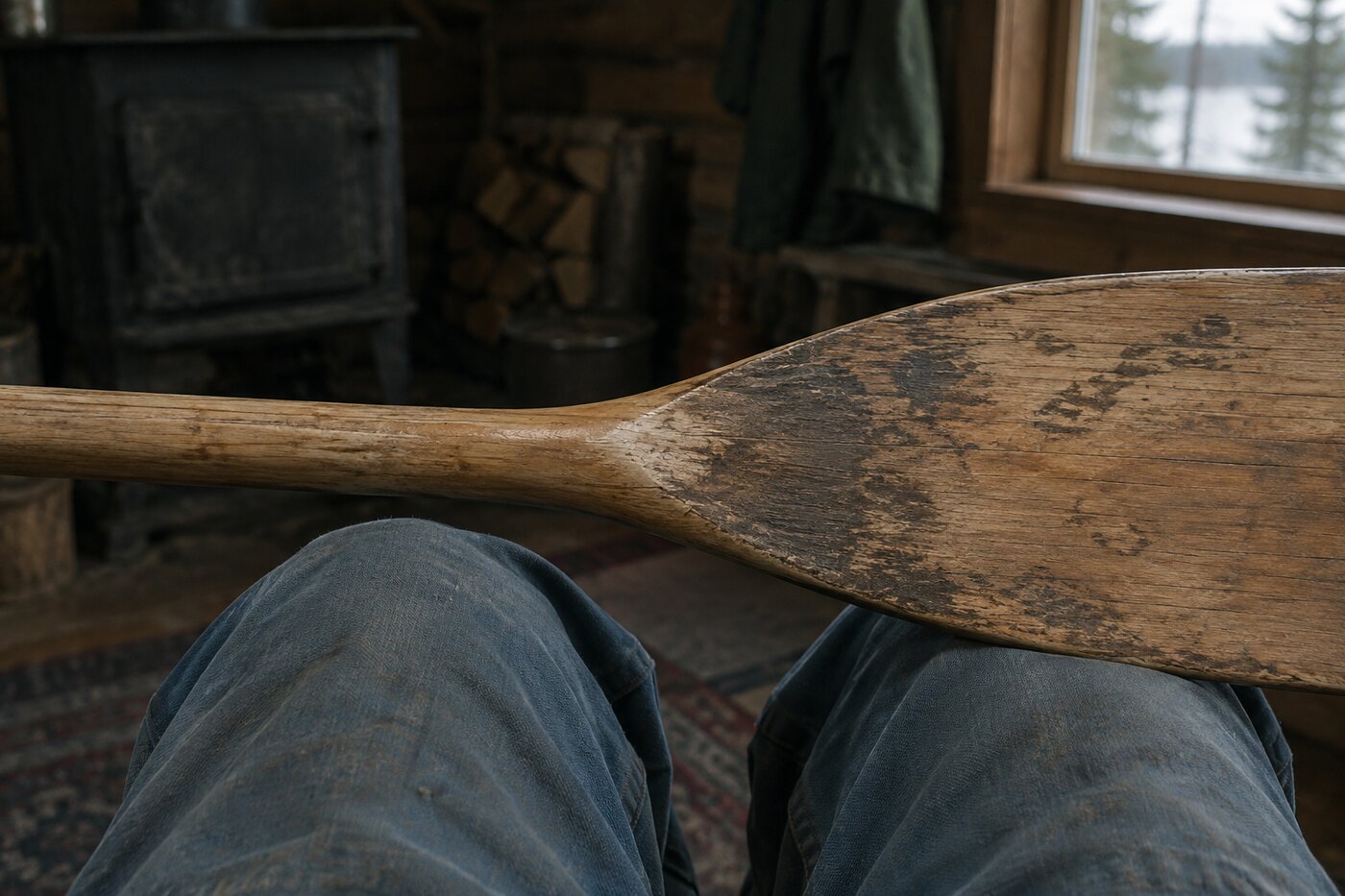
The paddle lives on two nails in the shed, laid across them like something at rest rather than something stored. It is not a good paddle. I should say that up front. It is a hardware-store paddle, ash or something claiming to be ash, and the blade has a split at the tip that I stopped a long time ago with a wrap of fiberglass tape that has itself gone amber and brittle. I have better paddles. This is the one I take.
You could read the whole history off it if you knew how, and by now I half know how. Start at the grip. The grip is a palm-shaped knob at the top, and the varnish is gone from it entirely, not worn thin but gone, sanded off by a hand that was never sanding, just holding. The wood there is a paler color than the rest, the color of the inside of the tree, and it has a shine to it that no varnish ever gave anything. It is the shine of skin. Oil and salt and pressure, ten thousand strokes’ worth, buffing the grain down until it stopped being grain and started being surface. My thumb sits on the front of that knob. There is a shallow dish there now, no deeper than a coin, where the thumb has been.
Then down the shaft to the throat, where the loom meets the blade. That is where the lower hand rides, and that is the smooth place, the one I mean when I say the smooth place. The shaft is round there and it should feel like wood, dry and slightly toothed, the way the shaft feels everywhere else. It does not. It feels like a stone out of a river. The hand has polished a band of it pale and glassy, maybe six inches long, exactly the reach of one grip, and if you close your eyes and run your palm up the shaft you can find it in the dark by the change in the wood. The friction stops. That is the tell. Everywhere else the wood grips back a little. There it lets go.
I have thought about why that patch and not another. It is because that is where the work is. The upper hand pushes and the lower hand is the fulcrum, and the fulcrum takes the load, and the load, applied ten thousand times with a wet hand, is a slow sandpaper. You do not feel it happening. You never once feel the wood leaving. You feel the water, and the catch of the blade, and the little grunt at the top of the stroke where you lever the boat forward, and meanwhile the wood is quietly going, a molecule of it, a season of it, onto your palm and into the lake.
There is a thing that happens with tools like this. The axe handle does it, worn to a waist behind the head where the hand chokes up for close work. The mitten does it, the thumb of a work mitten going shiny and then bald while the rest stays furred. The hand finds one place and returns to it and returns to it, and the returning is the whole story, more than any single trip. No single trip did this. This is the trips, plural, the ones I remember and the far greater number I don’t. The morning the loons were on the water and would not move for the canoe. The afternoon it blew up out of the west and we quartered into it for an hour and my lower hand cramped into the shape of the shaft and would not fully open at the takeout. The evening — this is the shine, this specific evening is in the shine somewhere — when there was no wind at all and the paddle came out of the water without a sound and went back in without a sound and the smooth place did what it does, which is disappear, which is stop being anything my hand had to notice.
That is the trick of a worn-in tool. It removes itself. A new paddle you feel the whole time, the varnish tacky, the grip a size too big, the shaft telling your palm about every edge it has. This one I do not feel, and that is the sign that it has become good, or that I have, or that the difference between those two has worn away along with the varnish. The blade is bad and the tape is ugly and the tip is split and I take it anyway, because the shaft has agreed to my hand and no other paddle has, and agreement like that is not for sale at the hardware store. It is only ever earned, one wet stroke at a time, in a currency of your own wood.
I took it down off the nails yesterday to look at the tape, whether the fiberglass wrap was letting go, whether the split was walking up the blade the way splits do. The wrap is holding. The split has not moved. I ran my thumb up the shaft out of habit while I was thinking about the tip, not meaning to, and found the smooth place with my eyes on the blade, the way you find the last stair with your foot in the dark.
The paddle went back on the two nails. In the light through the shed door the throat had a low shine to it, that pale banded gloss, and I put my thumb on it one more time before I left. The wood was cool. The band was a little narrower at one end than the other, tapering, where the hand had ridden higher some years than others — a thing I had never noticed and could not now stop seeing.