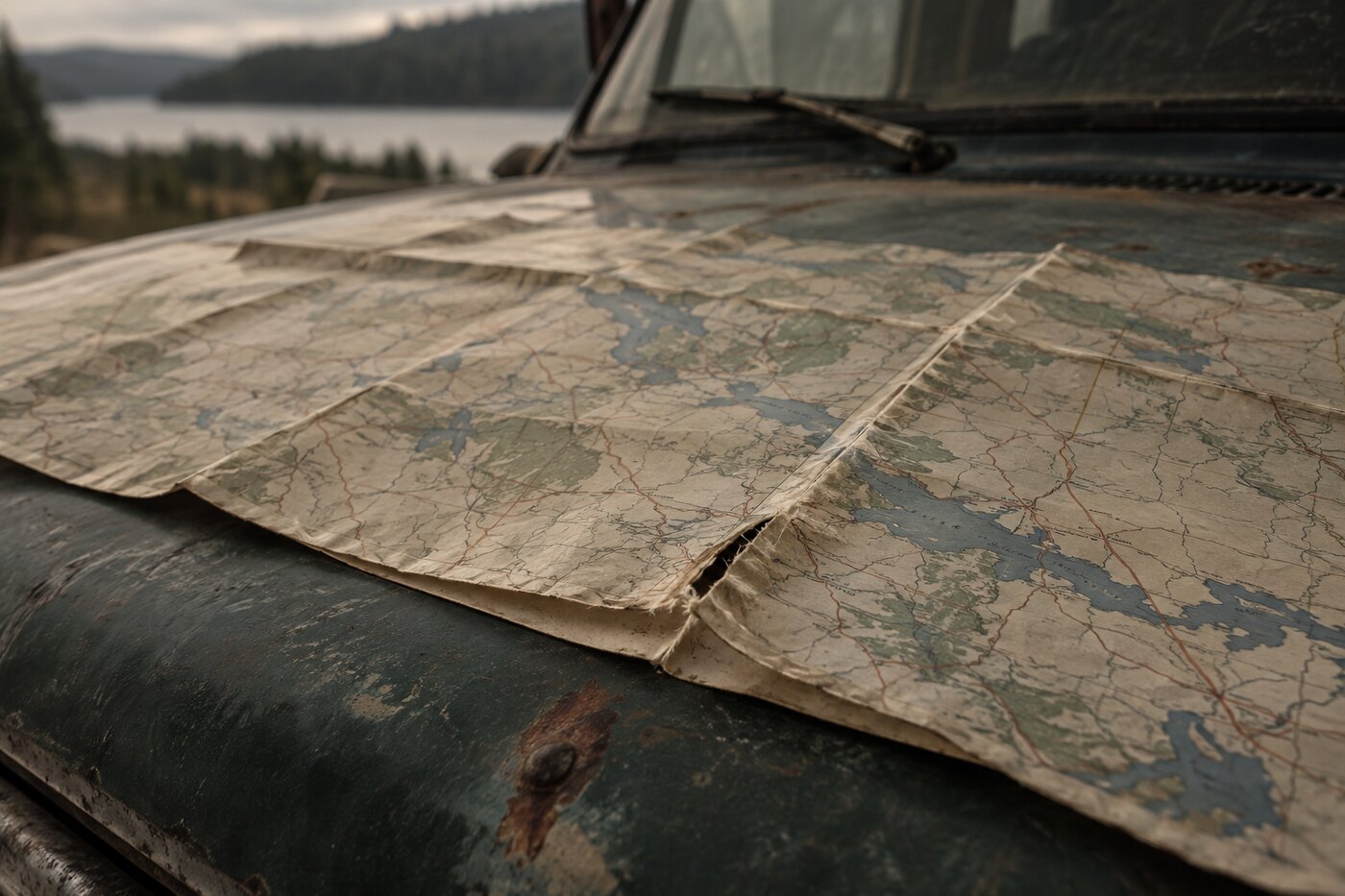
The map does not fold the way it wants to anymore. It has a way it wants to fold, a set of creases pressed into it at the factory by a machine that knew exactly where the paper should bend, and I have spent years overruling that machine, folding it wrong in a hurry, on a knee, in a wind, against the grain of its own intentions, until now it folds along creases that are half the factory’s and half mine, and the two do not agree, and the paper has given up trying to reconcile them.
I got it out on the hood of the truck to find the turn I had missed, which is the only reason a person gets a paper map out anymore, and it came out of the door pocket already half-open, sprung, unable to hold itself closed. That is the first sign of a map that has been used. A new map is tight, resistant, snapping back to its folds like it resents being opened. A used map sags open on its own, soft at every seam, eager, having lost the memory of ever having been rectangular.
I spread it flat and the creases stood up off the hood in a low relief, a whole topography of folding laid over the topography it was printed to show. Some of the fold lines had gone white, the ink worn clean off the ridge of them, so that a road running across a fold simply vanished for the width of the crease and picked up again on the other side, and you learned to carry the road across the gap in your head, to trust that the highway did not actually end at the fold even though the map now said it did.
There is a place, southeast, where the paper has worn to a furred softness, a patch gone almost to cloth. That is the corner I open most, the country I actually travel, and the map has recorded that not as a mark of importance but as damage, the way a stair records the traffic on it by wearing down in the middle of the tread. The parts of the map I never go — the far northwest, some empty quarter of muskeg and lakes I have no reason for — those parts are still crisp, still factory, still holding their ink and their folds. The map is worn precisely where I have lived and pristine precisely where I haven’t, which is a kind of honesty I did not ask it for.
And the tear. The tear is at the county line, and it is not a coincidence that it is at the county line, because the county line runs right down a fold, and the fold is where the paper flexes, and the county line was where I made the wrong turn that had me opening and closing the map six times in ten minutes on a cold day with cold hands. Every one of those opens and closes worked the fold a little further, and somewhere in there the paper gave, a small split starting in from the edge, following the crease inward toward the middle of the map the way a check in a board follows the grain. It has not torn all the way through. It is maybe a third of the way to the fold’s center, a slit you can put a fingernail into, and it stops, for now, at a spot where the paper is still whole.
I could tape it. I keep meaning to tape it. There is a way this goes, where you lay a strip of clear tape down the back of the seam before the split reaches the middle, and the tape holds the two counties together and the map lives another few years. But the tape stiffens the paper right there, makes a hard panel that will not fold with the rest, and then the fold moves to just alongside the tape, and the next tear starts there, at the edge of the repair, which is the story of every repair. You do not stop the tearing. You relocate it.
A phone would not do any of this. A phone shows you the county line clean and unbroken and identical every time, no crease, no fur, no white worn ridge where a road ought to be, no record whatsoever of the wrong turn that put you there. It is a better map and a worse object. It remembers the terrain perfectly and remembers you not at all. The paper is the opposite. It has lost some of the terrain to wear and it has kept every decision I ever made over it, pressed into the folds, worn into the corners, split at the line where I got it wrong. The paper knows me better than the country. The phone knows the country better than me.
I found the turn. It was where the fold crosses the wear, of course, in the soft southeast corner, at a junction the crease ran straight through so that the road I wanted disappeared into the white of the fold and I had to lift the map and angle it to the light and carry the road across the gap in my head to see where it went. Then I refolded it to put it away, and it fought me, folding half its way and half mine, never square, and I pressed it down along the seam with the flat of my hand to make it lie flat enough to fit the door pocket.
The split at the county line opened another sixteenth of an inch under my palm as I creased it. I felt the small give of the fiber letting go, not a sound, just a softness where a moment before there had been resistance, and I stopped pressing, and left it there half-folded on the hood, the slit standing a little open now to the light, not yet reaching the center, holding at the last whole inch of paper.