I tied the boat at dusk with a knot I have tied a thousand times, and then I went up to the house and left it there, and that is the whole strange business — you make a contract out of rope and consequence and then you go inside and sleep while the other party to it, the weather, works the night shift.
The knot was a round turn and two half hitches, which is not a fancy knot and does not want to be. It is the knot for exactly this: a load that will pull and slacken and pull again all night as the water moves and the wind leans. The round turn takes the strain so your hands don’t have to hold it while you finish; the two half hitches lock it off; and if you seat them right, snug them down against the standing part, the knot draws tighter under load instead of looser, which is the only property that matters when you are about to stop watching it.
I seated it by feel in the last of the light. You learn to tie in the dark because the dark is usually when you are tying — the day’s work runs long, the sun goes while you are still doing the last thing, and the rope comes down to your hands as a texture and not a picture. I felt the round turn bite the post. I felt the first half hitch snug, and the second snug against it, and I gave the whole thing the small firm tug that is less a test than a signature, a way of saying to the knot, there, that is what I meant. Then I coiled the tail and tucked it and turned my back on it, which is the part that takes a kind of nerve you stop noticing you are spending.
Because here is what you are actually doing. You are trusting a few loops of rope to stand between a boat and the whole night. The wind does not sleep. It comes up off the lake in the small hours with nobody watching, and it works on the boat, and the boat works on the rope, and the rope works on the knot, a slow steady arguing back and forth in the dark, thousands of little pulls, and you are not there for any of them. You are under a blanket a hundred yards away, having delegated the entire matter to a hitch you tied by feel.
I lay awake a while listening. You can hear a lake change its mind. Early on it was quiet, just the small slap of water on the hull, a sound so regular it is nearly silence. Then somewhere past midnight the wind came around — I heard it find the birches first, that rising hush, and then reach the water — and the slap on the hull got louder and less regular, and I lay there and thought about the two half hitches. Not with alarm. With the particular attention you give to a thing you have done all you can about. Either the knot was good or it was not, and the knowing of which was several hours away, out in the dark, being decided without me.
This is the intimacy no one mentions about rope. You end up trusting it the way you trust few things, because the trust is total and the thing is dumb. The rope has no judgment. It cannot re-tie itself if I got it wrong. It can only be what I made it in the last light, and hold or not hold according to that, and report the verdict in the morning. There is something clarifying about a trust with no give in it. The knot will not try harder for my sake. It will not care. It will simply have kept its word or not.
I slept eventually. The wind saw to its business. And in the gray of the morning I went down the slope to the dock in the wet grass, in that cold that has not yet decided to be day, to read the verdict.
The boat was there. That was the first thing, the thing the eye checks before the mind catches up — a shape in the right place, riding easy, where a gap of empty water would have meant the night had won. It had swung. The wind had walked it around to the lee of the dock and held it there, and the rope had let it swing and not let it leave, which is the entire job.
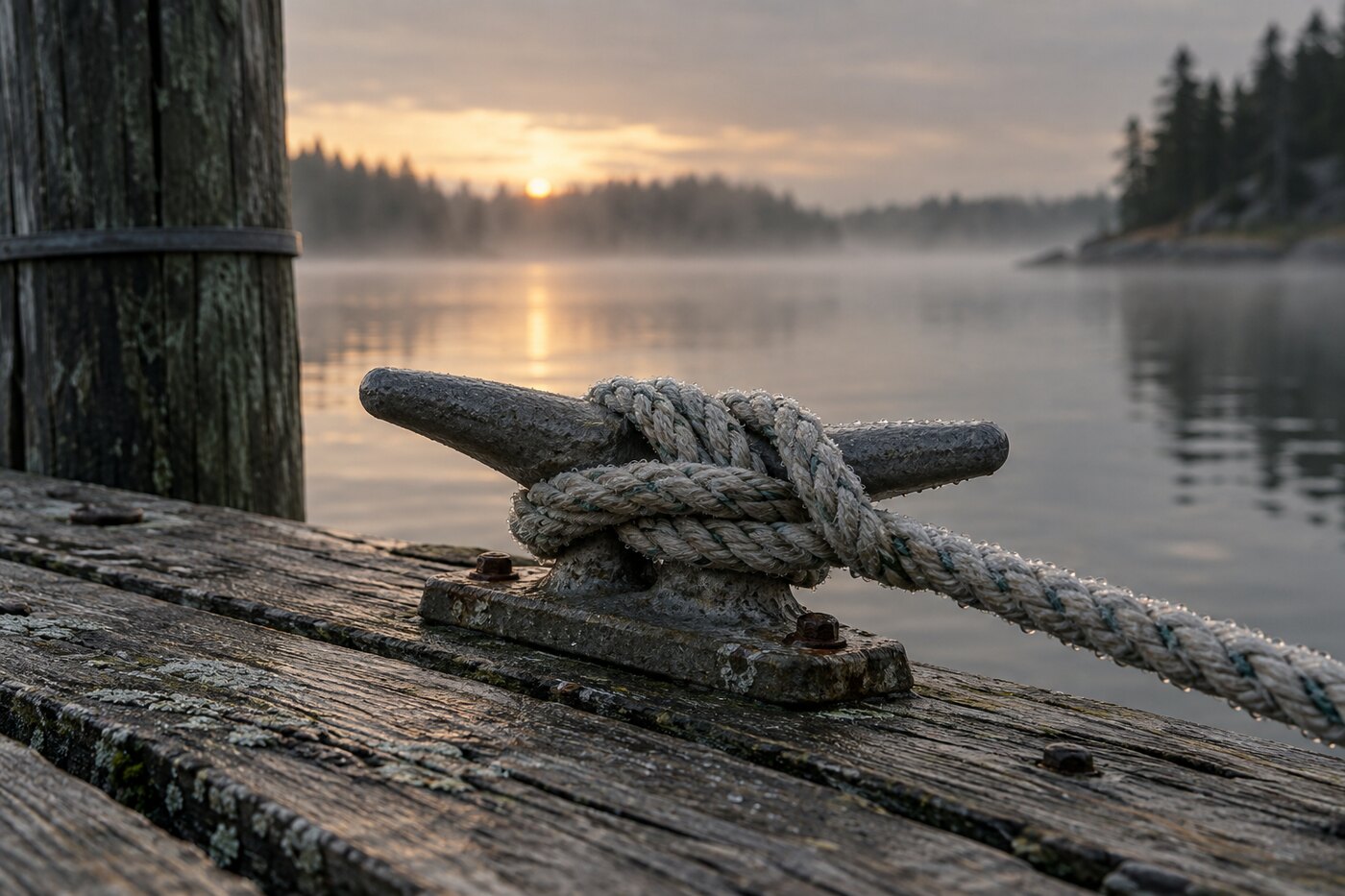
I crouched and looked at the knot. It had drawn down hard in the night, harder than I had left it, the two half hitches pulled up so tight against the round turn that they had become nearly one object, a dense wet knuckle of rope. Dew stood on it in fine beads. The rope had swollen with the damp and the working, gone stiff and cold, and where it crossed the post it had pressed a shine into the weathered wood, a bright worn patch that had not been there yesterday. The knot had kept its word all night and drawn tighter for the keeping, the way some promises do.
I went to untie it and it did not want to come. That is the last thing about a knot that held: it holds against you, too, in the morning, having no way to know the emergency is over. I worked a thumb into the first half hitch and the rope was too tight and too wet to give, so I left it a moment, both hands cold, and looked out at the lake, which was flat again now, and lying about the night the way water does, going silver in the first real light with not a mark on it to show what it had spent the dark arguing about.