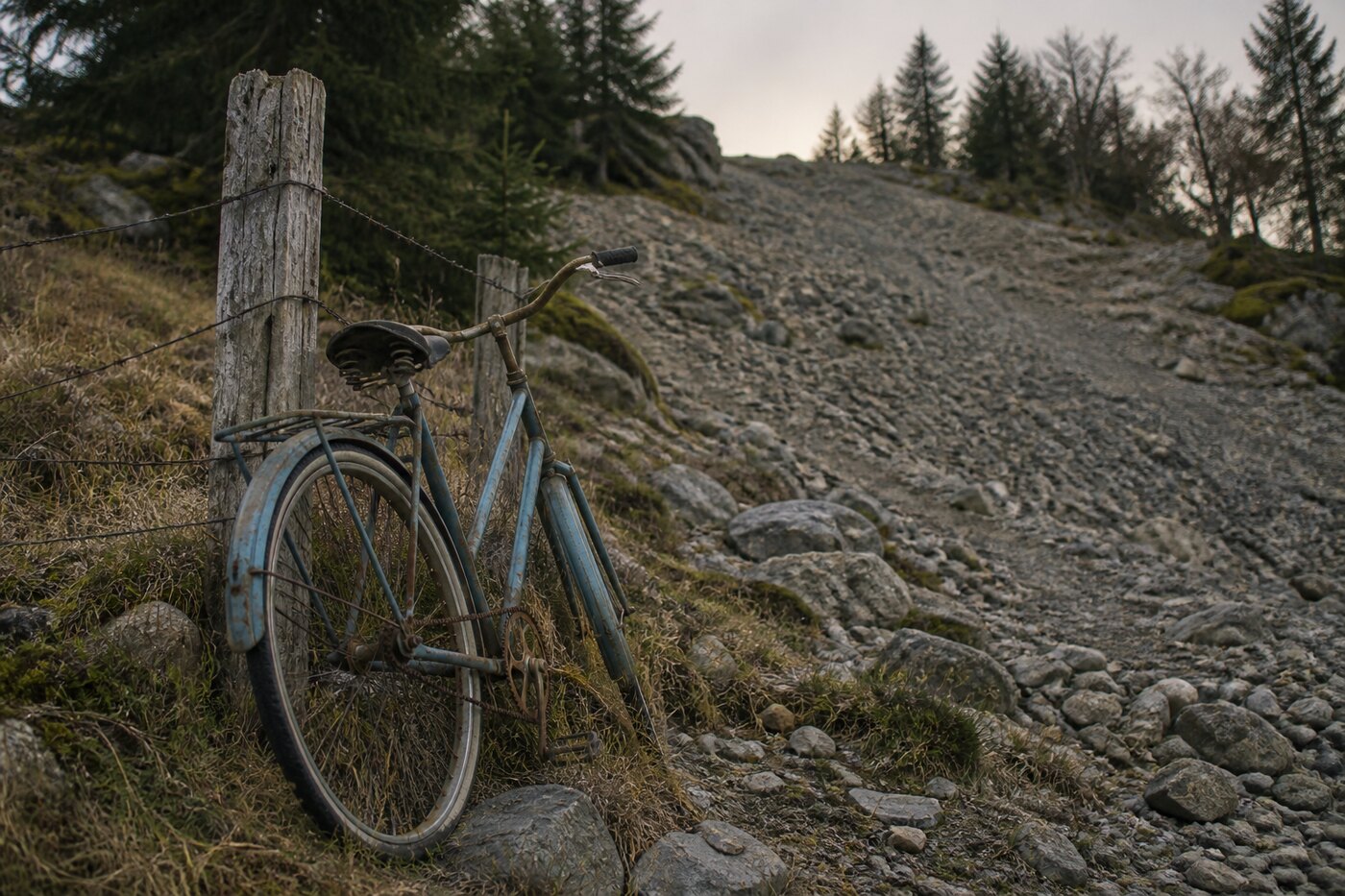
The hill starts where the pavement ends, at the mailbox with the dented flag, and it goes up past the fence line to the crest by the dead spruce, and it is the same hill it was on Tuesday. I want that on the record before I say anything else. The hill did not change. The road crew did not come in the night and add grade. The distance from the mailbox to the spruce is the distance it has always been. Everything that changed is on my side of the argument, and that is exactly what makes the argument so hard to win.
Tuesday I went up it without thinking. That is the honest report. I remember standing on the pedals for the steep middle section, but standing the way you stand to look over a fence, not the way you stand to fight, and the top arrived while I was thinking about something else. I filed the hill under easy. The body keeps files like that, quiet ones, and it does not tell you it is keeping them, and it does not tell you they are provisional.
Today the same hill is a different country. I came off the pavement at the mailbox in the same gear, expecting the same easy, and by the fence line the gear was wrong and there was no right one below it. The chain was already in the biggest cog. I had nowhere to shift but into memory, and memory said this was easy, and the legs said memory was a liar, and the legs had the better evidence, because the legs were the ones being asked.
Nothing about the machine was different. Same bike, same tires at the same pressure — I had pumped them that morning, sixty pounds, the taped handle wheezing at the top of each stroke — same chain, oiled, same everything that could be measured with a gauge. The hill was smaller yesterday and the only instrument that registered the change was me.
So I went looking for what I’d spent. This is the part you do while pushing down on pedals that push back, the mind casting around for an accounting. I had slept badly, for one, a thin broken sleep with the window open to a wind that kept starting conversations. That withdraws something from the account you don’t see until you try to draw on it. And I had eaten wrong, or eaten late, or not eaten enough of the right dull heavy food — I had eaten like a man who was not planning to climb anything, and now I was climbing, spending calories I had declined to deposit. And there was a third thing, harder to name, a general reluctance in the whole body, a day the machine of me simply did not want to make power, for reasons it did not file a report about.
The grade got to the steep middle, the part I had stood up for on Tuesday, and I stood up for it again and found the standing did not help the way it had. The pedals came around slow and slower. I could hear myself now, the breath gone loud and ragged, the freewheel ticking, the tires grinding the gravel, and under all of it a small mean voice doing the math and arriving, with each rotation, closer to a number I did not want.
There is a moment on a hill that is losing you where you can feel the decision coming before you make it. The cadence drops below the point where momentum helps. The front wheel starts to wander, hunting for traction, because you are going slow enough now that steering is a thing you have to do on purpose. The next stroke is not available at the price the legs are willing to pay, and the one after that is definitely not, and you can either grind to a stop still mounted, which is its own small humiliation, tipping sideways with a foot trapped, or you can get off.
I got off.
I want to describe the specific quality of this shame, because it is not the shame of being seen. There was no one on that road. There was a fence, a dead spruce, a magpie that did not care. It is the shame of the private ledger being read back to you in your own handwriting. You told yourself a story about what you were — a person for whom this hill was easy — and the hill has now audited the story and found it dated. The audit is fair. That is the worst of it. You cannot even resent the hill, which did nothing, which only sat there being the same grade it always was while you got off and took hold of the seat and the bars and began to walk.
Pushing a bike uphill is a peculiar labor. It is harder in some ways than riding — you are lifting your own dead weight and the bike’s, and the pedals swing and knock your shins if you don’t mind them — but it is a labor the legs will accept when they have refused the other, because it asks for a different kind of effort, slower, lower, without the sharp peak of the pedal stroke. The gravel came under my shoes one crunch at a time. The bike ticked along beside me, riderless, patient, a machine briefly relieved of its passenger and none the worse for it. The magpie moved to a further post.
I got to the crest at the dead spruce, the same crest I’d have reached on Tuesday, and the hill did not know the difference and did not keep score, and the road flattened and ran on toward home the way it always does. I stood there and got my breath back and looked down the grade I had just walked, which from the top looked like nothing, a gentle thing, a hill a child could ride.
There was a bright smear of green on my right shin where the pedal had caught it twice while I pushed, grass and a little skin, already stiffening. I did not wipe it off. It would be a bruise by Tuesday, the next time I came to the mailbox with the dented flag and told myself the hill was easy.