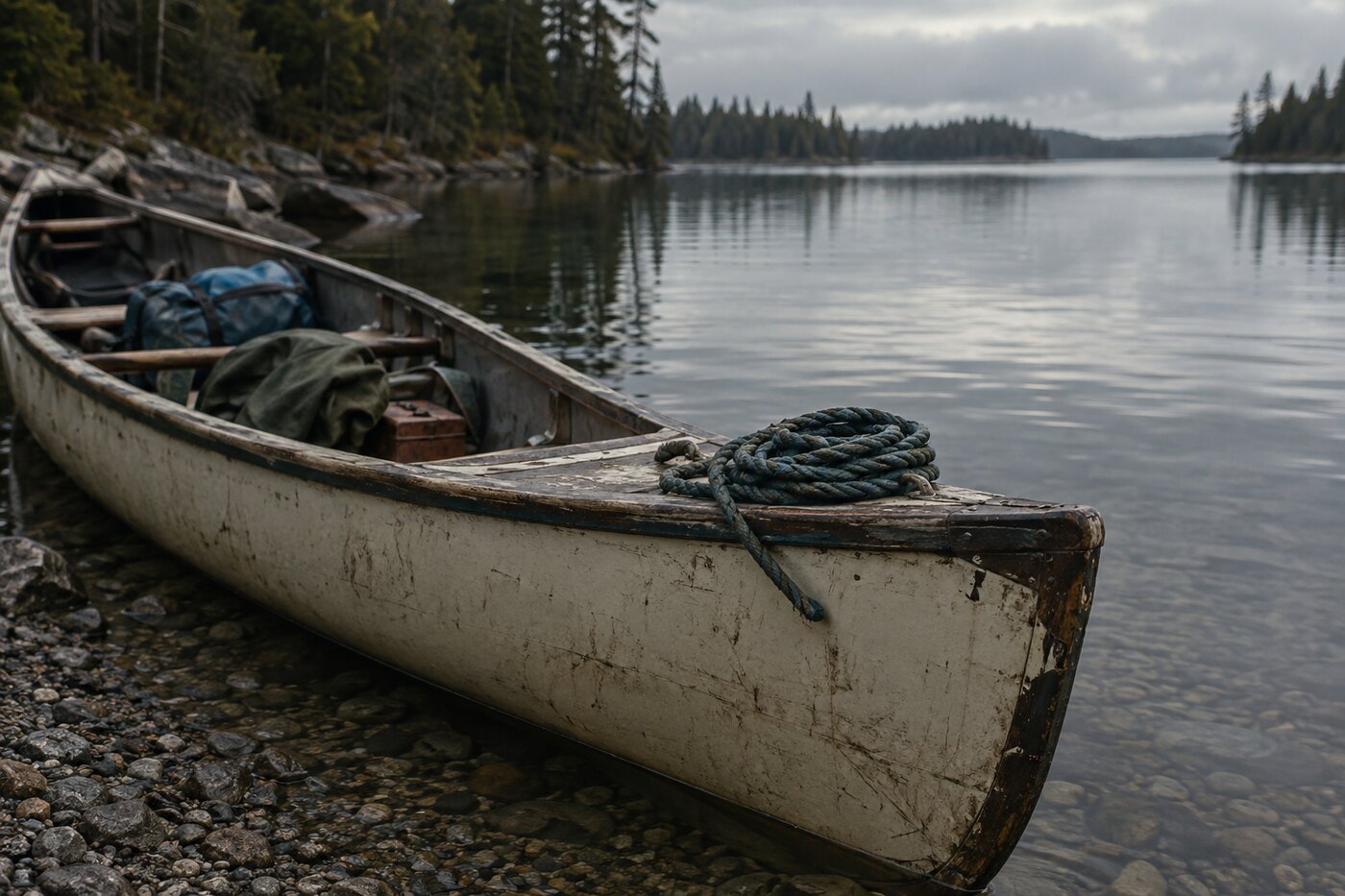
Water does not care and does not hurry, and those are its two strongest arguments. It will take your dropped keys with the same indifference it takes a leaf, and it will hold a canoe off the dock all day if you have loaded the canoe wrong, and it will not raise its voice once during any of it. You do the shouting. Water just keeps making its slow legal points about weight and balance and where things want to go.
Loading a canoe is the first negotiation and I have lost it many ways. Put the weight too far back and the bow rides up and every gust gets under it and swings you like a weathervane. Put it too far forward and the boat plows, shoving a little wall of water ahead of it, wallowing. Put it high and the whole thing gets tippy and nervous, wanting to trade places with the lake. The water registers every one of these decisions instantly and without comment, translating your judgment into how the boat sits, and you read your own competence in the waterline before you have taken a single stroke.
Then there is getting in and out, which no one does with grace, and anyone who claims otherwise has a dock you don’t have. The canoe is stable in exactly the way a thing on water is stable, which is to say conditionally, and it moves when you step, so you step low and quick and keep your weight in the center and you still lurch, always, one hand slapping down for a gunwale, the boat and the dock briefly discussing whether to part company with you between them. I have made this transfer a thousand times. It has never once looked like anything but a man not quite falling.
Docking badly is a genre. You come in too hot and the bow kisses the dock harder than you meant and shoves you back off. You come in too soft and stall three feet out, in the dead water, and have to paddle those last three feet in little apologetic strokes while someone watches. You come in at the wrong angle and the wind takes the stern and swings it wide and now you are parallel to the dock and drifting down it, fending off with a paddle, doing the whole arrival sideways. The water does not help. The water is only the medium in which your approach is made visible.
Bilge water is the argument that follows you home. However careful you are, some lake gets aboard — off the paddle, over the side, up through a seam — and it collects in the low middle of the boat, a shallow sliding pool that goes wherever the boat leans, sloshing forward when you slow, back when you speed, a small private tide keeping time with your mistakes. It soaks the bottom of the pack you were sure you had set high enough. It is never much. It is always enough.
Rope on water has a smell, and it is one of the truest smells there is. Wet hemp or wet manila, that dense brown smell, half garden and half animal, comes up off a mooring line as you coil it and stays in the hands after. I could find a boat launch blindfolded by that smell. It means the rope has been doing its work in the wet, holding a hull against the water’s steady sideways press, and coming up heavier than it went down because rope, too, takes on the lake and is slow to give it back.
The oars-versus-paddles question is a question about your relationship to the water. Rowing, you face backward, you cannot see where you are going, you trust the water behind you and pull with the big muscles and go fast and blind. Paddling, you face forward, you see the argument coming, and you answer it with smaller muscles and more of them. Neither is better. They are two different ways of not being in charge of a lake.
And under all of it, the whole time, the drop. The private dread every person on the water carries, of the keys or the phone or the one irreplaceable thing going over the side into water that is exactly deep enough. It concentrates the mind. It makes you zip the pocket. Water does not have to threaten you to change your behavior. It only has to be there, dark and patient and indifferent, and you find yourself moving carefully around the edge of it without being told.
I pulled the canoe out at the end of the day and tipped it to drain. The bilge water came out in a warm rush over the gravel, carrying two birch seeds and a bead of my own two-stroke oil, and ran down between the stones, and where it soaked in the gravel went dark in a patch the shape of nothing, already shrinking at the edges, not yet gone.