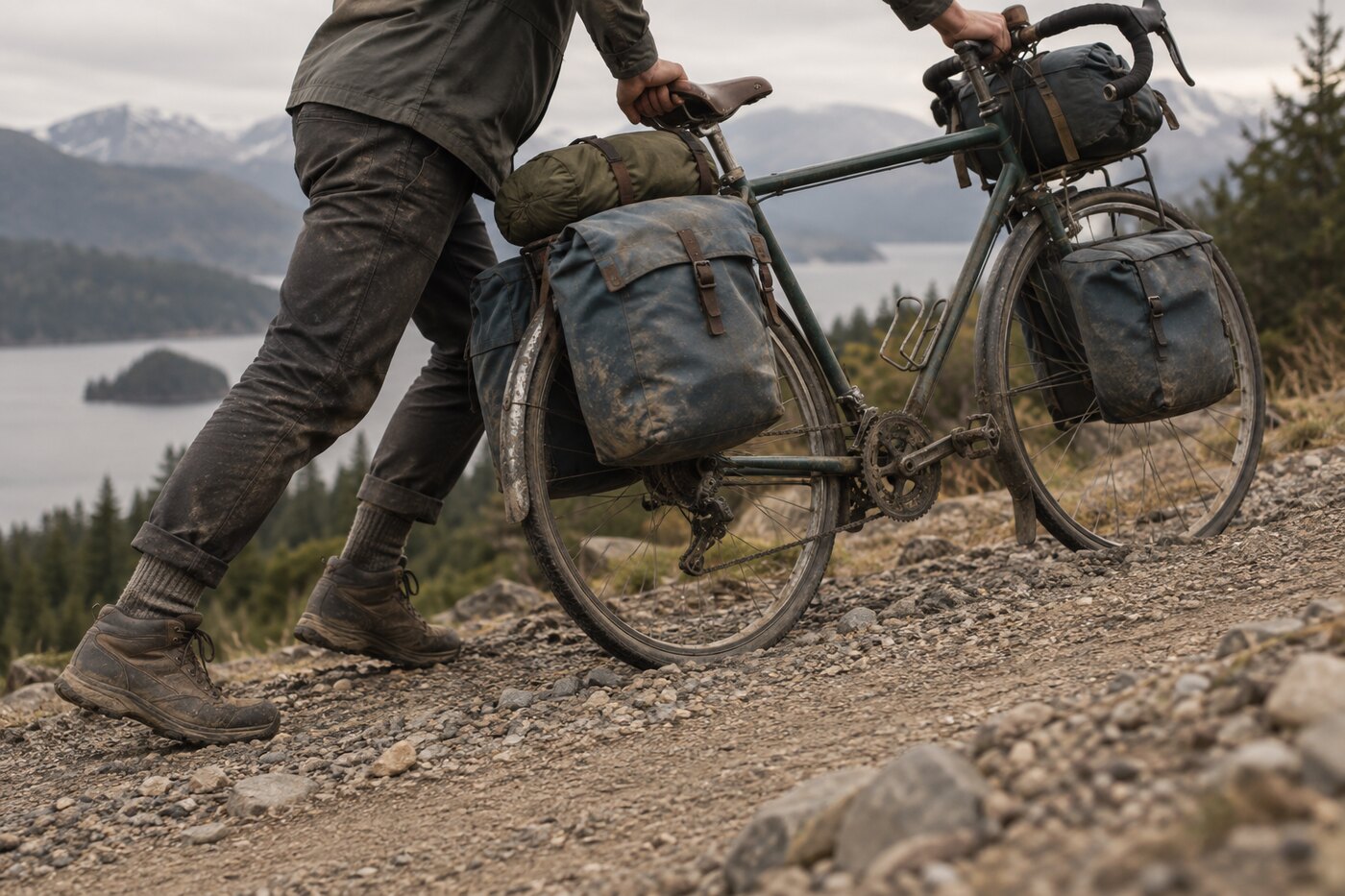
The first hill on an old bicycle tells you the truth about the arrangement. Up to that hill the bike has been carrying you, more or less, a gift of wheels and momentum, and you have been enjoying the fiction that you and the machine are separate things. Then the road tilts and the fiction ends. The chain goes tight. The pedals stop being a pleasure and become a question. And you understand, in the legs first and the lungs right after, that you are not riding the engine. You are the engine. The bike is just the part that doesn’t get tired.
Everything human-powered runs on this same honest arithmetic. There is a weight, and a slope, and a distance, and a body, and no app between them to soften the terms. You can carry a device that counts your effort but it cannot spend any of it for you. The counting happens whether or not anyone counts.
Wind taught me the most, because wind pretends to be weather when it is actually an argument. From the porch it is weather — a stir in the birches, a nice sound. From the middle of the lake with a paddle in your hands it is a party to the negotiation, and it does not negotiate in good faith. You point the canoe where you want to go and the wind points it back, patiently, all day, taking a foot for every three you earn. There is no wind so light it costs nothing. You learn to read the water for the dark ruffled patches coming, and to quarter into them, and to accept that a straight line across open water is a thing you drew on a map and the map does not paddle.
A canoe behaves like two different boats depending on what is in it. Empty, it is skittish, sitting high, catching every gust, wanting to spin. Loaded, it settles and tracks and holds a line, heavier to start and heavier to stop, but honest once it’s moving — it goes where it was going and takes a while to be talked out of it. The same is true of a body. Loaded with a good sleep and a real breakfast, it holds its line up a grade. Loaded with a bad night, it catches every gust of doubt and wants to spin.
Boots know the trail better than the person in them. There is a stretch of trail I have walked in enough conditions that my feet make the corrections before I decide to, stepping wide of the root, short of the wet rock, long over the washout, while my attention is somewhere else entirely. This is not skill exactly. It is the body having filed the route in a place the mind cannot reach to check. On a strange trail the feet lose this and go back to guessing, and you trip on the plain parts, because you are back to steering a machine you don’t know.
Snowshoes are the purest lesson in weight. On foot the snow is a wall you sink into to the thigh. On the shoes the same snow is a floor, barely, a floor that flexes and gives and holds you an inch under the surface, and the whole enterprise is just the trick of spreading the same weight over more ground until the ground agrees to bear it. Physics done with your legs. No abstraction anywhere in it.
And then there is the pushing. This is the private one. There comes a grade on a loaded bike where the arithmetic simply comes out against you, where one more stroke is not available at any price the legs will pay, and you get off, and you push. There is a specific shame in it that has nothing to do with anyone watching, because usually no one is. It is the shame of the engine admitting it is only an engine, of hearing your own breath and the tick of the freewheel and the crunch of gravel under a bike you are now walking, uphill, defeated in the small daily way that leaves no mark and teaches everything.
But you get to the top of the grade the same as if you’d ridden it. The hill does not know the difference and does not keep score. You get on again where it flattens, and the machine takes up its half of the bargain, and for a while you are separate things again, coasting, the engine cooling, until the next place the road decides to remind you.
I leaned the bike against the fence at the top and stood there getting my breath. The chain had thrown a little grease onto my right calf where it had rubbed, a black comma along the muscle, and I looked at it and did not wipe it off. Below me the grade ran down the way I’d come, gentle-looking from up here, the way every hill is gentle-looking from the end of it.