The bruise on my shin was already there before I remembered earning it. I found it in the morning, getting dressed, a green-brown map the size of a thumbprint, low on the bone where a gunwale or a rock or the truck’s tailgate had made its point yesterday and moved on. I pressed it. It answered. I could not have told you which one it was. The body keeps a better ledger than the mind, and it does not itemize.
This is the part no one photographs. The photo, if there had been one, would have been taken at the water, or the top of the grade, or the moment the fish came over the side. Bright, forward-facing, the sun doing its flattering work. But the real accounting comes later, in the dim of a Sunday, when the doing is done and the body starts reading you back the bill.
Sunburn keeps the plainest record. Mine came off the lake in the shape of the day: a red band at the back of the neck where the collar had ridden low, a paler stripe under the watch, two white feet that had lived all afternoon inside boots while the shins above them cooked. You wear the geometry of your own carelessness for a week. It itches when it turns to peel. You find yourself sanding a shoulder blade against a doorframe like a cow against a post, without dignity, without an audience, which is the only honest way to scratch.
The hands are the last to come clean. There is a smell that rope leaves, a dry hemp smell that lives in the creases of the palm, and under it the fish, and under that the faint gray of two-stroke fuel from priming the outboard. I washed them twice at the sink. The soap took the top layer. The rest stayed down in the grain of the skin the way it stays in the grain of a cutting board, and I smelled it that night when I put my hand near my face, and again the next morning, fainter, an argument the water kept losing slowly.
The shoulders remembered the pack. Not while I carried it — while I carried it the strap was just a fact, a pressure I stopped noticing by the second mile. It was afterward, setting the pack down, that the shoulder spoke up, a hot raw line where the webbing had sawed at the same inch of me for three hours. I looked in the mirror at a red groove I had felt nothing about at the time. The pain had waited politely for me to finish before it introduced itself.
Hunger after paddling is not the hunger of a skipped lunch. It is a flat, wide, humorless hunger, and it does not care what it gets. I have stood at the counter and eaten bread with nothing on it, fast, because the arms had spent something the stomach was now calling in. There is a sleep that comes after a day of wind, too — wind is work even when you are only standing in it — a sleep that arrives sideways and takes you before you have decided to go. You wake with the mark of the pillow seam on your cheek and no memory of the last thing you thought.
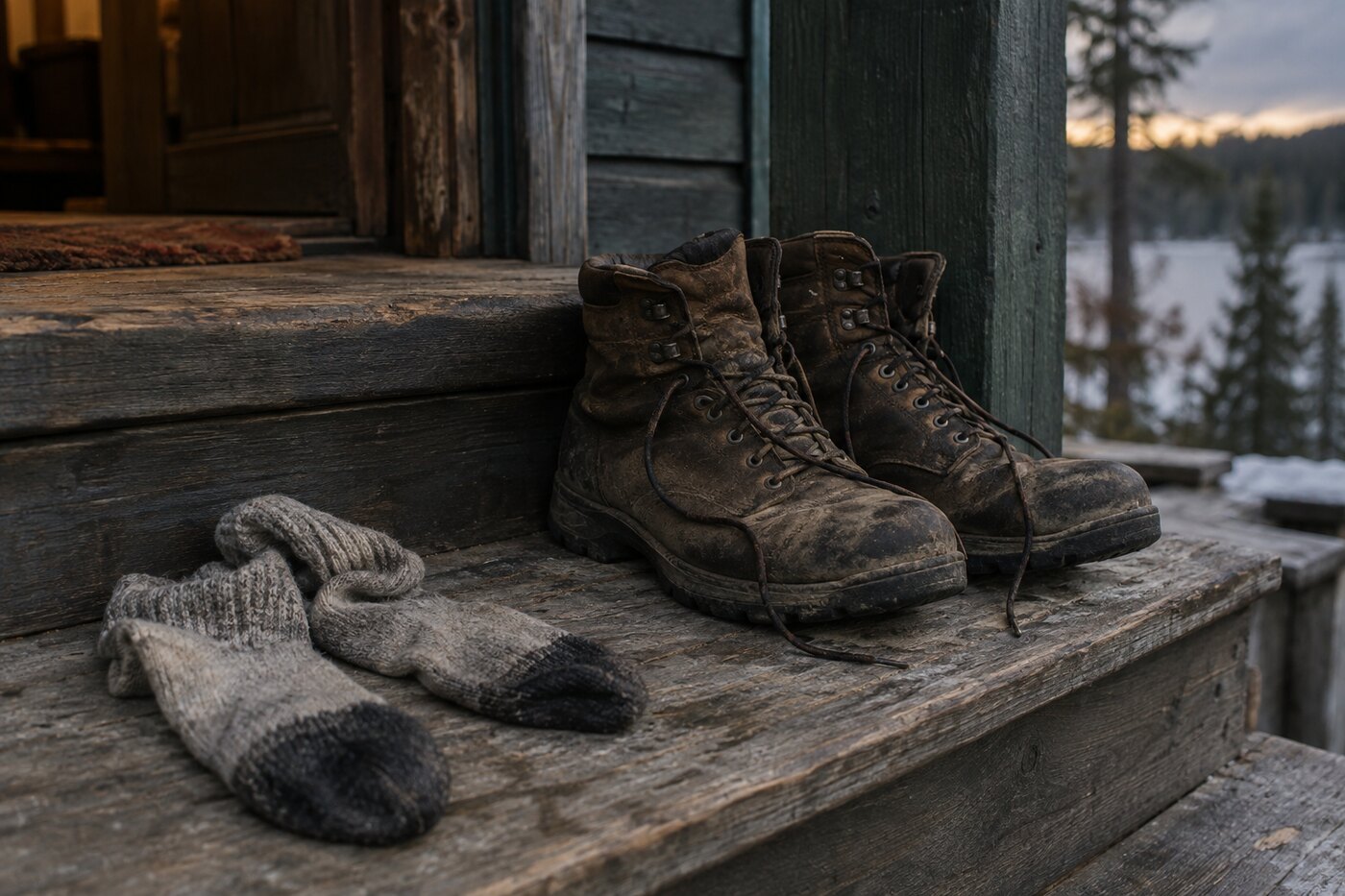
And then the boots come off. This is the true end of it, the small ceremony no one designed. You sit on the step and work the laces, stiff with lake water, and pull the first boot, and the foot comes out into the air changed, wider, hot, alive to every current of the evening. The sock is damp at the toe. You peel it. The relief is enormous and completely private, a pleasure with no name and no witness, the day draining out through the soles of two tired feet.
The next day the knees have opinions about the stairs. They did not mention this yesterday. Yesterday they went up the grade without comment, because there was a reason to, and reasons are a kind of painkiller. Now there is no reason, only the stairs, and the knees make a small formal remark on each one, going down worse than up, the way a bill is worse than the meal.
None of this is injury. I want to be clear. It is just the body being read out loud after a day of being used for what it is. Indoors you can go a long time without finding out what you are made of. Outside hands it back to you in pieces, over the following days, in bruises you can’t source and a smell you can’t scrub and a groove in the shoulder that will be gone by Thursday.
The boots are on the back step where I left them. One has fallen against the other. The leather is drying pale and stiff at the creases, curling up at the toe, holding the shape of a foot that is no longer in it, and will hold it until I put them on again.