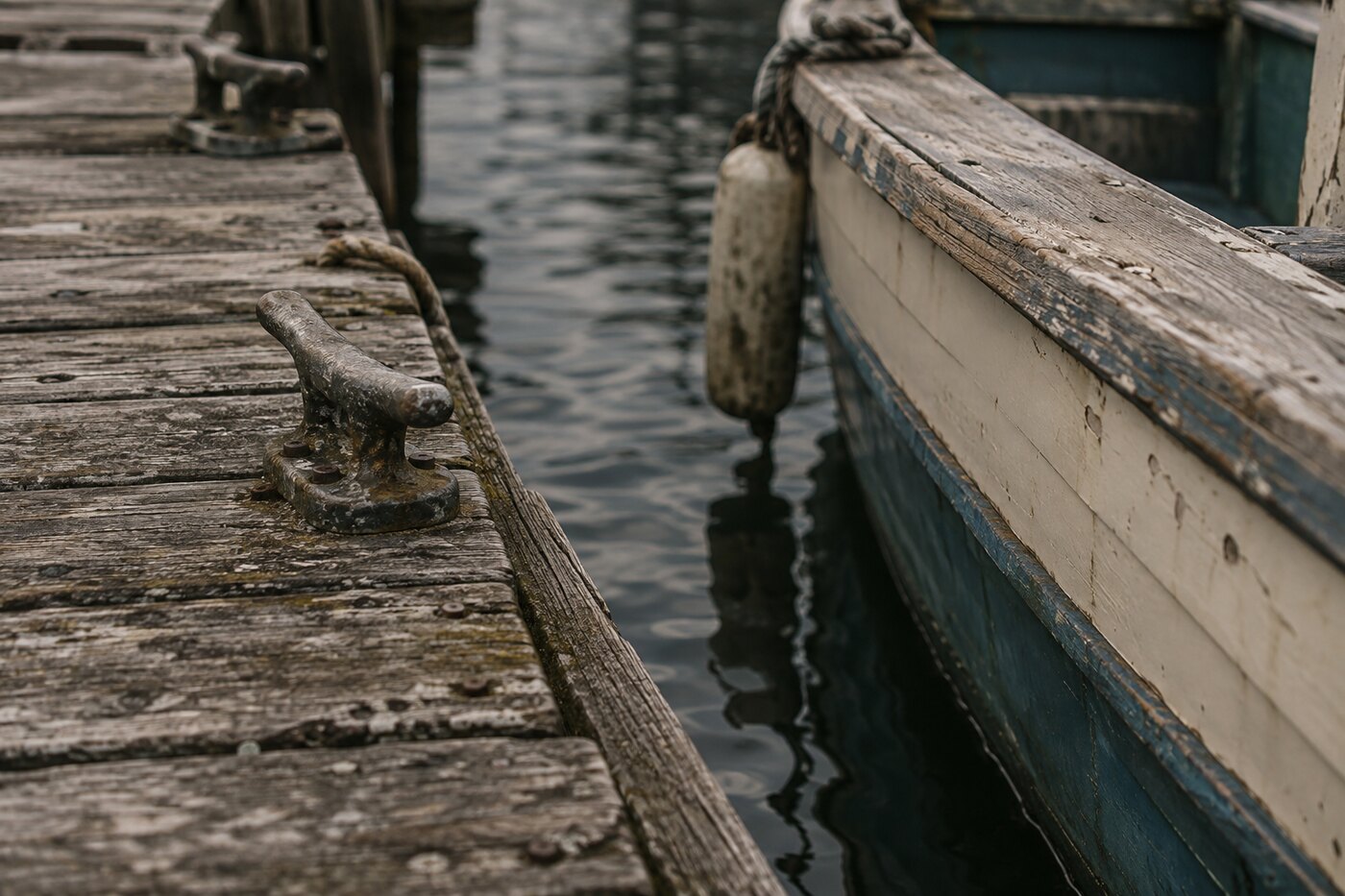
I had it lined up. That is the thing I want on the record first. I came off the throttle at the right distance, swung the bow a few degrees, let the boat coast in on its own momentum the way you are supposed to, gliding the last two lengths with the engine just ticking. Textbook. For about four seconds it was the best docking of my life, and there was a man on the dock to see it, which is the only reason any of the rest happened the way it did.
The wind was off the lake, quartering in behind me, and I had accounted for it, or thought I had, which is a different thing. A boat with no drive on it is not a boat anymore, it is a sail with a bad shape, and the wind had been reading my plan the whole time and disagreeing with it politely. In the last length the bow came in like it was going to kiss the dock, and I stepped up onto the gunwale with the line in my hand and reached for the cleat, already composing the small nod I would give the man, the nod that says I do this all the time.
The gap opened instead of closing.
This is the part that has no dignity. You commit your weight to a reach that assumes the boat is coming to you, and instead the stern swings out on the wind and the whole hull slides sideways away from the dock, and the eighteen inches you were reaching across becomes three feet in the time it takes to notice. The reach turns into a lean. The lean turns into a lunge. There is a moment, mid-lunge, fully committed, one foot on the boat and one hand clawing at a cleat that is retreating, where you understand with total clarity that physics has been doing the math this whole time and you have been doing hope.
I got a finger on the cleat. Not a hand. A finger, then two, hooked over the far horn of it, and I hauled, which does not move a dock but does move a boat, so the hull came grinding back in toward me with all my weight pulling it, and the rubrail met the dock edge with a sound like a dropped drawer, a flat wooden bang that went up and down the shore and told everyone within a quarter mile exactly how it had gone. The man reached down and took the line out of my hand. He did not say anything. He did not have to. He cleated it off in one motion, the motion I had been rehearsing to perform for him, and stepped back.
I got both feet onto the dock and stood up and my legs did the thing legs do after the body has spent everything in one second, a fine buzz in the knees. The boat sat where it should have sat all along, tied, rocking, innocent, giving no sign it had just made a fool of me in front of a stranger. There was a fresh scuff on the rubrail, a pale scrape in the black where it had met the dock, and a matching bright gouge in the gray dock plank, the two of them having exchanged a little material in the collision, each keeping a mark of the other.
The man said the wind gets funny by the point in the afternoon. That was all. It was a kindness, and I took it, because it let the wind be the reason, and the wind was in fact a reason, though not the whole one. The whole one is that docking is a negotiation and I had walked in assuming it was a foregone conclusion. The dock does not care about the plan. The dock is a fixed fact and the boat is a floating opinion and the water underneath is on nobody’s side, and every landing is that argument run again from the start, and the only way to win it clean is to leave yourself a way to be wrong. I had not. I had lined up perfectly for the wind that was blowing four seconds ago.
I fussed with the line longer than it needed, retying a cleat hitch that was already fine, because it gave my hands something to do that was not shaking and gave my face something to point at that was not the man. This is the real content of the thing. Not the near-fall, which was over in a breath, but the standing around afterward, arranging yourself back into someone who meant to do that. The photo would have been the boat coming in against the evening water, clean and slow, the best four seconds. The photo would have quit right before the story started.
I stepped off eventually and walked up the dock past the man, who had gone back to his own boat, and we nodded, and the nod I gave him was not the one I’d rehearsed. It was the other one. The one that admits the wind won.
Down at the water the boat kept working against its lines in the chop, easing off and coming back, easing off and coming back, and the fresh scuff on the rubrail ground a little more black into the pale gouge on the plank every time it came, widening it, the two marks slowly becoming one mark that neither of us had cleaned up before I walked away.