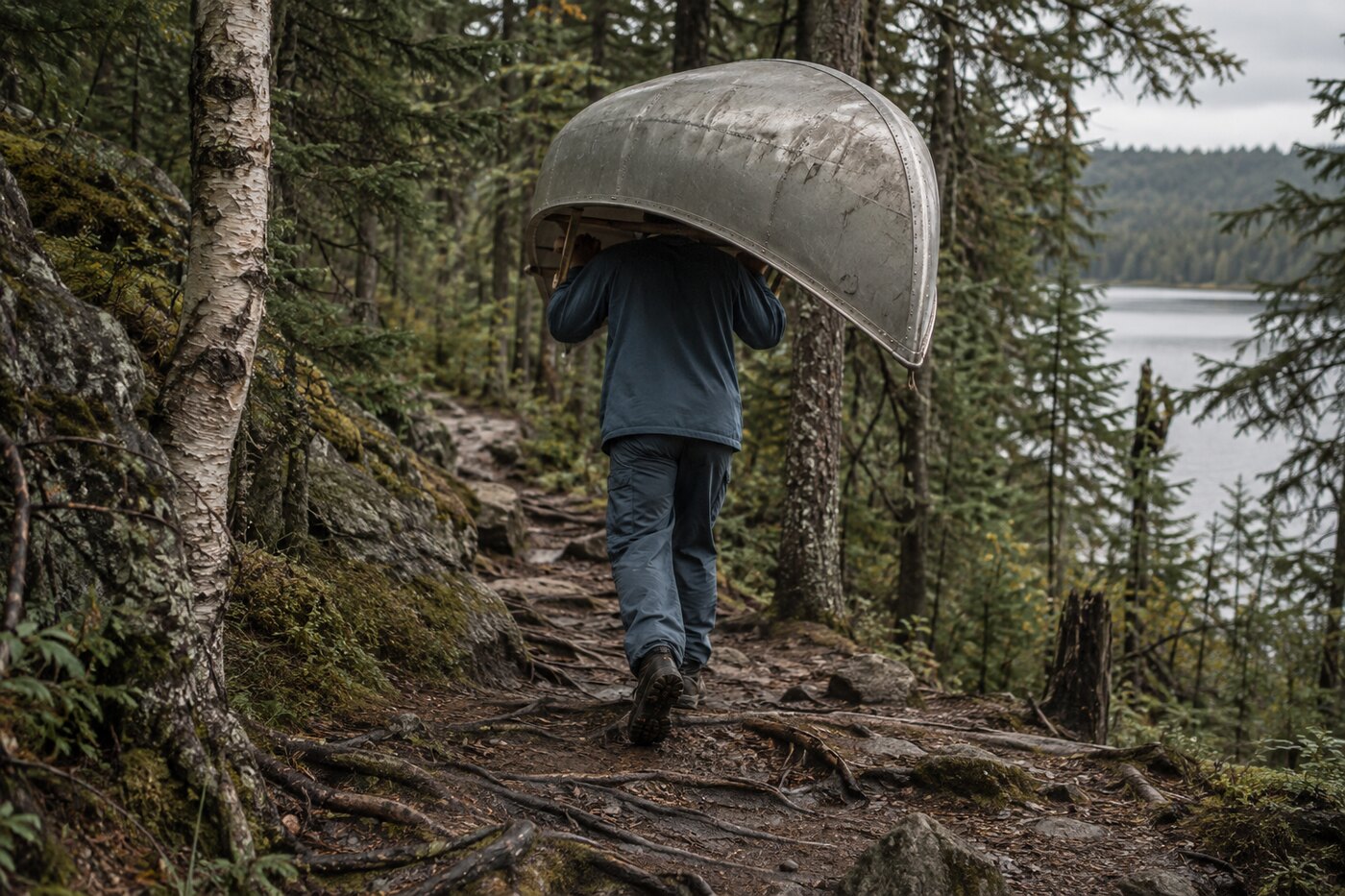
The canoe was heavier coming back. This is not true and I will not be talked out of it.
In the morning it was nothing. We flipped it up onto the shoulders at the put-in and the aluminum found the yoke and settled and I walked the portage into the first lake barely feeling it, ducking the low cedar, stepping the roots I’d been told about, the hull a roof over my head that I carried like a hat. The trail was a quarter mile of nothing. I remember thinking it was shorter than they’d said. I remember having opinions about other people’s portages. That is the kind of thing you think in the morning, when the arms are full and the day is a promise and the boat weighs whatever the label claims, fifty-nine pounds, a number, an abstraction.
Then the day happened, the way a day on water happens. Paddling is not hard until it is all of it. Stroke after stroke, the small burn in the shoulder that you notice and dismiss and then stop being able to dismiss, the wind that came up on the big lake at noon and turned the far shore into an argument, the mile we ferried across a chop that slapped the bow and threw a cupful into the bilge every third wave. We ate on a rock. We went on. The sun did its work on the back of the neck and the water did its work on the arms, and by mid-afternoon the paddle had gone from a thing I held to a thing I was, my hands closing on it out of habit long after the grip had stopped being a decision.
We came back to the portage from the other side near five. Same trail. Same quarter mile. The same roots, in the same places, waiting.
The lift told me before my legs did. We flipped the canoe up and the aluminum came onto my shoulders and it was not the morning’s boat. It had gained the whole day. The yoke, which had rested light on the trapezius at dawn, now found the exact bruised line where the pack straps had been sawing since noon, and it sat down on that line with its full and honest weight, and it did not get up. Fifty-nine pounds. The same fifty-nine pounds. Physics is very firm about this and I have no counterargument except my body, which was filing a different report.
The trail was longer going back. This is also not true. It was the same trail, run in reverse, and reverse is where the roots hide, because you memorized them facing the other way and now they come at you new. The low cedar that I’d ducked so cleanly in the morning caught the stern and stopped me dead, and I had to back up under the boat, blind, feeling for the trail with my heels. Water I hadn’t drained sloshed forward in the bilge every time the ground pitched down, a slow cold weight that ran to the bow and pulled the nose toward the dirt, so I was carrying the boat and negotiating with it at the same time, a boat that leaned whichever way I didn’t want.
The shoulder is where the trip gets totaled. Not the arms, though the arms had made the payment. The shoulder, the single line where the yoke crosses, is the ledger, and by the halfway rock it was sending up a bright clean signal I could not talk down. I stopped there. Everyone stops there. There is a rock at the halfway of every portage worn pale on top from being the place people stop, and I set the bow on it and stood inside the shade of the hull breathing, and the boat’s weight came off and left an afterweight, a pressure that stayed on the bone after the thing making it was gone.
That is the part the morning me did not know. That the weight of a trip is not what you carry out. It is what you carry back, when the carrying muscle is the spent one, when the same object presses on tissue that has already spent the day being pressed. The canoe was a fact. The day was the multiplier. Nobody weighs the day. It does not go on the label. But it is in the boat by evening, every stroke of it, riding in the aluminum like the water in the bilge, sloshing to the front on the downhills.
I got it up off the rock and went on. The last hundred yards a portage always steepens, or seems to, the body counting down and finding the count too slow. I could hear the takeout before I could see it, small waves on gravel, and I aimed the bow at the sound and walked the last of it half-blind with sweat, the yoke grinding its line, the boat swaying its slow disagreement over every root.
We set it down in the shallows and flipped it upright and it floated the way it had floated in the morning, light, indifferent, giving nothing back. Fifty-nine pounds of aluminum sitting on the water like it had never been anywhere. I loaded the packs and stepped in and my shoulder kept the shape of the yoke for a long time after, a dull stripe I could find with a thumb.
There was still water in the bilge when we pushed off. It ran to the stern as the bow came up, and settled against the back seat, cold through the hull under my knee, and stayed there, refusing to be the last thing bailed.