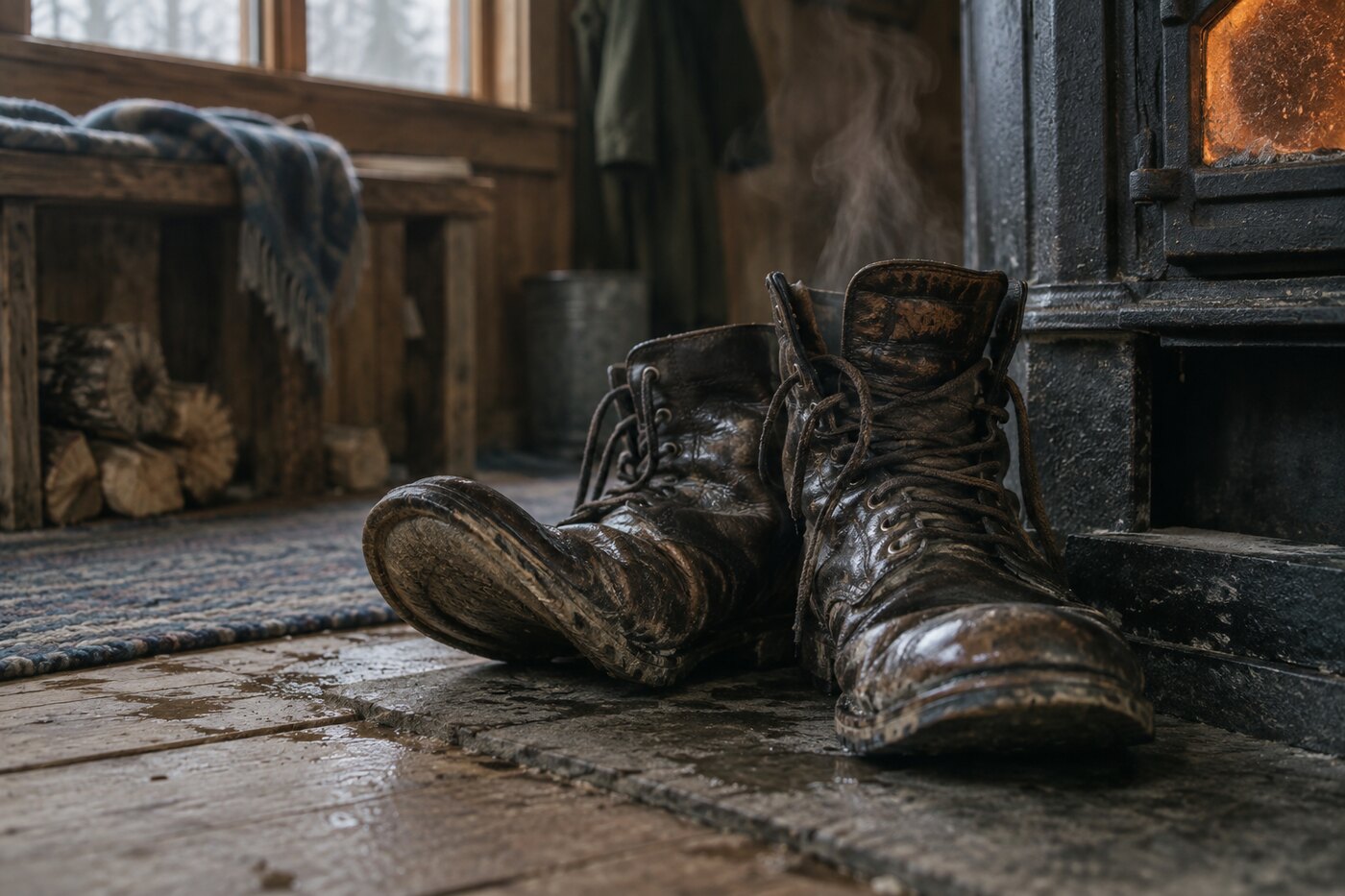
I put the boots by the stove and by morning they had lied about the walk, or told the truth about it, depending on how you count.
They came off my feet soaked through. The creek was higher than the map admitted, brown with the night’s rain, and the crossing that should have been a hop from rock to rock became a wade with the water at the knee and the current pushing at the ankle like something with an opinion. I stepped where I could and not where I wanted. One rock rolled. I caught myself on the far bank with a hand in the mud and a boot half-full, and I stood there a second breathing while the water ran back out of the eyelets.
Wet leather is a different animal than dry. It goes heavy and dark and it stops being a tool and starts being a poultice, drawing the cold up into the arch. I walked the last two miles in boots that squelched with each step, the socks gone to sponge, the laces swollen so tight I could not have loosened them if I’d wanted to. The foot swims a little in a flooded boot. It rolls easier. It finds the outside edge on a slope because the leather has quit holding it to the center. So the walk got sloppier the wetter it got, the body cutting corners it would not cut dry, and the leather logged all of it the way a road logs a flood, in silt and set and where the water finally sat.
At the cabin I pulled them off and stood them by the stove. Not too close. Close leather cooks, cracks, curls up like a leaf and never comes back. You want the warmth to come at it slow, from a foot away, so the water leaves without the shape leaving with it. I set them at an angle to the heat and turned them once before I slept, the way you’d turn something roasting, and I went to bed with my feet finally dry and did not think about them again until light.
In the morning they had set crooked.
Not ruined. Crooked. The left boot had dried with a twist in it, the toe cocked in toward the other one, the whole upper leaning the way my ankle must have leaned coming off that rolling rock. I picked it up and the twist was cured into it now, permanent as a scar, the leather stiffened in the exact posture of the mistake. The sole had cupped, too. Where I’d rolled onto the outside edge for two wet miles, the leather had dried in that roll, the arch lifted, the outer welt pressed down, so that when I stood the boot on the table it did not sit flat. It rocked. It wanted to lean the way I’d been leaning.
You could read the day off them. Here is the creek. Here is the rock that moved. Here is where the foot gave up on the center line and rode the edge home. The right boot had a milder version of the same story, a slight outward set, the accommodating boot, the one that took up the slack for the one that failed. Between them they had a record more honest than the one in my head, which had already started rounding the crossing up into something I’d handled well.
I worked the left one over my hand while the coffee heated. The leather had gone board-stiff overnight, and it argued with my fingers, holding its new crooked mind. I pressed the cupped sole flat against the table and it gave a little and sprang back. I could soften it. Dubbin, a slow warmth, work it back toward straight over a few days, coax the twist out the way you’d work a knot out of a shoulder. Leather forgives if you ask it early and ask it often. Wait too long and the shape is just the shape, and every walk after this one will be a walk taken slightly sideways, the boot insisting on the creek forever.
But you do not fix a boot on the morning after. The morning after, you put it back on. I forced my foot in against the stiffness, laced it half-tight, and stood, and the crookedness that had looked so wrong on the table went quiet under weight, because my foot was crooked in exactly the same way. The twist met a twist. The cup met an arch that had learned the same lesson. The boot and the foot had been to the same place and come back agreeing.
I walked out to the woodpile in them to test the day. They held. The left one rocked when I stopped, a small tip toward the outside, and then my weight came down and settled it. Nobody watching would have seen a thing. Only the boot and I knew the boot was lying flat by an effort.
The wet ones from yesterday’s socks I’d hung over the stove rail, and they had dried too, gone stiff as paper, holding the shape of a foot that wasn’t there. I left the boots on and left the coffee going and went to bring in an armload of wood, and the left sole ticked against the doorsill on the way out, once, where the cup rode a hair too high to clear it.