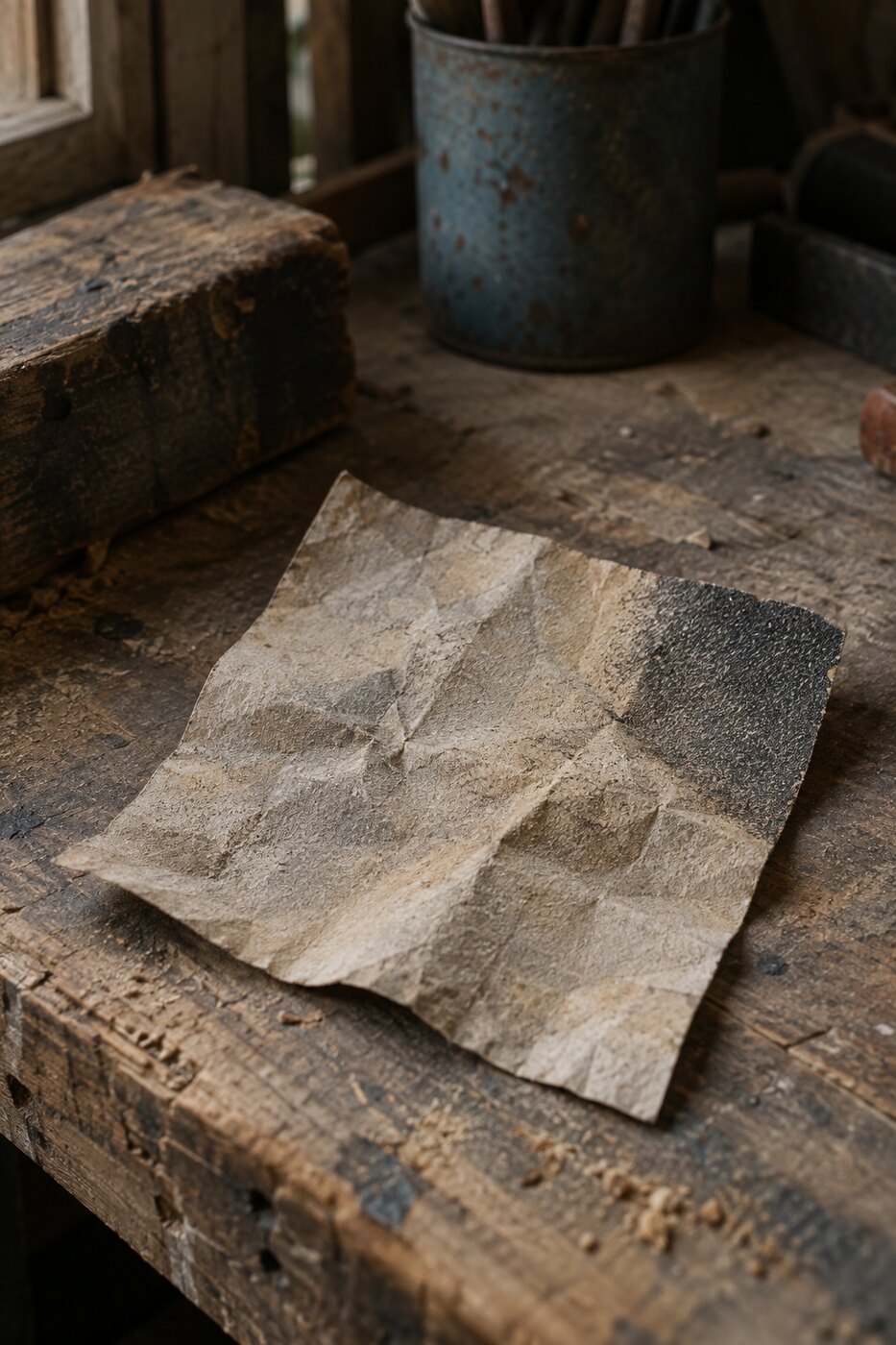
The sheet had worked itself out unevenly, the way they do. You bear down where the work is, and the middle goes first — the grit shears off and the paper backing shines through, pink and smooth, useless. Run your thumb across it and it slides. Dead.
But the corners. You never quite use the corners. This one had a corner still alive, the grit standing up sharp when I dragged a thumbnail over it, biting back the way new paper does. A live edge on a dead sheet.
You do not throw out a sheet with a corner left. Not when the box of new is in the shed and the corner is right here and the job is small — a burr on a bolt head, a splinter lifting off a rail, the kind of thing that wants three strokes, not a fresh sheet.
So you fold it. You fold the dead part behind, back on itself, until the good corner stands out proud on a firm little pad you can pinch between finger and thumb. The crease cracks the backing and the grit sheds off the fold line in a fine dark dust, but the corner holds. Folded, it gets into places the flat sheet never could — the inside of a curve, the root of a thread.
I worked the corner down to almost nothing, and then it was nothing, smooth as the rest.
It went back on the bench anyway, folded, in the shape of its last use. There was still grit in the crease, down in the fold where my thumb had never pressed, saved by the very bend that killed the rest.