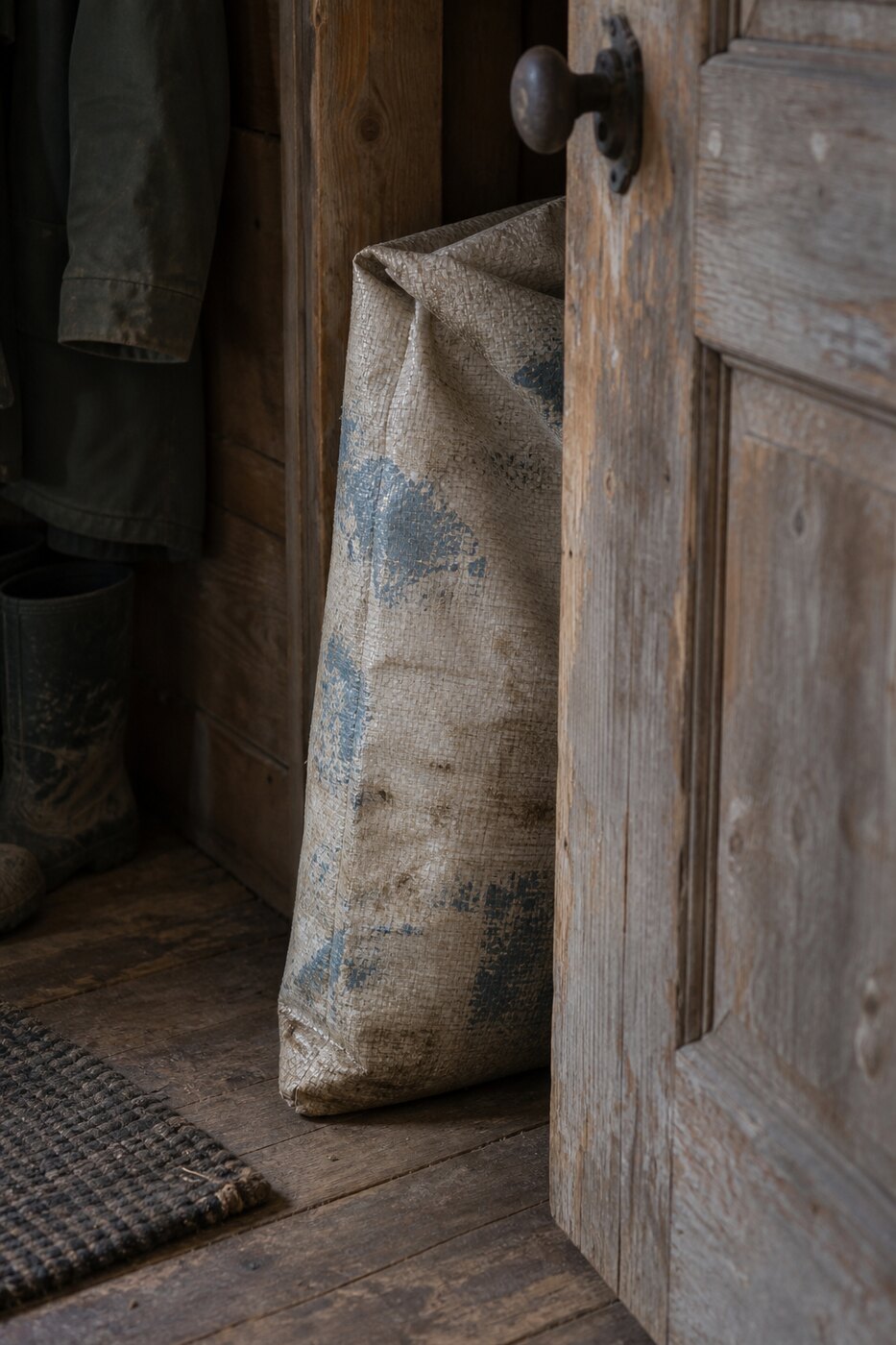
The sack was empty by Tuesday. I turned it upside down over the bin and shook it, and a last handful of dust and cracked pellets came out in a small brown cloud that hung and then settled. The woven plastic held a fine grit in its weave that no shaking would give up.
Empty, it weighed almost nothing. A rectangle of blue and white, the lettering cracked where the folds of shipping had worked it, a seam of red stitching along the bottom that I would pick open later if I needed the string.
I did not throw it out. You do not throw out a sack.
I laid it flat on the floor and pressed the air across it with my forearm, and folded it in thirds the long way, then in half, then in half again, until it was a firm square that stood on its own edge. The plastic held the creases. It kept the shape the way a folded flag does, stiff with its own geometry.
Then behind the door, with the others. There is always a small drift of them there, a stack that leans. Nobody decided to start it. They gather the way sacks gather, one load at a time.
They wait for the next thing that needs carrying. Kindling. Wet boots. Garden pulls in the fall. A sack will hold whatever, and when that job is done you shake it out and fold it and it goes back behind the door.
The grit stayed in the weave. You could feel it through the folded plastic, a faint sand, holding the smell of the feed after the feed was gone.