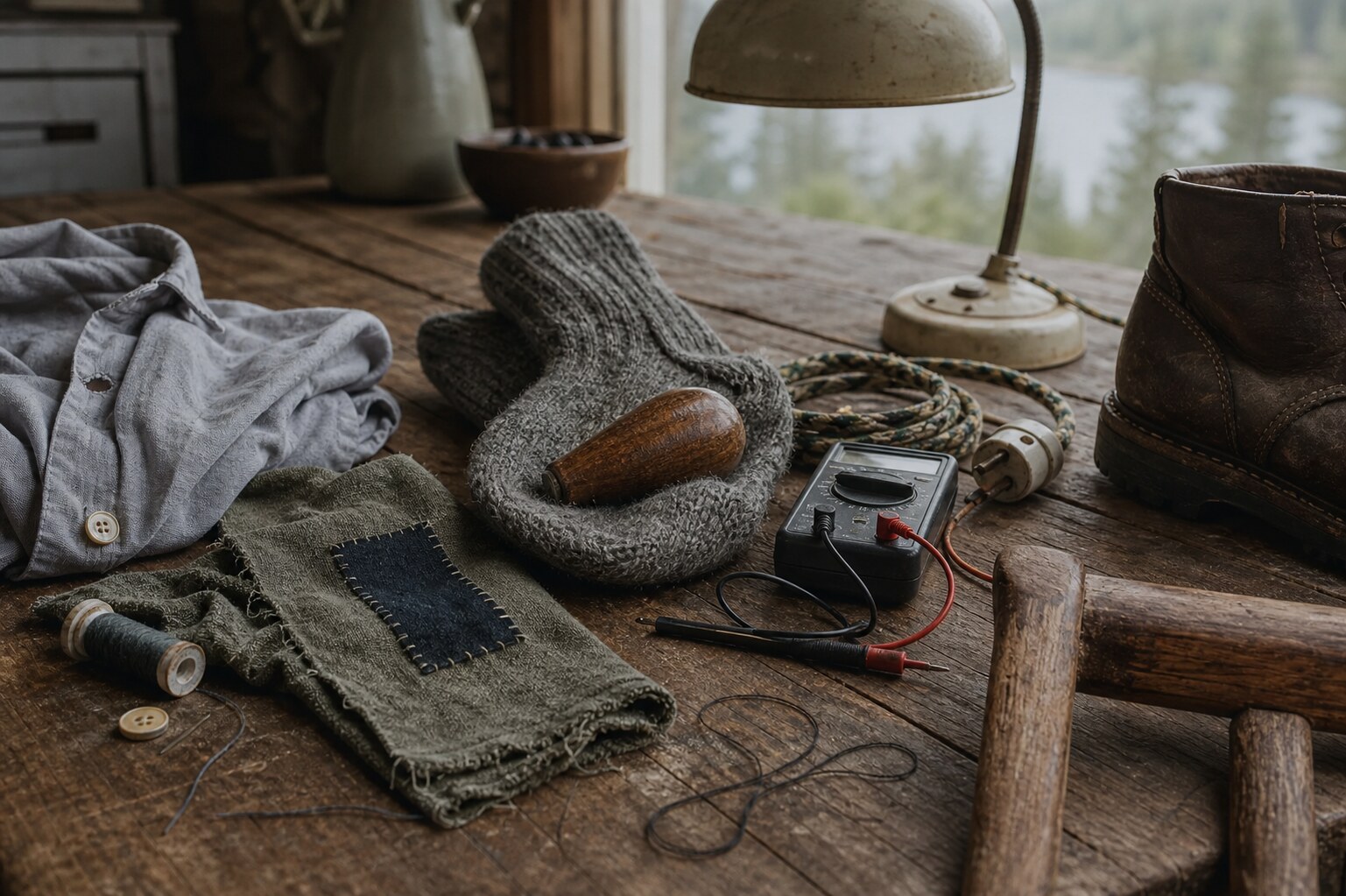
The right mitten came out of the basket first, the way it always does. It is the one that works. Gray wool, flecked with a darker gray the dye never fully took, knit tight enough that the cold has to argue its way in. It smells of the porch it lives on — woodsmoke, a little damp, the animal smell wool keeps no matter how long it has been off the sheep. It is not soft anymore. It has been wet and dried too many times for that. It has gone stiff and then shaped, and what it shaped to is a fist.
You can see it lying flat. The cuff is round and open, honest, the way it was knit. But the hand part is not flat the way a new mitten is flat. It holds a curl. The fingers have a bend cabled into them now, a memory of closing, and the thumb sits off at its angle, cocked and ready, already reaching for something that isn’t in the basket.
I turned it over and found the thin place before I was looking for it.
It is on the pad of the thumb, the inside face, where the thumb meets the first finger when the hand closes. The wool there has gone pale and flat and almost shiny. The individual stitches, which everywhere else stand up in their little rows, have been pressed down and rubbed sideways until they stopped being stitches and started being a surface. You can see light through it if you hold it up. Not a hole. The idea of a hole. The place where the wool has agreed, in principle, to eventually let go.
I know exactly what put it there. Not one thing. All of them.
The latch on the gate, the cold steel one, thumbed open and shut a dozen times a day, the thumb pressing the lever while the fingers held the post. The shovel, the D-handle, gripped low so the thumb rides the shaft, and the sawing back-and-forth of a full scoop that grinds the wool against the wood. The rope on the sled, wrapped once around the hand and pinched by the thumb so it won’t slip. The pull-cord. The kindling held while the other hand swings. The thumb is where you pinch, and pinching is most of what a hand does that a mitten survives.
There was a tag once. Sewn into the cuff, a little folded strip printed with a size and a fiber content and a country. It named the mitten. It made a claim about what the mitten was. That tag is gone — worn off, or picked off, I don’t remember — and it would have been useless anyway. It described the mitten in the store. It knew nothing about this hand, this gate, this particular way of holding a rope so it won’t burn through the palm.
The thin place knows all of it. The thin place is the only true label the mitten ever wore. It is a map of one hand’s grip, printed by the grip itself, in the one spot where the holding actually happens. You could read a life of small work off it if you knew how. The tag said what the mitten was made of. The wear says what it was for.
I pushed my finger against the thin spot from the inside. It gave more than I wanted. Under a little pressure the pale patch domed out, the stitches spreading, and I could see the daylight widen between them. Another season of gates and it would be a hole. Maybe not even a season. A cold snap, a stubborn latch, and the thumb would come through into the air and the mitten would stop being a mitten in the one place a mitten is asked to be one.
So there is the choice, and it is a small one, and I stood in the porch light having it anyway.
I could darn it. I have the wool for it, a leftover ball close enough in gray, and a darning needle in the tin with the buttons. You lay a little grid of new threads across the thin place and weave them into the sound wool around it, and if you do it right you build a patch that is stronger than what it replaces. The thumb would hold. It would also, I know, wear through again — not near the patch, not somewhere new, but in exactly the same spot, because the spot is not a flaw in the wool. The spot is where the hand is. Darn it a hundred times and the hundred-and-first hole comes up in the same place, the thumb finding the thumb’s own worn road.
Or I could let it go. Let the thin place get honest and open into a hole, and wear the mitten with the thumb out, the way you see on men who have stopped pretending, the bare thumb pink in the cold and oddly useful, better for feeling a knot or a nail. A mitten with the working part worn off, still doing the rest of its job for the fingers that don’t argue with anything.
I did not decide in the porch. I put the mitten back in the basket, thumb up, the way it likes to sit.
The thin place caught the light again when I set it down. Under it, a single strand of the gray wool had already parted — not the patch giving way, just one fiber, one twist of one ply, standing loose off the surface where a thumb had asked one thing too many of it. I left it standing. It would find the rest of them soon enough.