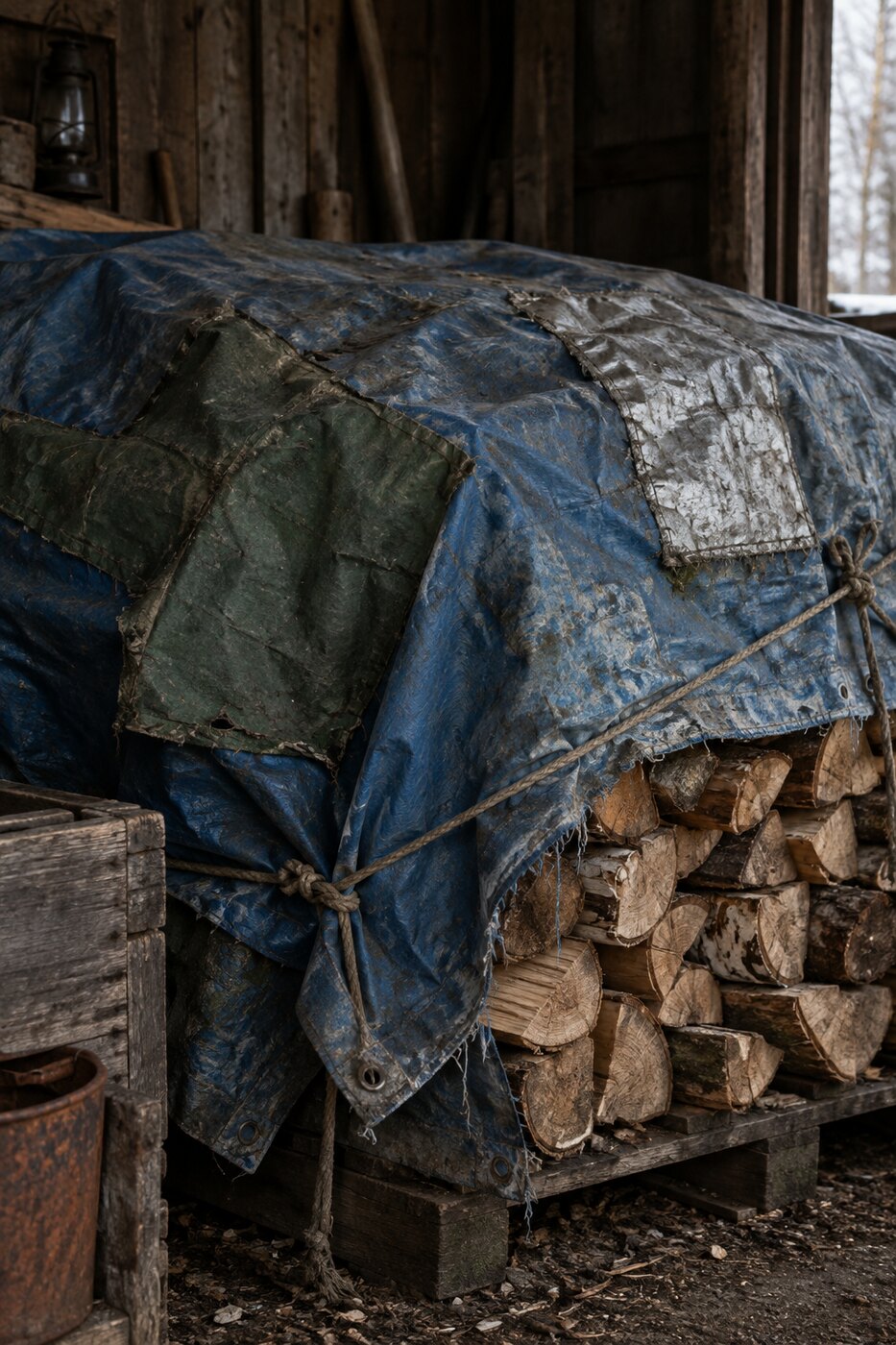
It’s lashed down over the woodpile and it doesn’t lie easy anymore. The cold has gone into it and it holds the cold, so when the wind gets under an edge the whole sheet cracks and booms like something sheet metal, a stiff plastic thunder it never made when it was new and soft. The original blue is barely blue now. It’s gone chalky, the color faded up out of it and a white dust left on the surface that comes off on your hand, the way old plastic surrenders itself a little at a time to the sun.
The grommets tell the first part of the story. The factory grommets are mostly gone — torn out, the brass ring pulling clean through the weakened plastic under load, leaving a ragged mouth where a clean hole used to be. So they’ve been re-set, some of them, with the little kits, a new ring hammered in an inch back from the ruined one. And where there was no more edge to set a grommet into, there’s the other trick: a smooth stone folded into the corner of the tarp and a cord cinched behind it, a knuckle of stone giving the rope something to grab where the material no longer can. You can read a tarp’s whole history of being tied down wrong and tied down again just along its hem.
But it’s the patches that really talk. This tarp has been patched so many times it’s more repair than original, and the repairs are layered, and layers can be read.
There’s a green patch low on one side, a piece cut off a different, deader tarp, taped down over a tear. Under the green, where the tape’s edge has lifted, you can see silver — a patch of that silver duct tape, the wide kind, laid down under the green in some earlier year, itself covering something. And under the silver, when I peel back a corner that’s lost its stick, the chalky blue, and in the blue the original wound, a split maybe eight inches long, its edges still not quite meeting. Green over silver over blue. Three repairs stacked on one failure, each one made when the one before it gave up.
I know some of these. That’s the strange part, standing there in the cold reading my own tarp. The long split under the layered patch — that was the windstorm, the one that got under the whole sheet at two in the morning and tried to take it into the trees, and I found it in the gray light torn stem to stern along a fold. The neat round patch up top, tape in a rough circle — that was the branch, the dead limb that came down off the spruce in a wet spring and punched straight through. The way the whole crown of the tarp has gone brittlest and palest right in the middle — that’s not one event, that’s a summer, the summer it sat spread in full sun for months while the sun took the life out of the plastic fiber by fiber.
It’s strata, is what it is. You read it the way you’d read a cut bank by the road, the bands stacked oldest at the bottom, each layer a period with its own weather. Except a cut bank keeps millennia and this keeps years, and the years are legible because I lived them — every patch a dated event, a windstorm or a branch or a season of sun, kept not in a record I wrote but in the material itself, in the literal covered-over places where the tarp failed and got saved. Nothing about it is pretty. It’s a chalky booming patchwork of mismatched greens and silvers over a blue that’s given up. But it is articulate. It says exactly what happened to it, in order, if you know how to run your hand down it.
Repair does that. A thing repaired enough times stops being a thing and becomes a record of its own troubles — the archive isn’t kept somewhere else, it’s the object, and every patch is a page. You could throw the tarp out and buy a stiff bright new blue one that lies flat and doesn’t boom, and you’d be throwing out the log along with the leak. The new one would keep the rain off just as well and it would tell you nothing. This one keeps the rain off and remembers everything.
It’s raining now, the cold thin rain that comes before snow, and the tarp is doing its job. It’s louder than it used to be — the rain drums on the stiff chalky plastic and the layered patches, a harder, flatter sound than rain on new tarp, every drop landing on something that has been broken and covered over. The green patch, the silver under it, the split blue under that — all of it shedding water, all of it holding, and under the whole loud archive of it the split wood stays dry, stacked and waiting, dark where the rain has darkened the tarp’s edge and dry an inch in where the layers begin.