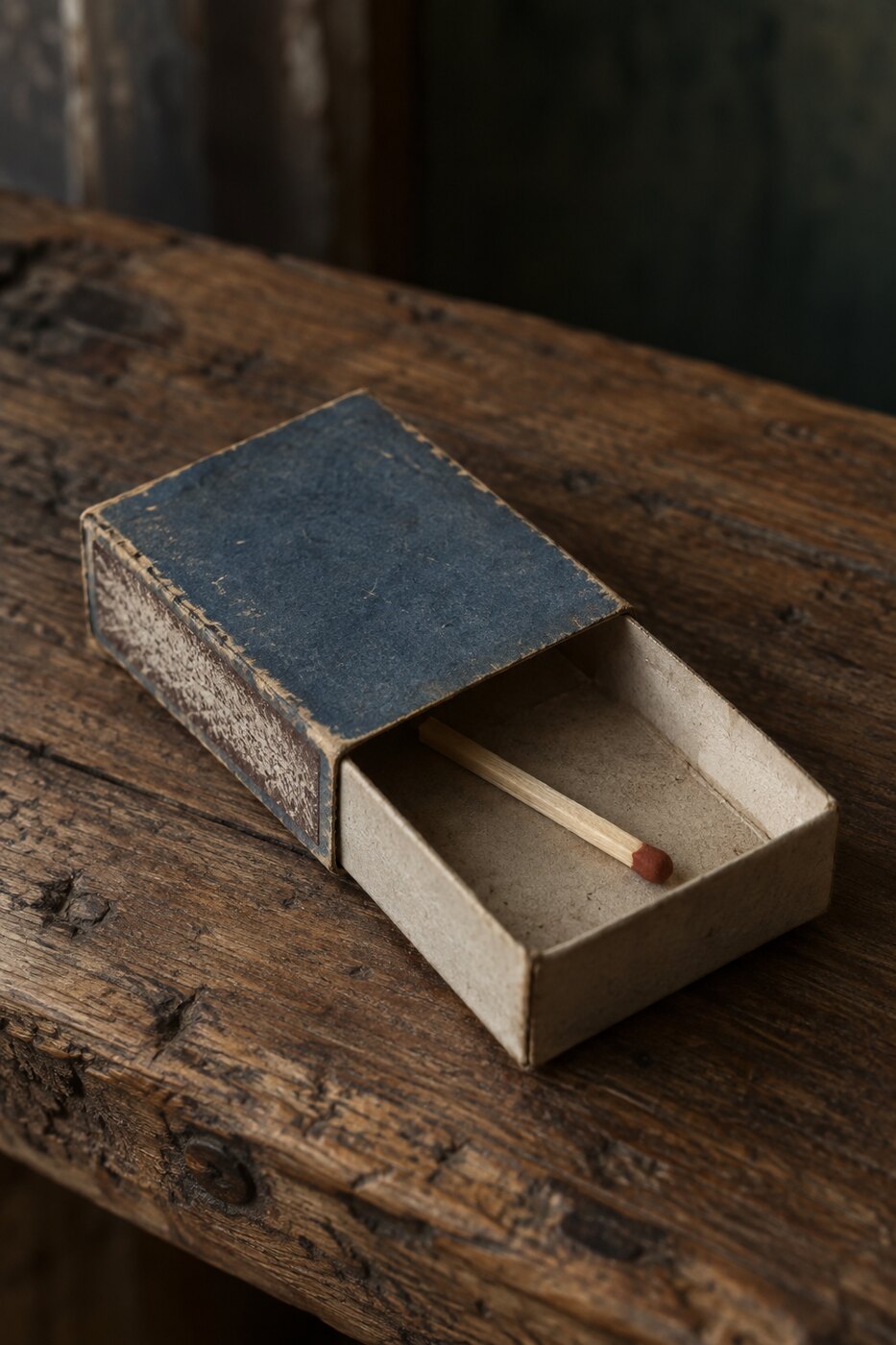
The box has stopped rattling. That’s how you know before you open it. A full box of matches has a sound when you pick it up — a dry busy shuffle, a hundred small sticks knocking — and as it empties the sound thins, goes from a shuffle to a clatter to a single dull knock, and then to this, which is almost nothing. A soft tick when you tilt it. One match, sliding the length of the drawer and stopping at the end.
You slide the drawer open with a thumb. The inner tray comes out of its sleeve the way it always has, that little friction, and there it is against the bare cardboard: one wooden match, the red head intact, lying alone in a space made for many. It looks longer alone than it did in the crowd. Everything about the box has gone quiet around it.
The strike strip on the outside is worn. You notice it now the way you didn’t when there were plenty. Down the length of it there are patches gone smooth and pale where the grit has been used up — the good spots, the spots everyone’s thumb went to first, rubbed down to slick cardboard that won’t catch a head anymore. And there are other patches, toward the ends, still dark and rough and unused, saved by accident, never chosen when choosing was cheap. When you have one match, the strip stops being a strip and becomes a map of where the friction still lives.
A single match changes the hand. I’ve watched it do it. With a full box you strike carelessly — grab one, drag it any old where on the strip, and if it doesn’t catch you toss it and take another, no thought, the striking as thoughtless as the summer latch, as breathing. The match is disposable and the hand treats it so. But down to one, the hand goes slow and deliberate and a little reverent, and none of that reverence was decided on. It just arrives, the way care arrives around anything that can’t be replaced until you get to a store you’re not getting to today.
So you hold it differently. Closer to the head than you would, for control, but not so close you’ll snuff it when it lights — there’s a right grip and the fingers hunt for it. You study the strip and pick your spot, one of the dark rough patches you’d have ignored a week ago, because you get one drag and it has to bite. You angle the head against the grit at the angle that’s worked before, the shallow one, the one that carries the head along enough travel to heat without snapping the stick. And you don’t strike yet, because first you deal with the draft.
There’s always a draft. The lamp’s by the window, the stove’s near the door, and a single match and a draft are enemies. So you cup. The free hand comes up and around, making a pocket of still air, and you turn your body to put your back to the room, and only then, inside that little shelter of palm and shoulder, do you draw the head down the rough patch, once, committed, the whole motion aimed at a single outcome. There’s no second try in the plan. The plan is: this match, this drag, this flame.
And you won’t spend it on anything that doesn’t matter. That’s the other thing scarcity does — it sorts. A last match doesn’t get used to check whether the pilot’s out or to peer at something in a dark cupboard. It gets saved for the thing that earns it. The stove, so there’s heat and a way to cook. The lamp, so there’s light to work by. Something that pays back the match many times over. The last match makes you rank your fires, and only the top of the ranking gets lit. An ordinary object, the most ordinary, a thing that comes a hundred to a box for pocket change — and being the last of its kind it turns ceremonial, handled like something that matters, because for this one strike it does.
I struck it at the stove. Back to the room, hand cupped, the dark rough patch of strip chosen, the shallow angle set. Drew it down.
It caught. The head flared with that small sulfur spit, the flame ducking low in the cup of my hand and then standing up as I brought it to the burner, and the gas took with a soft round thump and there was blue fire and heat and the thing was done, the whole careful ceremony of it over in three seconds, the match already burning down toward my fingers as ordinary as any match that ever lit. I shook it out. The head was a black curl. The stick was warm.
The box is empty now. I put the spent match back in the drawer, which makes no sense, and I put the drawer back in the sleeve, and I set the empty box back on the shelf by the stove where the matches live, where a full one will go when there is a full one. It weighs nothing. It rattles with just the one dead match if you tilt it, that same soft tick, and I kept it anyway, out of a habit I couldn’t have named, the worn strip facing out and the dark rough patches at the ends still there, still good, waiting for matches that aren’t in it.