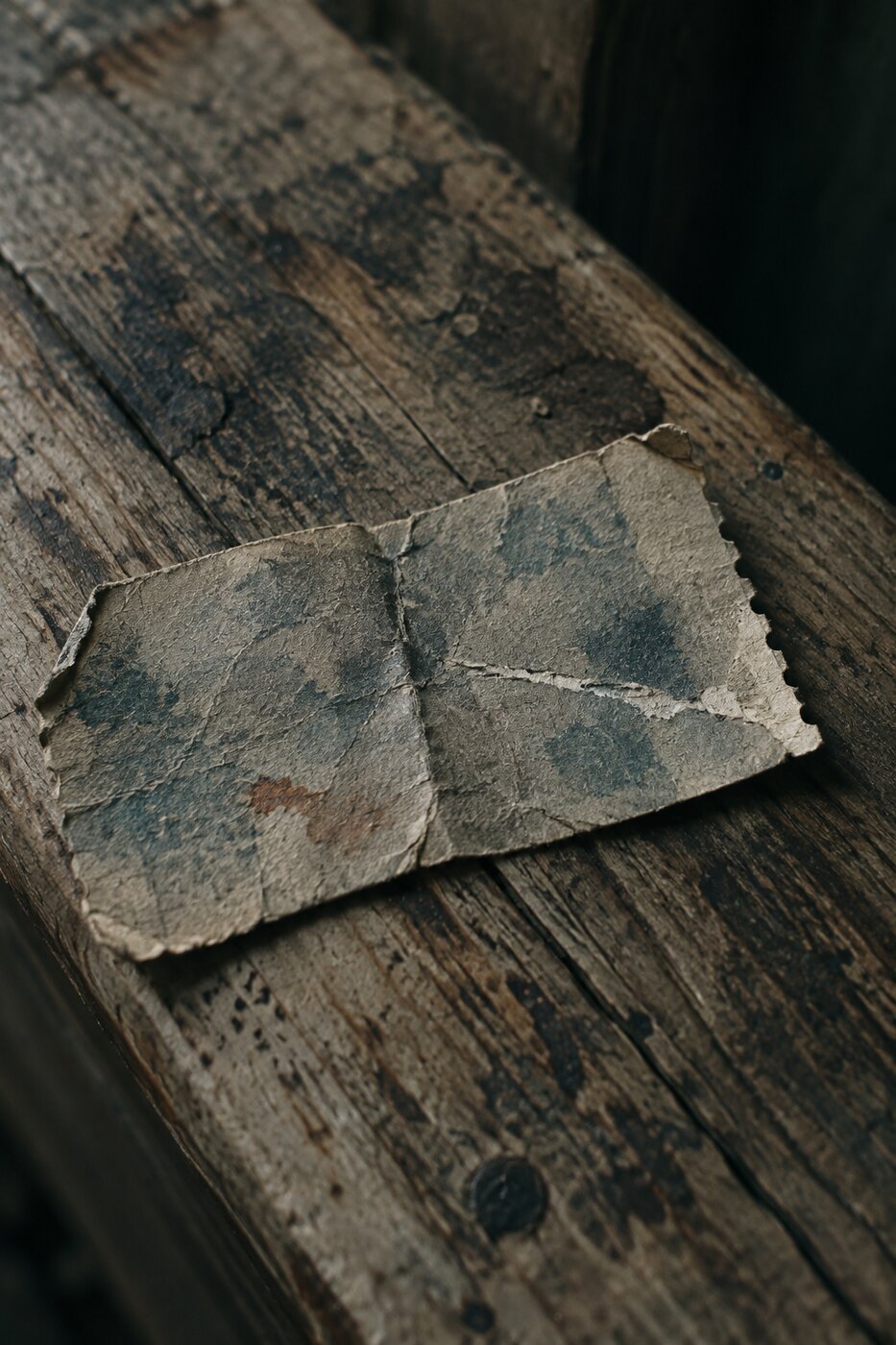
The stub lived in the same pocket as my keys for a season, and the keys won. It came out of that pocket softer than paper has any right to be, the nap raised like cloth, the printed ink worn down to a ghost in the places that stood proud of the folds. You could still feel the perforated edge with a thumbnail, the little scalloped run where it had been torn from its other half at a door I no longer remember standing in.
It was a ticket to something. I know that much from the shape of it and the one word that survives across the top in capitals, though even that word has lost its middle letters to a crease that finally went all the way through. There was a date once, printed small in the corner, and the keys found the corner. There was a seat number, a row, a section — the coordinates of one specific chair I sat in for a couple of hours on one specific night. All gone to abrasion now. The stub knows I was assigned a place. It can no longer say which.
Keys do patient work. A single key in a pocket is nothing, but a ring of them, riding against a folded scrap through a hundred walks to the car and back, is a slow machine. The teeth caught the folds and opened them into splits. The flat of a key sanded the raised ink off the high spots. There is a bright scratch across the face where something — the ring itself, maybe — bit down and dragged. The paper took all of it. Paper is soft and keys are not, and the pocket is a small dark room where they were pressed together for months.
I could not tell you much about the event. A show of some kind. There was a crowd, and a wait to get in, and a man at the door who tore the ticket without looking at it and handed me back the half I still have. I remember the tearing more than the show. The clean quick sound of it, the way he did it one-handed, a motion he had made ten thousand times that night. What was on the stage has gone the way the ink has gone. Worn down to the impression of having been there.
I kept the stub without meaning to. It stayed in the pocket because I forgot it, and it survived the wash once — I found it flattened and gray and dried stiff in the bottom of the machine, and instead of throwing it out I pressed it flat under a book, because by then it had been through too much to throw away. It had earned something. Not sentiment. Wear. It was proof, and the proof was more convincing for being beaten up. A crisp unused ticket proves you bought a seat. A wrecked one proves you went, and kept going, and carried the fact of it around until the carrying nearly erased it.
I have other stubs, kept better, and they are worth less to me. There is one in a drawer that never went in a pocket at all, saved flat from the night it was torn, the ink sharp, the date legible, the seat number crisp enough to read across the room. I know exactly where I sat and what I saw and who was next to me. And I almost never take it out. It is a record, complete and dull, the way a printed receipt is complete and dull. This soft gray one I handle all the time, precisely because it fought so hard to stay. The information wore off and the object got heavier.
Somewhere a machine has a cleaner record. A row in a database that knows the date and the seat and the price I paid, and will know it long after this scrap is dust. But the database was never in my pocket. It never rode against my keys. It cannot show you the crease where the paper gave up, or the bright drag of the scratch, or the soft raised nap where a thumb found it again and again without deciding to. The record in the machine is accurate. The record in my pocket is true. They are not the same thing.
I keep it now in a box where it can’t be worn any further, which is its own kind of loss — a thing shaped entirely by friction, put somewhere friction can’t reach it. It has stopped changing. For a while it changed constantly, a little softer every week, and now it holds still, a gray folded scrap with one capital word going bald across the top. I take it out less than I mean to. When I do, I am careful, because the main crease is one opening away from becoming two pieces.
It has not come apart yet. I keep meaning to read the date under the wear, to hold it at the right angle to the light and find the numbers pressed into the paper even where the ink is gone. The impression should still be down there. The machine that printed it bore down hard. I have never managed to make the numbers out. I fold it back along the crease it already has, which is the only crease it will accept, and put it away.