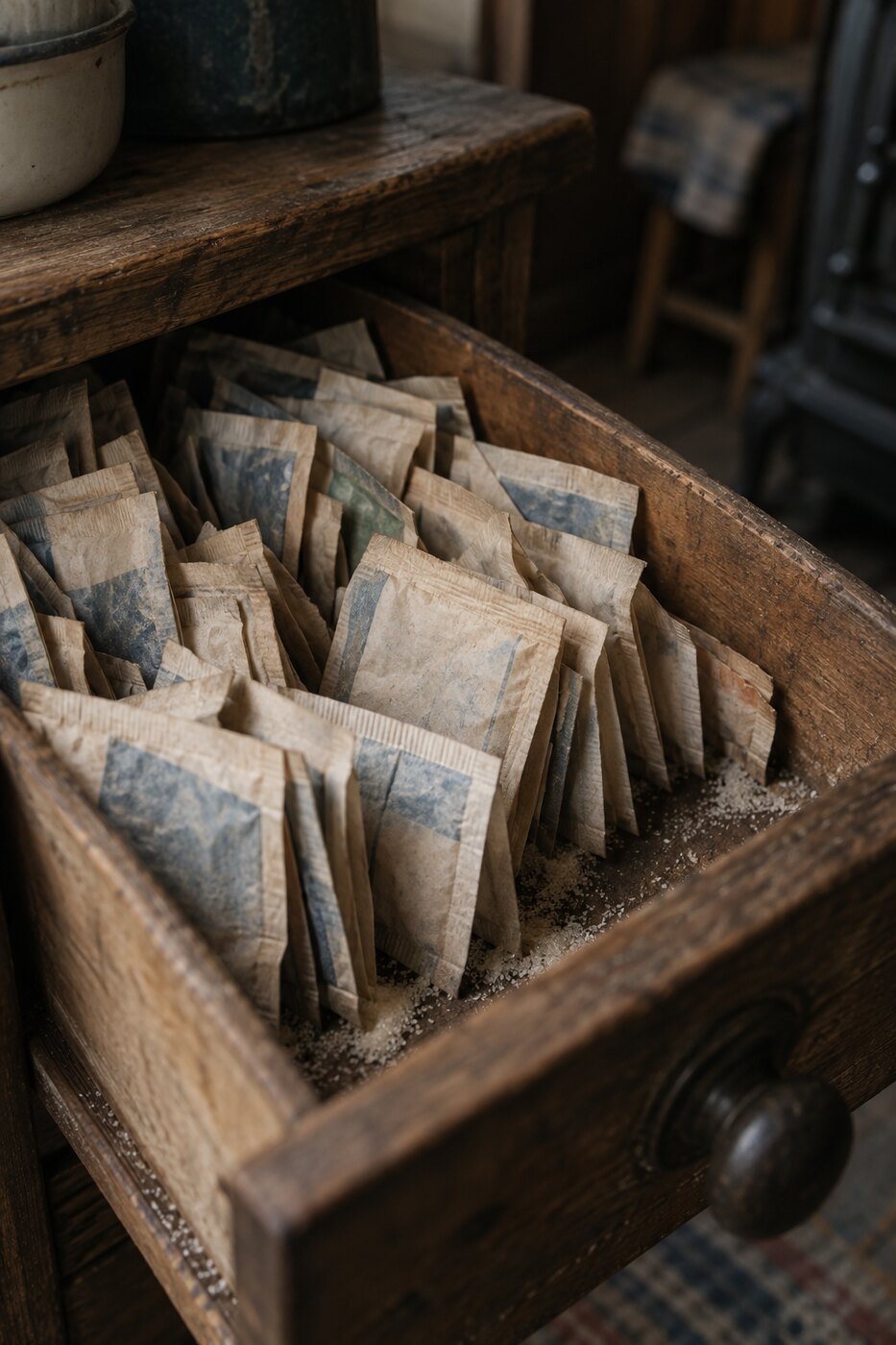
The drawer was meant for dish towels and had become the sugar drawer instead. It stuck when I pulled it, because the packets had drifted to the back and stood up on their edges, and the top layer caught on the frame. I had to reach in and press them down to get it open. When it slid, they whispered against each other, that dry paper-and-grain sound, hundreds of little envelopes shifting at once.
I never bought a single one. That is the first thing to understand about the drawer. Every packet in it came off a table. A diner, a truck stop, a motel breakfast, the coffee station in a waiting room, the bowl by the register at a place that let you take a handful. I took two or three and used none of them at the table, because I drink my coffee black, and I put the rest in my coat pocket the way you pocket a book of matches you’ll never strike. At home they went in the drawer.
Every one of them has a logo. That is the thing I could not get over, once I started noticing. A packet of sugar holds maybe a teaspoon. It costs the restaurant a fraction of a cent. And still, almost every one of them is printed. A diner in a town of six hundred people had its name put on the sugar. A pancake house with a cartoon stack, steam coming off in three curls. A truck stop with the silhouette of a rig. A seafood place with an anchor, inland, four hundred miles from any sea. The coffee shop with just its phone number and the word FRESH. Each one decided the sugar was a place to say who it was.
Some of them have gone hard. The sugar inside has taken on the damp and set into a single block you can feel through the paper, a little brick that no longer pours. Some have leaked at the seam, and there is a fine grit at the bottom of the drawer, sugar that got out and sat, gone slightly gray with dust. A few have faded where they lay face-up under the one hour a year the sun reaches that counter. The oldest are printed on plain paper. The newer ones have a slick coating that resists a pen, so I stopped trying to date the backs and let the printing speak for itself.
I told myself, for years, that I kept them for emergencies. Sugar keeps. If the power went out, if the storm came, if the road closed — I would have sugar. It was never true. I have never once opened this drawer for sugar. When I bake I buy a bag. The packets are not food. They stopped being food the moment I decided not to use them. They became something else. A card catalog of every counter I ever sat at with a cup in front of me.
I can read the drawer like a route. Here is the diner off the highway that burned down; I have four of its packets and there will never be a fifth. Here is the motel chain that changed its name twice; the sugar came in three different logos and I have all three, the way tree rings hold the dry years. Here is a place I cannot picture at all anymore, whose name on the packet means nothing to me, and yet I must have sat there, must have had a cup, must have reached into the little chrome caddy and taken these. The packet remembers a morning I do not.
The packets are not all sugar, either, and I did not sort those out. There are the pink ones and the blue ones and the ones dressed up as raw, tan crystals in a kraft-paper sleeve that costs more to print than the sugar in it. There are the honey packets that weep at the corner if you look at them wrong, and one long tube of stevia from a place that had gotten religion about health while still serving pie. I took whatever was in the caddy. The caddy was the point. What the restaurant chose to put in front of me, printed with its name, on the assumption I might want something sweet and might, someday, want to remember who offered it.
The restaurants insisted on themselves and then most of them closed. The logo outlives the room. The cartoon rooster stays brighter than the diner ever was by the end, when the vinyl was cracked and the coffee scorched and the waitress was the owner’s daughter working a double. The packet does not know any of that. It says the name in confident type and holds its teaspoon and waits.
There is no order to how they lie in there. I have tried, a few times, to stand them up in rows by region, or to band the dead places together with a rubber band. The rubber bands go brittle and snap. The rows fall the first time I open the drawer too fast. So they lie the way sugar lies, heaped and shifting, the printed sides catching the light at every angle, a hundred small businesses all shouting their names into a towel drawer where no customer will ever read them.
I pressed the top layer down again and slid the drawer shut. It caught at the same place it always catches. Somewhere in the back, one of the split packets is still letting go of itself, a grain at a time, into the seam of the drawer, where I will find it as grit the next time and wipe it up and never know which packet it came from.