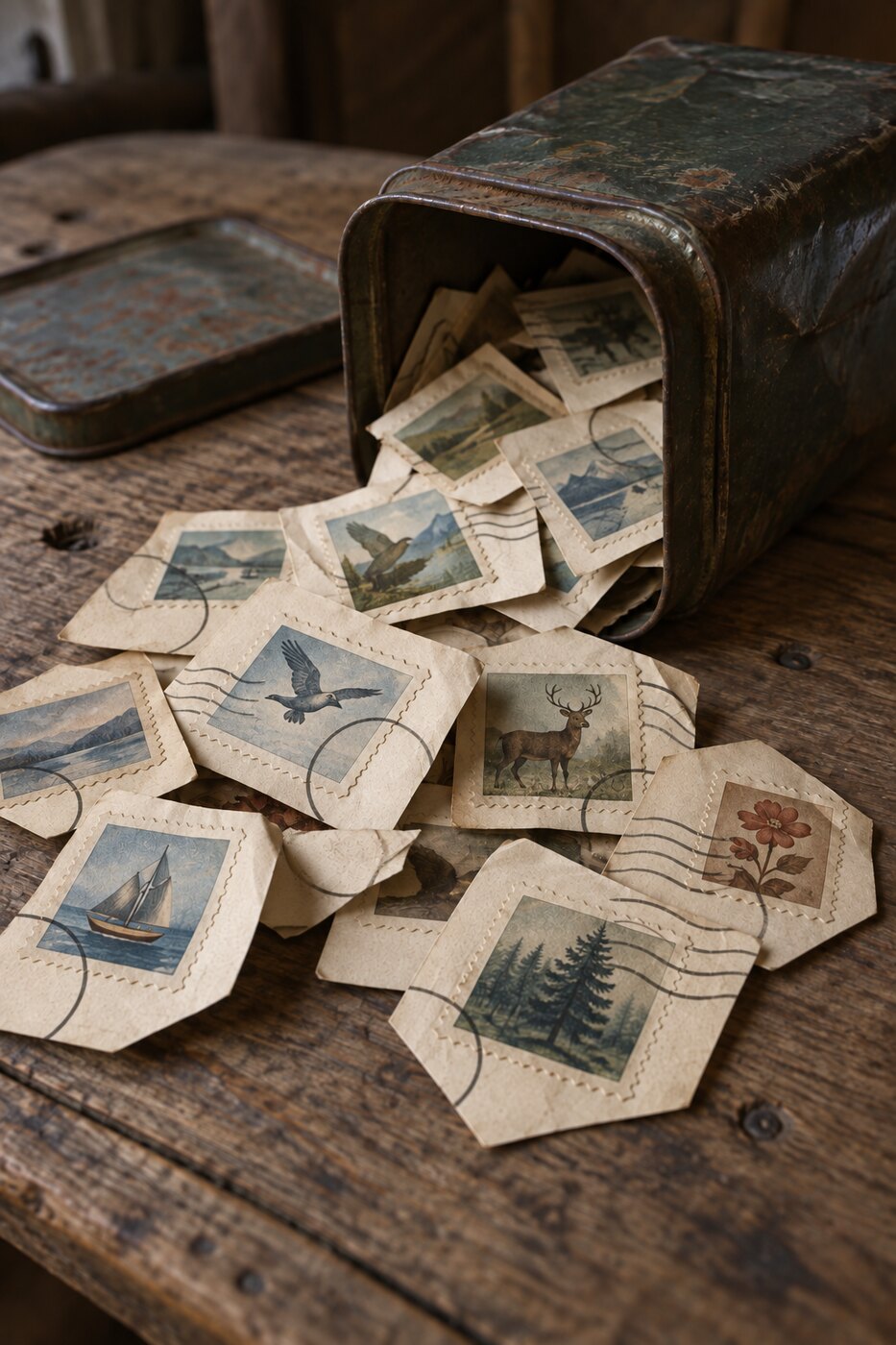
The box had held loose tea once. Tin, with a painted scene worn down to bare metal at the corners, and a lid that no longer sat flush because I had pried it open too many times with my thumbnail. Inside were the stamps. Not a collection in any way a collector would recognize. No album, no glassine sleeves, no tongs. Just corners. Squares and triangles cut off the tops of envelopes with the kitchen scissors, each stamp still married to a margin of the paper it had traveled on.
I started keeping them the year the letters stopped coming regularly. When there were only a few a month, each one felt like more than its message. I would read the letter, do whatever the letter asked, pay the bill or answer the card, and then, before the envelope went in the bin, I would cut the corner off. It took two seconds. The scissors lived in the same drawer as the rest of the mail’s tools: the letter opener I never used, the roll of stamps, the return-address labels a charity sent me by the sheet.
A stamp is a small paid-for thing. Somebody chose it, or the machine chose it, and then a tongue wet the back of it, or a thumb pressed a self-adhesive one down and rubbed once to be sure. That is the part I think about. Every stamp in the tin was licked or pressed by a hand. Then it was carried to a box or a counter, and canceled, and sorted, and driven, and walked up to my door. The postmark is the record of all that. A ring of ink, the town name, the date, sometimes clear and sometimes just a gray bruise across the corner where the machine hit it at speed.
The cancellations are the point, more than the stamps. A mint stamp is worth its face. A canceled one has been somewhere. The wavy lines the machine lays down to kill the stamp so it can’t be used again — those lines are the evidence that the thing did its job. It carried a letter once and will not carry another. It is spent. I keep the spent ones.
Some corners have more than a postmark. A thumbprint in the ink. A crease where the envelope got bent going through a slot. One has a coffee ring clipping the edge, brown gone pale. One has the corner torn instead of cut, because I opened that envelope in a hurry and took the stamp off later from the ripped piece, and the tear runs right through the date so I cannot read the year. The paper backing varies: white, manila, the blue-lined edge of an airmail envelope, one square of pale green from a card that smelled faintly of somebody’s house for about a week after it arrived.
I sort them sometimes, though not into any system. I tip the tin out onto the table and move them around with one finger. By town, if the postmarks are clear. By color of the stamp. By how much of the envelope came with them. I never finish. I put them back in the tin loose, the way they were, and the sorting undoes itself the next time I move the box.
There are stamps in there from people who are dead now. I don’t mark those. I couldn’t tell you which ones without reading the return address on the scrap, and half the scraps don’t have one, because the return address is on the back flap and the back flap went in the bin with the rest of the envelope. So the corner survives and the sender doesn’t, at least not on the paper. What survives is the handling. The place it was mailed from. The day the machine stamped it. The fact that a hand licked and stuck, and a route carried it to me.
None of it is worth anything. I looked once, the way you do, at what the old stamps go for. Common. All common. The kind of stamps that come on the kind of mail that ordinary people send each other. Bills and cards and the occasional real letter. Nobody frames these. The value, if there is one, is that each square is a receipt for a trip nobody kept a record of otherwise. A letter went from there to here. Here is the corner of it.
The tin fills slower now. Whole months go by with nothing to cut. The mail that comes is printed, metered, a red rectangle sprayed on by a machine that never touched a tongue. You cannot keep a corner of that. There is nothing to keep. It says the postage was paid but it does not say anyone paid attention. I let those go in the bin whole.
I add a stamp when a real one comes. It still happens. A card at Christmas from the few who still send them, a stamp with a bird or a flag or a flower on it, chosen off a roll at a counter and licked or peeled and pressed by somebody who thought of me long enough to do it. I cut the corner. I open the tin. The lid fights me the way it does. I drop the corner in with the others and it lands wherever it lands.
The tea smell is long gone from the tin. What it holds now has its own smell, dry paper and old glue and a faint mineral edge off the metal. The torn corner with the year running through it is still in there somewhere. I have never been able to put a date to it. I keep meaning to hold it to the light and work out the numbers under the tear, and every time I decide the tear is part of it now, and I close the lid.