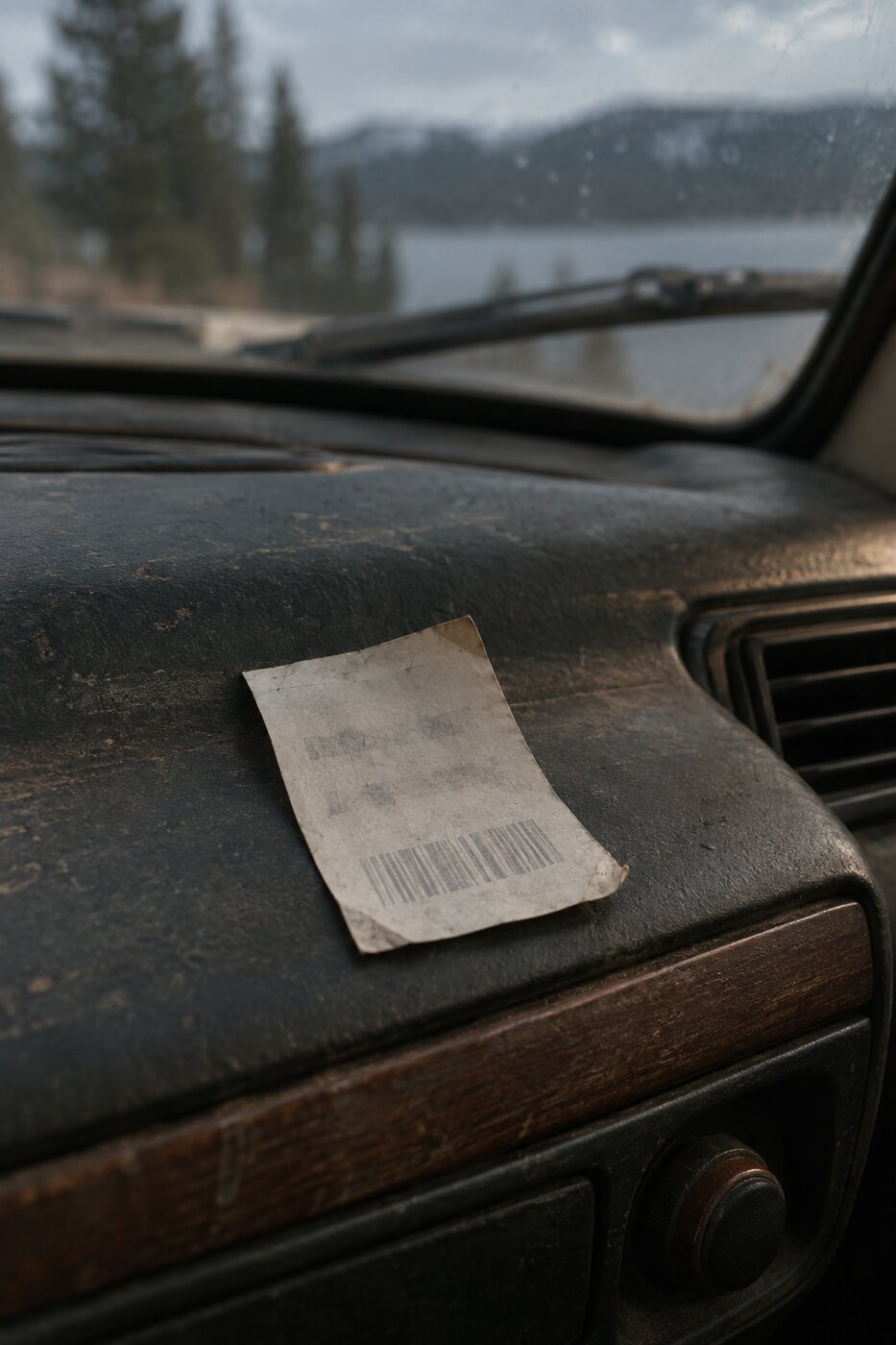
The slip came out of a yellow machine that made me wait for it, the little printed tongue easing forward with a hum before it let go. A gate lifted. I drove in.
It is thermal paper, so it is already fading — the black going brown, the barcode softening into a smear, the numbers still there if I hold it flat to the light. Time in, near the top. Time out, lower down, stamped when I fed it back to a machine at the exit and the machine told me what the two hours had cost and I paid it in coins from the door pocket.
Two hours in a town I was passing through. I do not remember why I stopped. Lunch, maybe, or a bathroom, or just the tiredness that makes a person pull off and walk around a block to remember they have legs. The town did not keep me. I was gone by the time the ink was dry. Whatever I did there left nothing — no photograph, no name, no reason I could give you now for the stop.
Except this. The slip is the only thing that knows I was there. It has the date. It has the two times, in and out, bracketing exactly how long I existed in that town: two hours and a few minutes, paid for, gated, closed at both ends. The car is long gone. The town went on without the record of me. The record left with me, in coins’ worth of thermal paper, and lives now in the glove box of a different car.
The exit time is fading faster than the entry. Soon it will only say when I arrived, not when I left.