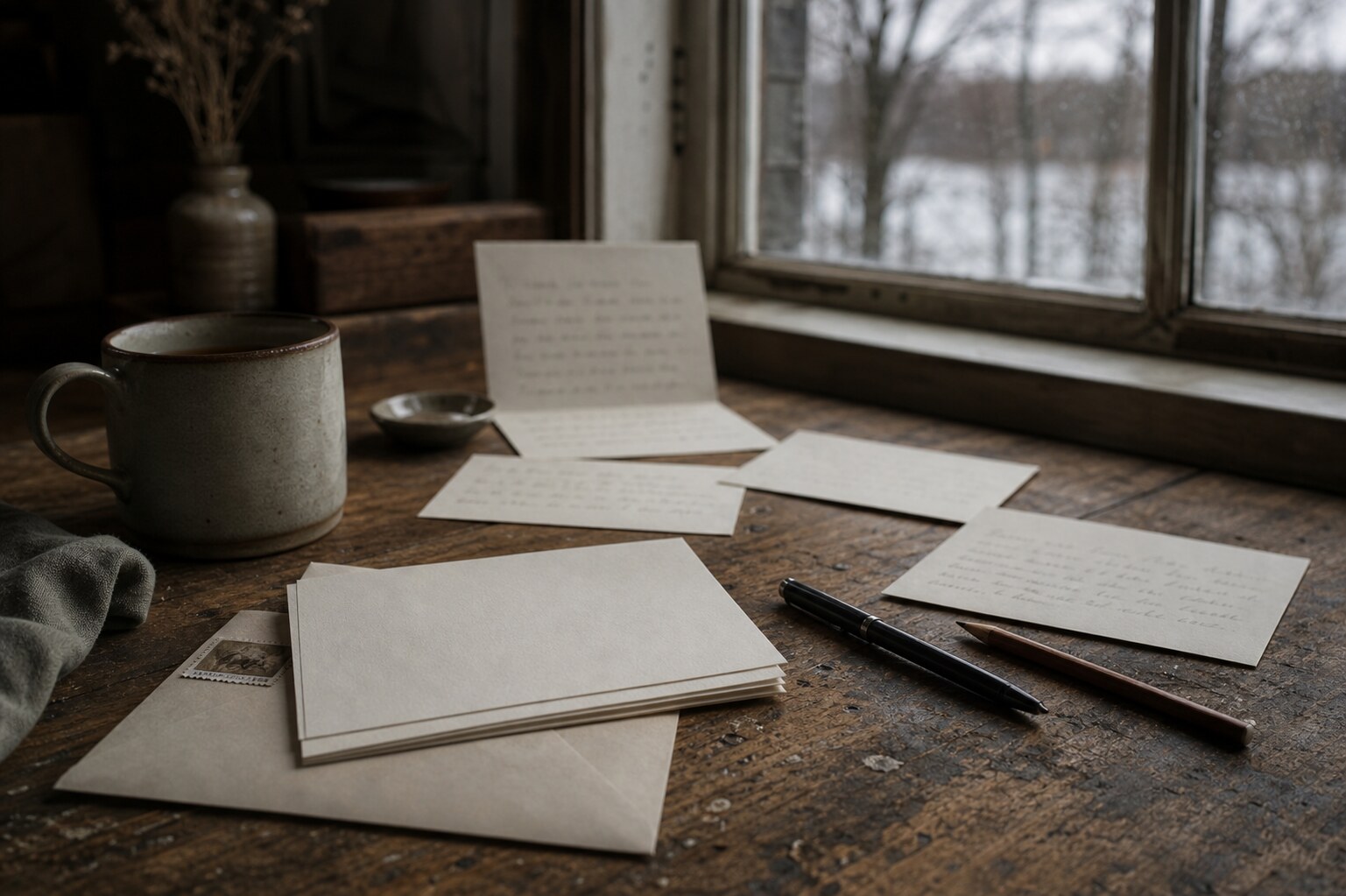
I cut the corners off the envelopes before I threw the letters away. Not the stamps — I was never after the stamps, and anyway most of these came through in the years when the stamp was a sticker of a flag and worth nothing to anyone. I cut two corners. The top left, where the return address sat, and the top right, where the postmark had landed across the stamp. Then the middle of the envelope, the part with my own name on it, and the letter inside, went in the bin.
The corners live in a used envelope, a fat one, gone soft at the flap from being opened and closed. When I tip it out onto the table they come in a small drift, all sizes, some cut straight and some cut in a hurry at an angle, some torn instead of cut on the days I could not find the scissors. They make almost no sound landing. Paper cut that small has no weight to speak of.
The return addresses are handwriting, mostly. That is what I was keeping, though it took me a while to know it. A return address in a person’s own hand, up in the corner, written small because the corner is small, the way people cramp their own street and town to make it fit. Some are printed labels, the kind that come free from a charity that wants money, a strip of them with a cardinal or a lighthouse in the corner and your name already on them, and those I kept too because a person chose to use that particular free label, out of the strip, and licked it and stuck it slightly crooked. Even the crookedness is information.
The postmarks are the machine’s handwriting. A circle, or most of a circle, the town name curved along the top and the date curved along the bottom and a smear of cancellation lines fanning off to one side across where the stamp used to be. Some are crisp. Some are so light you have to angle the paper to the window to find the town, the ink half-starved, the machine low on whatever machines run low on. A few have doubled, printed twice, the envelope having gone through crooked, so the town sits ghosted beside itself and the date is unreadable in the overlap.
Here is what I did not keep: the letter. Every one of these had a message inside it, folded in thirds, and I read it, once or twice, and then I threw it away. That is the part people find backward. You are supposed to keep the letter and throw away the envelope. The letter is the point; the envelope is the wrapper the point traveled in. I did it the other way. I kept the wrapper and binned the point.
Because the message was between me and one person, and it ended when the letter did. But the routing — the routing was never really about the message. The return address and the postmark are the part that was around the message, the part that only ever cared about geography. Where it came from. Where it had been. What town’s machine touched it on what night. That part does not depend on what the letter said. A letter can say goodbye or say nothing or ask for money, and the postmark says only the town and the date, flatly, the same way it would for anyone’s goodbye or anyone’s nothing.
So what I have in the soft envelope is not correspondence. It is travel. Each clipped corner is a small piece of proof that something crossed the distance between one town and mine, physically, carried, sorted, stamped, driven, walked up to a box. The message it carried is gone and I could not reconstruct most of them if you paid me. But the routes remain, dozens of them, and laid out on the table they make a rough map of everywhere a piece of paper ever came to me from, which is a wider map than the one my own feet made.
The handwriting outlasts the person, sometimes. That is a thing I did not plan for and cannot look at squarely. There are return addresses in that envelope written by hands that have stopped writing. The address is still current in the corner — that street, that town, that cramped small hand fitting itself into the space the envelope allowed — as if the letter could still be answered, as if I could still cut a fresh envelope and send the routing back the way it came. I cannot. The route is one-directional now. It arrives and does not receive. But the corner does not know that. The corner still says, in the upper left, here is where to write back.
I do not add to it often anymore. Mail comes as bills and flyers now, printed windows and bulk rates, and there is nothing in the corner worth the scissors. But every so often something arrives in a real hand, a real return address cramped in the corner, a real town in the postmark, and I cut the two corners off before I open it, sometimes, before I even know what it says, because the routing is the part I have learned to save and the message is the part I have learned I will lose.
The envelope of corners does not close all the way anymore. The flap has given up its glue and the corners have added up to more than the envelope was meant to hold, so it sits on the shelf slightly open, a paper mouth, and when the furnace kicks on the draft lifts the flap a little and I can see the top layer shift — a handwritten street, a half-circle postmark, a town I would have to hold to the light to read — and then the furnace stops and the flap settles and I do not go look at which town it was.