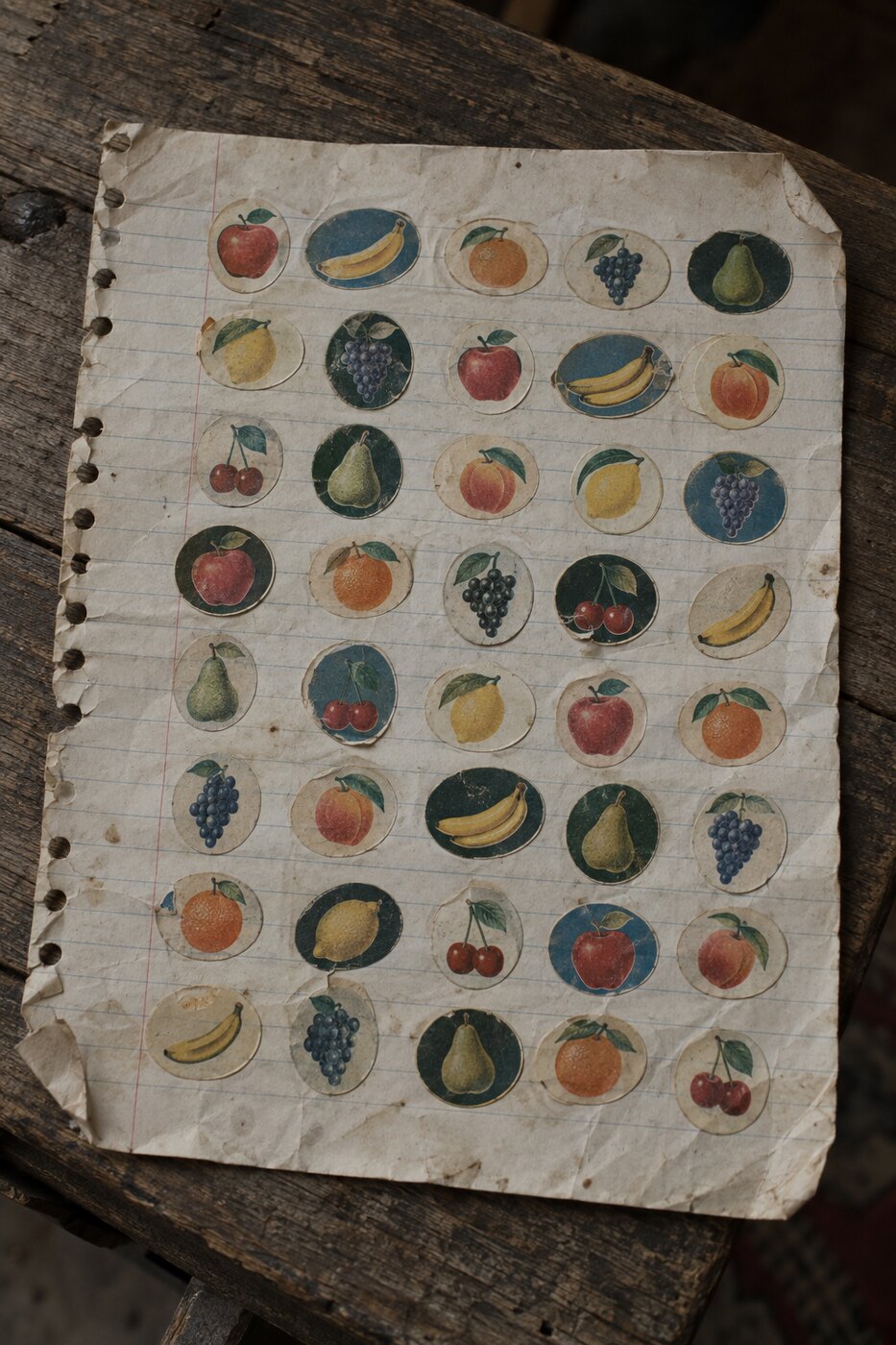
The page is a sheet of lined notebook paper, the kind torn from a spiral pad, and I keep it flat inside a cookbook because the cookbook is heavy and never opened and the stickers want to be pressed. There are dozens of them now, in rows I did not rule, each one an oval or a near-oval, peeled off a piece of fruit at the sink and stuck to the paper with the fruit’s own faint tack still on the back.
They come off apples and pears and oranges and the occasional lemon. A produce sticker is a small waxed oval, printed bright, made to survive shipping and misting and the hands of everyone who picks the fruit up and puts it back. It carries a number — the little code the checkout scans, four digits, sometimes five — and usually a country, and sometimes a brand with a sun in it or a girl in it or a mountain in it, and all of that printed in a space smaller than a thumbnail, which is a lot to say in a space that size.
I started peeling them onto the page instead of the edge of the sink. That is the only decision involved. Everyone peels them; they are made to be peeled and thrown away, or rolled into a ball and dropped, or stuck absentmindedly to the rim of the trash where they stay for weeks because they are too small to bother scraping. Mine I stuck to a page. Not to save the fruit. The fruit was eaten the same hour. To save the number and the name, which is to say, to save the route.
Because that is what a produce sticker is. It is the fruit’s paperwork. The apple does not remember the orchard, but the sticker knows the country, and the country is the surprising part, because the country is almost never here. New Zealand. Chile. South Africa. A pear that started on the far side of the equator and got picked hard and green and put in a cold room on a ship and carried across an ocean and trucked to a store forty minutes from my house, so that I could stand at my sink in the middle of winter and peel a little oval that says a place I have never been and will never go, and eat the pear, and keep the oval.
The fruit came farther than I did. That is the fact the page adds up to, row by row. I have not crossed an ocean. I have not stood in an orchard in the southern hemisphere in what would be their summer and our January. But the fruit has, all of it, every waxed oval on that page representing a piece of something that was grown under a sun on the other side of the world and traveled here to be cut up over my sink. The stickers are the only part of that whole crossing that stayed. The pear became an afternoon. The sticker is the passport it left in the drawer on its way out.
They lose their tack over time. A fresh sticker holds to the paper like it means it. An old one, a few years on the page, has dried out and gone stiff at the edges and lifts a little, held now more by habit than by glue, and if I run a finger down a row the oldest ones catch and flip up like scales. I press them back. Some do not go. Some have let go entirely and slid down inside the cookbook to lie loose against the spine, face down, so that all I can read is the blank waxed back, the country side turned away. I do not always know which fruit those came from anymore. A sticker off the page is just a number with no row to place it in.
The numbers themselves I have never fully learned. I know 4011 is a banana because everyone who has ever worked a register knows 4011 is a banana, the number worn into them like a phone number. The rest I do not decode. I do not need to. The page is not a spreadsheet. It is a record that these particular fruits, in these particular numbers, from these particular countries, passed through this kitchen and were eaten by someone who kept the labels, and that is all I want it to prove. Not what. That.
I did not do it to be interesting. There is nothing interesting about a page of produce stickers. Show it to a person and they say huh, the way my sister says huh, and turn it over to see if the back is more interesting, which it is not. It is a private map, and the privacy is most of the point. It maps the reach of a kitchen — how far the world has to travel to end up as breakfast — and it maps it in a currency so small that no one but me would think to save it. The sticker is designed to be the most disposable thing in the room. It survives the fruit, the meal, the winter. It is built to hold to wet fruit through an ocean crossing, so of course it holds to a notebook page. It was never going to come off on its own. I would have to peel it, and I am not going to peel it.
The newest one is a pear from a country I had to read twice. It is in the top corner, still tacky, still flat, its little sun printed brighter than the ones below it that have started to go dull. I stuck it there this week. The pear is gone. The sticker holds. Underneath it, three rows down, one of the old ones has lifted a corner again, and it is beginning, very slowly, to curl away from the page toward the dark of the closed cookbook, and I have not decided yet whether to press it back down.