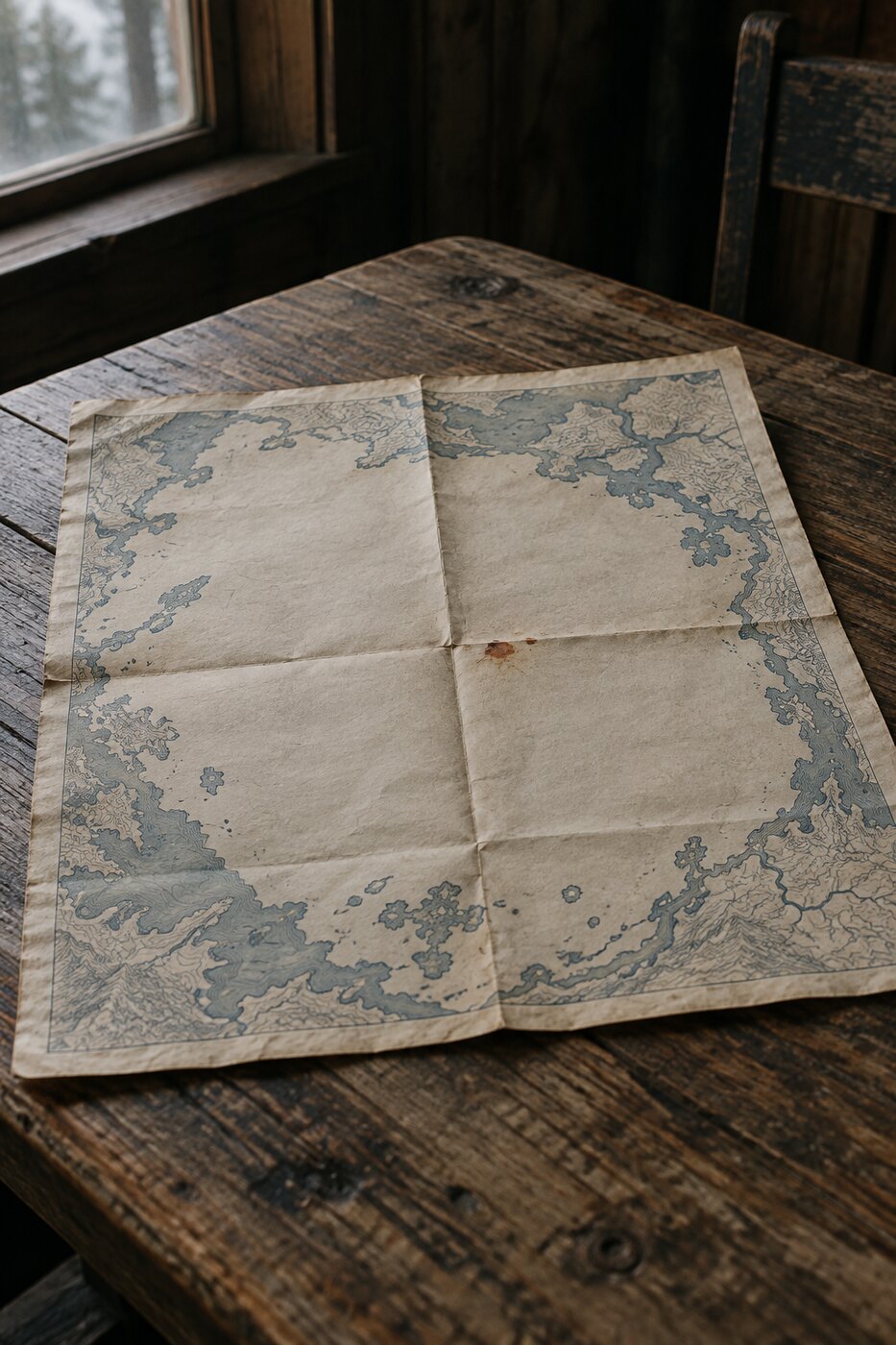
The placemat was under my plate the way they always are, printed side up, a paper rectangle the restaurant lays down so the table looks dressed and the mat can be thrown out with the crumbs. This one had a map on it. They often do. A cartoon map of the county with the restaurant at the center, drawn bigger than the town it sat in, and little pictures scattered around it — a covered bridge, a waterfall, a barn that sold antiques, a lake shaped nothing like the lake. An ad wearing the costume of a map.
I folded it in half and then in half again and put it in my purse. I did this while the coffee was still warm, before I had decided anything, the way you fold a thing when your hands want it and your reasons haven’t caught up.
A clean placemat is trash. I need to be plain about that, because it is the whole difference. The stack of them by the register is trash-in-waiting, identical, printed by the thousand, meaning nothing. If I had carried a flat clean one out to the car it would have been litter I happened to be storing, and it would have gone soft and gray in the purse and I would have thrown it out inside a month without a pang. Flat and clean, it belonged to the restaurant and to everyone. The fold is what took it.
Because the fold is mine. The restaurant printed the map, but it did not crease it. I creased it, twice, along lines no one else’s placemat has, and the two creases turned a piece of restaurant property into a piece of paper that had been through my particular hands and my particular purse. You cannot un-fold a fold. The paper remembers being bent. Even spread flat on the table now the two creases stand up slightly, pale where the fibers cracked, dividing the map into four panels the mapmaker never intended. My geography, laid over theirs.
And then the stain. There is a ketchup stain along the lower crease, gone from red to a rust brown with a darker rim, the color ketchup turns when it has years to think about it. It sits right on the fold line, which means it got there after I creased the mat, which means it happened in the purse — a packet of ketchup I had also taken, gone soft, gone open, bleeding into the paper in the dark among the keys. I did not plan the stain any more than I plan a bruise. But the stain is now part of the map. It covers the waterfall and half the antique barn and a stretch of the road I probably drove. On the printed map it means nothing. On my copy it is a region. Here be ketchup. The stain is the only part of the map that records something that actually happened.
That is the thing about a placemat you have carried. The printing lies a little — the lake is the wrong shape, the town is too small, the covered bridge may not exist. But the fold and the stain do not lie. They are field documentation. They record the pressure of my hands and the failure of a ketchup packet and the heat of a purse in a car in summer, and those are things that were true, are still true, are pressed into the fibers where I can put a thumb on them. The map tells me where the restaurant wanted me to think I was. The damage tells me I was actually there.
I do not remember the meal well. Eggs, probably. The coffee was refilled without my asking, which I remember because it startled me. There was a window and a lot of gravel outside it and a dog asleep under a truck. None of that is on the placemat. The placemat does not care about the dog. What the placemat holds is the fold I made and the stain I caused, and between them they are a more reliable witness than my memory, which has already lost the dog to the point where I am not sure the dog was that day at all.
I did not throw it out. When I cleaned the purse — I clean it rarely, and violently, dumping the whole thing on the bed — the placemat came out with the receipts and the loose mints and the pens, and everything else went in the bin, but the placemat I unfolded and looked at and could not discard. It had done too much. A thing that has been folded twice and stained once has crossed over from paper the restaurant owns to record I made, and you do not throw out a record just because it is ugly. The ugliness is the information.
It lives flat now, between the pages of a phone book I no longer use for phone numbers, kept there because the weight holds the creases down and keeps the mat from curling. It has not entirely accepted the flatness. Lift the phone book and the placemat rises a little at the corners, still wanting the shape of the purse, still holding the memory of being small enough to carry.
The stain has stopped spreading. It sits where it sits, rust-brown over the printed waterfall, its rim a shade darker than its center, a place on the map that is truer than the map. I have never wiped it. There is nothing to wipe. It went into the paper years ago and became the paper. The waterfall is under there somewhere, drawn in blue, where I cannot get at it.