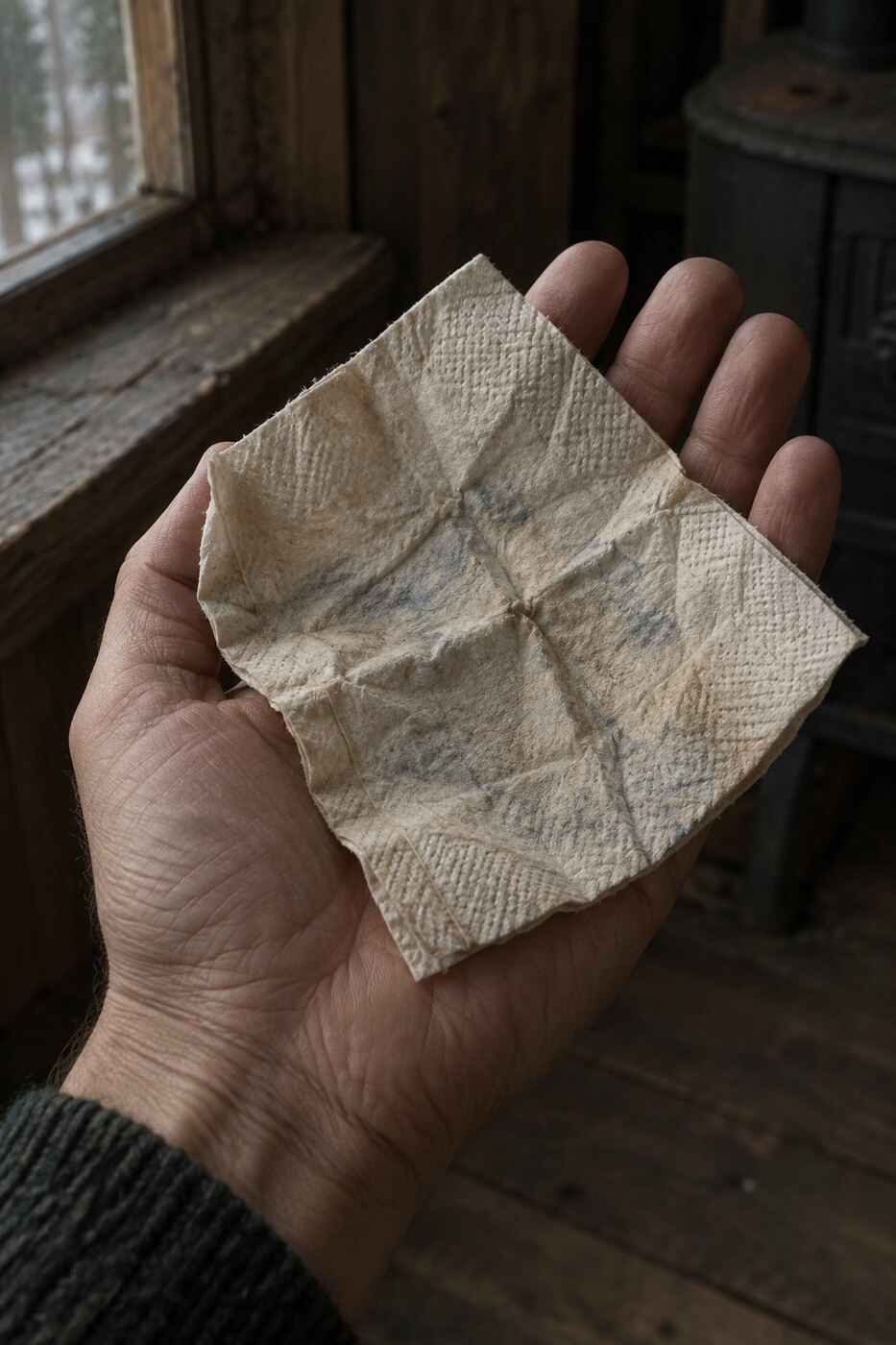
I found it when I put the coat back on in the fall. My hand went into the right pocket the way it does, looking for a glove, and closed instead on something soft and folded that was not a glove and not money and not a receipt. I pulled it out. It was a napkin. It took me a second to be sure, because it did not feel like paper anymore.
It had gone soft. That was the first thing. A paper napkin comes off the dispenser stiff and slightly waxy, with that faint resistance paper has before it has been asked to do anything. This one had lost all of that. It had been folded in quarters and carried in the pocket through however many weeks of walking, and the walking had worked it the way water works a stone. The folds had gone furred. The flat parts had gone limp. It had the drape of cloth, the give of a handkerchief laundered too many times, the surface broken down until it was more nap than sheet.
There was a logo on it, or there had been. A restaurant’s mark printed in one corner in thin blue ink, the name curved around something, a fork or a wheat sheaf, I could not tell anymore because the fold ran straight through it and the fold was where the wearing was worst. The ink had not so much faded as migrated, rubbed into the fibers until the letters were a bruise instead of a word. I could get maybe half the name if I held it to the window. The half I could get did not tell me which town.
I did not remember the meal. I want to be honest about that, because it would be easy to say the napkin brought it all back, and it did not. I remember that I must have eaten somewhere, that I must have wiped my mouth and then, instead of leaving the napkin balled on the plate, folded it in quarters and put it in my pocket, which is a thing I do without deciding to. My pockets are where paper goes to soften. I do not plan it. I just do not empty them, and the coat hangs in the closet through the warm months, and the paper inside it keeps being folded against itself every time the fabric shifts, and by fall it is not the same object anymore.
The meal left paperwork, is the thing. A meal always does. A receipt, a matchbook, a mint in cellophane, a napkin. The food gets eaten and turned into an afternoon and forgotten by evening, but the paperwork stays, and the paperwork is stiff and generic and prints the same logo for everyone who walks in. The napkin I pulled out of my pocket was, when it was handed to me, identical to a thousand others in the dispenser. It was restaurant property. It belonged to no one.
What made it mine was the softening. This is what I keep coming back to. I did not do anything to the napkin on purpose. I did not date it or press it in a book or write on it. I just carried it, and the carrying wore it down, and the wearing down is a record that only my particular pocket and my particular walking could have made. Another person’s coat would have furred it in a different place, along a different fold, because they turn a different way when they walk and reach for a different thing in that pocket. The generic napkin became specific by friction. It filed itself against me until it fit.
I did not throw it out. I want to say I meant to, that I stood over the bin the way you do, but the truth is the thought of throwing it away did not fully arrive. It was too soft. You cannot throw away something that has stopped being paper and started being cloth without it feeling like throwing away a small worn animal. So I refolded it along its own worn creases, which it accepted easily, having been folded there so long the folds were the only shape it still believed in, and I put it in the drawer with the other things I have not thrown out yet.
It does not prove much. It cannot even prove where I ate, now that the name has worn to a bruise. It cannot prove the meal was good or that I was happy or that anyone was across the table. It proves only that I ate somewhere, folded the napkin, and then walked far enough, over enough days, to turn a stiff printed square into a soft blank one. That is a small thing to have evidence of. It is also, I think, an accurate one. Most of what I did in those weeks left less.
I have taken it out a few times since. It does not change now, kept flat in the drawer instead of worked in the pocket. The softening has stopped, arrested at whatever point the fall interrupted it. If I put it back in a coat and walked another season, it would keep going, keep thinning, until one fold finally wore through and the napkin came apart into the four soft squares it has always secretly been. I have thought about doing that. Finishing what the walking started.
For now it stays folded in quarters, soft as a rag, the blue logo bruised across the crease where I cannot read it. The half of the name I can still make out ends in a letter that could be an S or could be the fold. I hold it to the window and it stays a bruise.