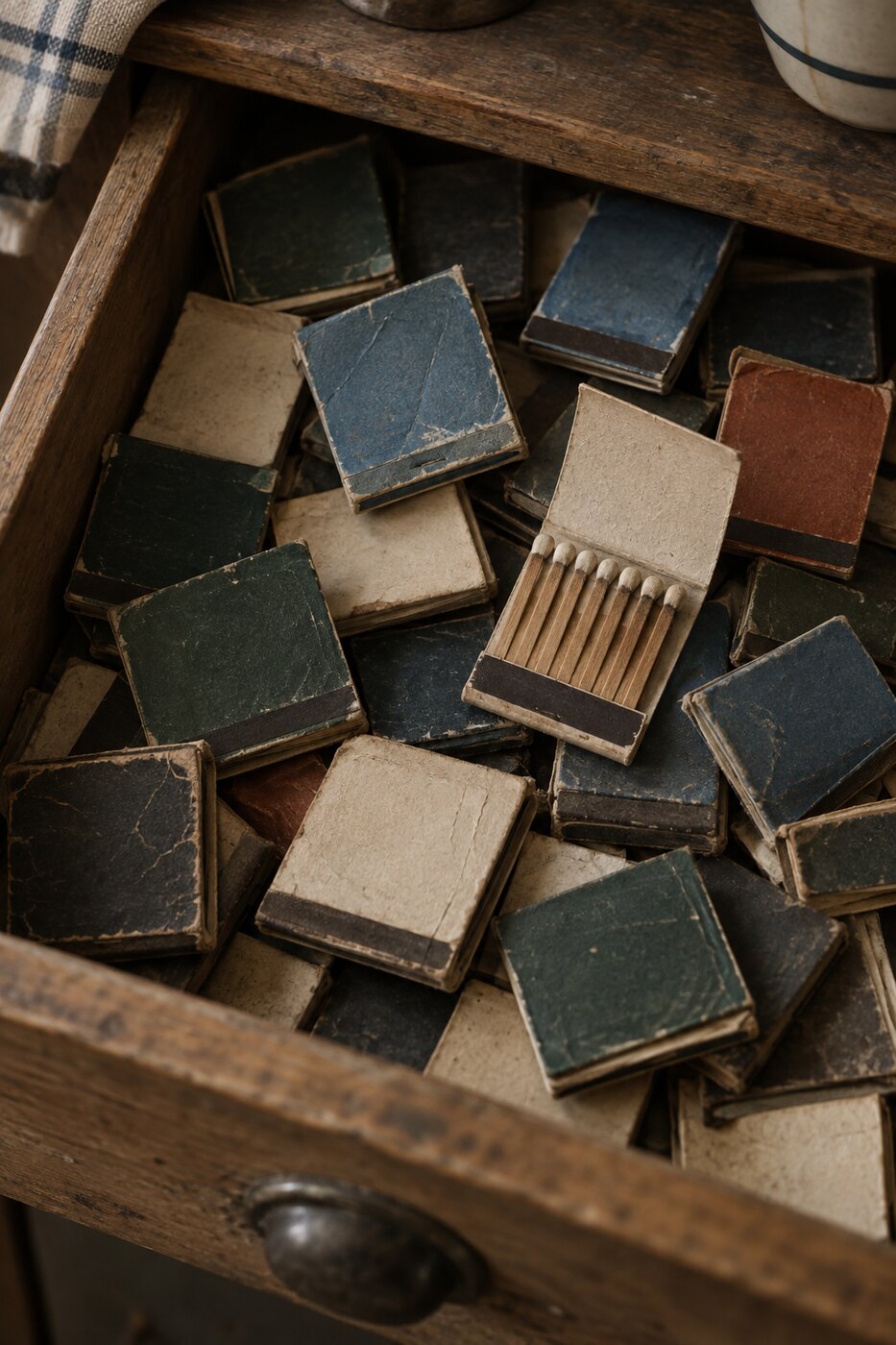
The drawer is the shallow one under the phone that no longer hangs on the wall. It sticks in humid weather and gives all at once, so the matchbooks slide forward in a small paper wave. They make a sound like a deck of cards deciding not to be a deck. I keep them there because that is where they landed, and because a drawer is honest about how much it can hold.
They smell like struck sulfur even when they are full. The smell does not come from the matches. It comes from the drawer, which learned the smell years ago and has not let it go.
Each one is a small printed argument for a place. A steakhouse with a bull on the cover, the bull worn pale at the fold where a thumb opened and closed it. A motel lounge in a font that was trying to look like handwriting. A diner named for a road. A bar named for a man, or for the year he opened it, or for a joke I no longer have the room to get. The covers are cardboard, thin, printed cheap, the ink already fading toward the brown that all cheap ink eventually becomes. Some have a phone number with only seven digits. Some have no number at all, as if the place assumed you already knew how to find it.
The point of a matchbook was never the matchbook. It was the free advertisement you carried in your pocket and lit, one match at a time, until the place had spent all its matches on you and you threw the cover away. A matchbook is a thing designed to be used up and discarded. That was the whole plan. Mine failed the plan.
Some are struck. You can read a night off a book of matches if you know how to look. The staple end is the last to go, so a book with only the far corner used got opened once, for one cigarette or one candle or one pilot light, and then closed and pocketed. A book struck down to the last three got carried a long time and lit a lot of things. The used matches are still folded back in, black-headed, curled, laid flat against the ones they burned beside. I did not throw the dead ones out. Throwing out the dead matches felt like editing.
Some are full. Every match still standing in its comb, red heads in a neat row, the strike strip on the back rough and unblemished. These are the places I meant to go back to. A full matchbook is a promise a room made to you across a table, and you took it, and then the years went by and you never lit a single one. The promise is still in there. The heads are still live. I have checked, gently, with a thumbnail, and the phosphorus still crumbles the way it should.
I did not gather them on purpose. That is the part I want to be accurate about. I was not the kind of person who collected matchbooks. I was the kind of person who emptied her coat pockets into a drawer, and the matchbooks were what the coat pockets held. A meal ends and you stand up and there is a bowl of matchbooks by the register, free, take one, and your hand does before your head decides. Then home, and the coat, and the drawer, and the years.
The names are the evidence. Not that I was there — I have no photograph of myself at the steakhouse with the bull. The matchbook does not prove I ate. It proves the room existed, and printed its own name, and handed that name to strangers with a strip of sandpaper and twenty small fires attached, on the reasonable assumption that a person could be trusted to carry an open flame out the door and not burn anything down. That is a strange amount of trust to find in a drawer. Rooms used to extend it freely. Most of them are gone now, or have stopped.
I called one of the numbers once. The seven-digit one, from the lounge with the handwriting font. It rang the way old numbers ring when they have been reassigned to a fax machine, a flat tone with no room behind it. I hung up before it could answer as itself. The matchbook did not know. The matchbook still says the place is open, in raised gold letters that have mostly rubbed flat, still ready to be believed by anyone who does not dial.
The covers wear at the fold first. That is where the thumb lives. On the ones I carried longest, the fold has gone soft and pale and slightly furred, the cardboard giving up its fibers a few at a time until the crease is more suggestion than paper. A few have split clean through at the fold, the front and back held together by the staple alone, the matches loose inside like teeth in an old jaw. I keep those too. A matchbook that has come apart at the fold has simply finished doing the one thing it did, which was open and close.
The strike strips are the part that outlasts everything. The ink fades, the fold splits, the numbers stop working, but the rough brown strip on the back stays exactly as rough as the day it was glued on, waiting for a match head to be dragged across it. I run a thumb over one sometimes when the drawer is open. It catches on the ridges. It would still light a match. Every full book in that drawer would still, this afternoon, make fire, if I asked it to, from the name of a place that closed before I stopped meaning to go back.
I have not asked. The heads are still red. The drawer still sticks.