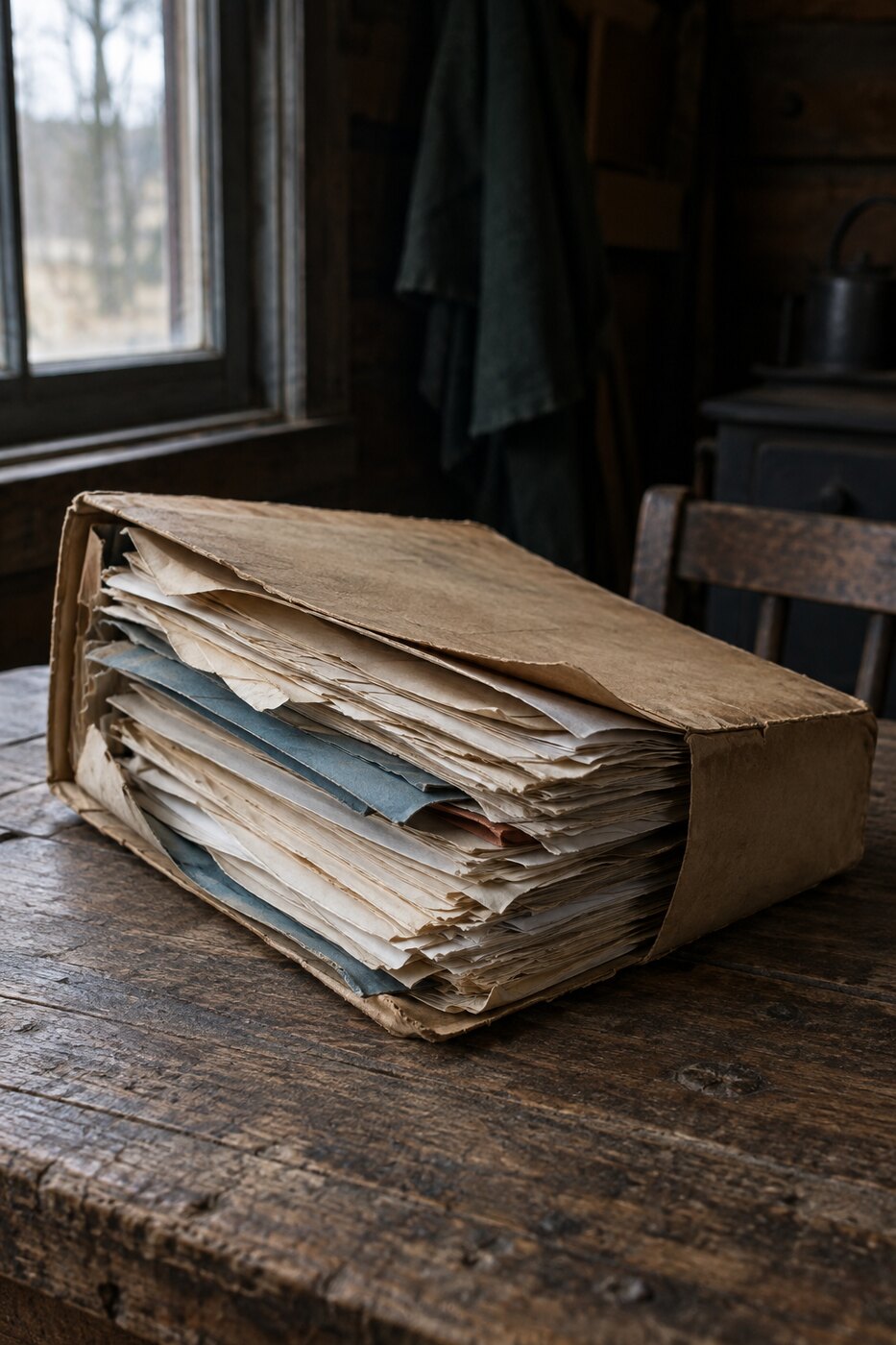
The folder is manila, gone soft at the fold, and the label is in pencil because I did not trust ink to be right. It says Misc. The period is doing work. It means: this is the end of the sorting. Everything past this point could not be sorted, and rather than throw it out I gave it a heading that admits it has no heading.
Every other category in the drawer is a claim. Letters claims a thing is a letter. Roads claims a thing came from moving. The claims are clean and they hold, mostly, until an object arrives that is clearly kept and clearly nothing. Then the claim system fails, and the object goes here, into the folder that makes no claim at all except that I could not let it go.
I turned it out on the table once to see what I had been unable to name. It did not lie flat. Nothing in Misc. lies flat, because flatness is a property of things that belong to a stack, and these belong to no stack.
A key. Small, brass, worn bright on the shoulders. It opens nothing I own. I know that because I tried every lock in the house the day I decided to either use it or discard it, and it turned in none of them, and I discarded it into the folder instead of the bin, which is the whole story of the folder in one motion. A key that opens nothing is not a key. It is a shape that used to be a key. But somewhere it fit, once, and the fitting was real, and the brass remembers the fitting even though the door is gone. That is exactly the kind of testimony the other folders will not take.
A button off a coat that is gone. The coat wore out and went, and I cut the buttons first, out of the habit that says good buttons should not leave with a bad coat, and the other buttons went into the button jar with their kind. This one did not match. It was the spare, sewn inside the hem by the maker, never used, a slightly different shade. So it fit no jar and came here, the only survivor of a coat, a spare for a garment that no longer exists, a solution kept long after the problem wore out.
A scrap of paper with a phone number and no name. I have carried this from folder to folder for years. I cannot throw it out because it was clearly important enough to write down in a hurry, and I cannot file it because I do not know whose it is, and I cannot call it because what would I say. It is pure evidence with the meaning burned off. Somebody, once, needed this number badly enough to grab a pen. The need is gone and the number remains, seven digits of a stranger, filed under the only heading honest enough to hold it.
A washer. A single steel washer that came off something I was taking apart, that I set on the folder for a second and that stayed, and that I now cannot separate from the folder’s contents in my mind, so it lives here, a piece of hardware in an archive of paper, testifying to a repair I cannot reconstruct.
This is the thing about a life. It sheds more evidence than it can file. Every clean category is a fiction that the world keeps violating, and the honest response to the violation is not a better system, it is a folder that says Misc. and means I know. I know these do not go together. I know a key and a button and a stranger’s number and a washer are not a category. I am keeping them anyway, together, precisely because they are the proof that the sorting never finishes, that under every neat archive there is the overflow the archive could not absorb.
I have thought about grading it. Going through Misc. with a firm hand and a bin and sending back to the world the things that no longer testify to anything I can name. I got as far as the key. I held it up, brass worn bright on the shoulders, and I could not do it, because a key that opens nothing is still shaped exactly like the door it lost, and to throw it out would be to agree the door never existed, and I am not prepared to agree to that about a door I cannot even remember.
I swept it all back in with the side of my hand. The key, the odd button, the number, the washer, and the several things I have not mentioned because I could not tell you what they are, only that I kept them. The folder would not close over the heap. It never does. It gapes a half inch, soft at the fold, and I pressed it into the drawer against the resistance of its own contents, and it went in, bulging, pencil label up.
The washer had slid to the front. I can see it through the gap, steel against the manila, a plain round fact from a repair I will never place, holding the folder open just enough that it will not lie flat with the others, which is the only place it has ever agreed to be.