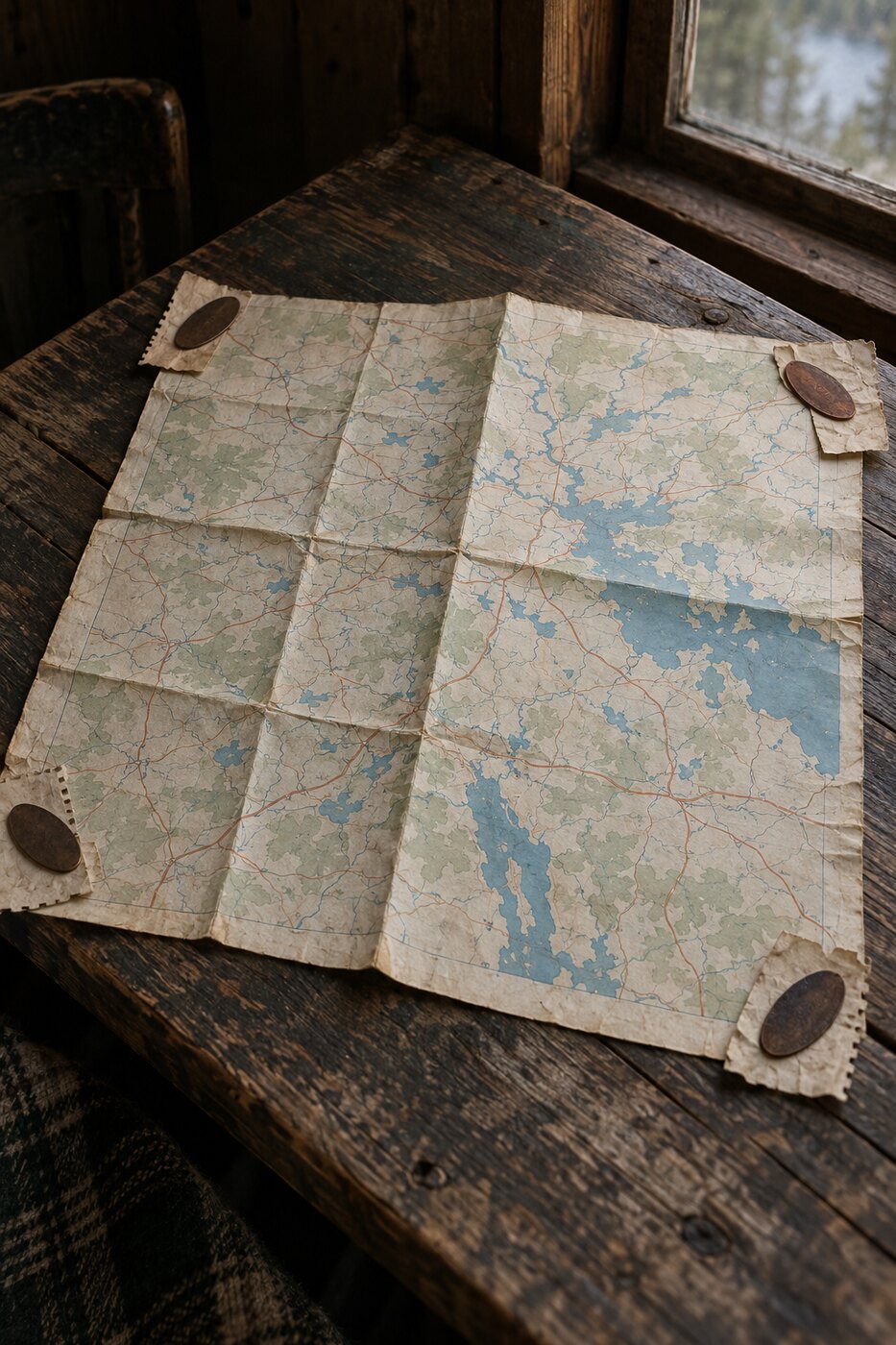
The maps go soft before anything else does. A road map lives in a door pocket and gets opened at the wrong speed by the wrong hand, refolded against its creases, until the paper gives up its stiffness and the folds go furred and one of them tears through at the intersection you needed most. The maps in this drawer are all soft. You can tell how much a road was driven by how ruined its map is.
I keep the maps folded to the panel I used. Not the cover. The panel. Whatever square of the country I was crossing, that is the face-up part, and the fold has trained itself into that square so it opens there by habit, to a stretch of highway with a pencil mark at a turnoff I have long since forgotten the reason for. The mark says I stopped there or meant to. The map does not say why. The map is soft and the reason is gone and the pencil mark remains, insisting on a decision.
A shot glass is in the drawer, wrapped in a sock so it does not chip the pennies. It says a state across the front in a font the state did not choose. I have never drunk from it. It is not for drinking; it is for proving I was in the state, a small heavy certificate of glass, and it does that better than it would hold whiskey. The magnets are near it, a scatter of towns and landmarks, some still with their backing and some not, and I will not sort the working ones from the dead ones because the sorting would rank them and they are not ranked.
The receipts are the honest core again, the way they always are. Toll stubs, a ferry crossing on thermal paper going brown, a parking slip from a lot by a thing I drove a long way to see. These have times on them. The maps say where. The receipts say when, and how much, and the how-much is the part that dates them hardest, prices from a fuel economy that has moved on without telling the paper.
Pressed pennies at the bottom, in a tin so they do not scratch. You put a real cent in the machine with two quarters and crank the wheel and the cent comes out oval and smooth, the year rolled out of it, a landmark stamped over where the face was. It is a coin that has been told to stop being money and start being a place. It cannot be spent now. It is worth one cent of copper and it will never be that cent again, and it is filed here with the maps, defaced on purpose, which is the most deliberate thing in the drawer.
None of this is wanderlust. I want the drawer to be clear on that. There is no romance of the open road in here. There is a windshield full of bug strike and low sun, a fluorescent aisle at a service plaza, a squeegee, a tank, a needle, the friction of getting from a place to a place. The maps went soft from use, not from love. The pennies got flattened because the machine was there and cranking it passed the time while someone else used the bathroom. This is highway memory, which is mostly the memory of being in transit, of the country going by at the speed of the far lane, and it leaves exactly this kind of debris: soft paper, defaced coins, glass that never held a drink.
I laid a new toll stub in the drawer this week, thermal, already curling, the time on it going pale at the edge. I set it under a pressed penny to keep it flat and the penny held it down, oval and heavy, a place pressed over a year. The map I used that day is still in the door pocket, not filed yet, softening, and there is a fresh pencil mark on it at a turnoff whose reason I can already feel starting to go.