A meal leaves paperwork. Nobody tells you this going in. You sit down to eat and you stand up fed, and in between the table quietly generates documents, and most people leave them on the table, which is the correct thing to do. I brought some home. This is the folder of them, creased flat, and it does not smell like food anymore, though it did when it went in.
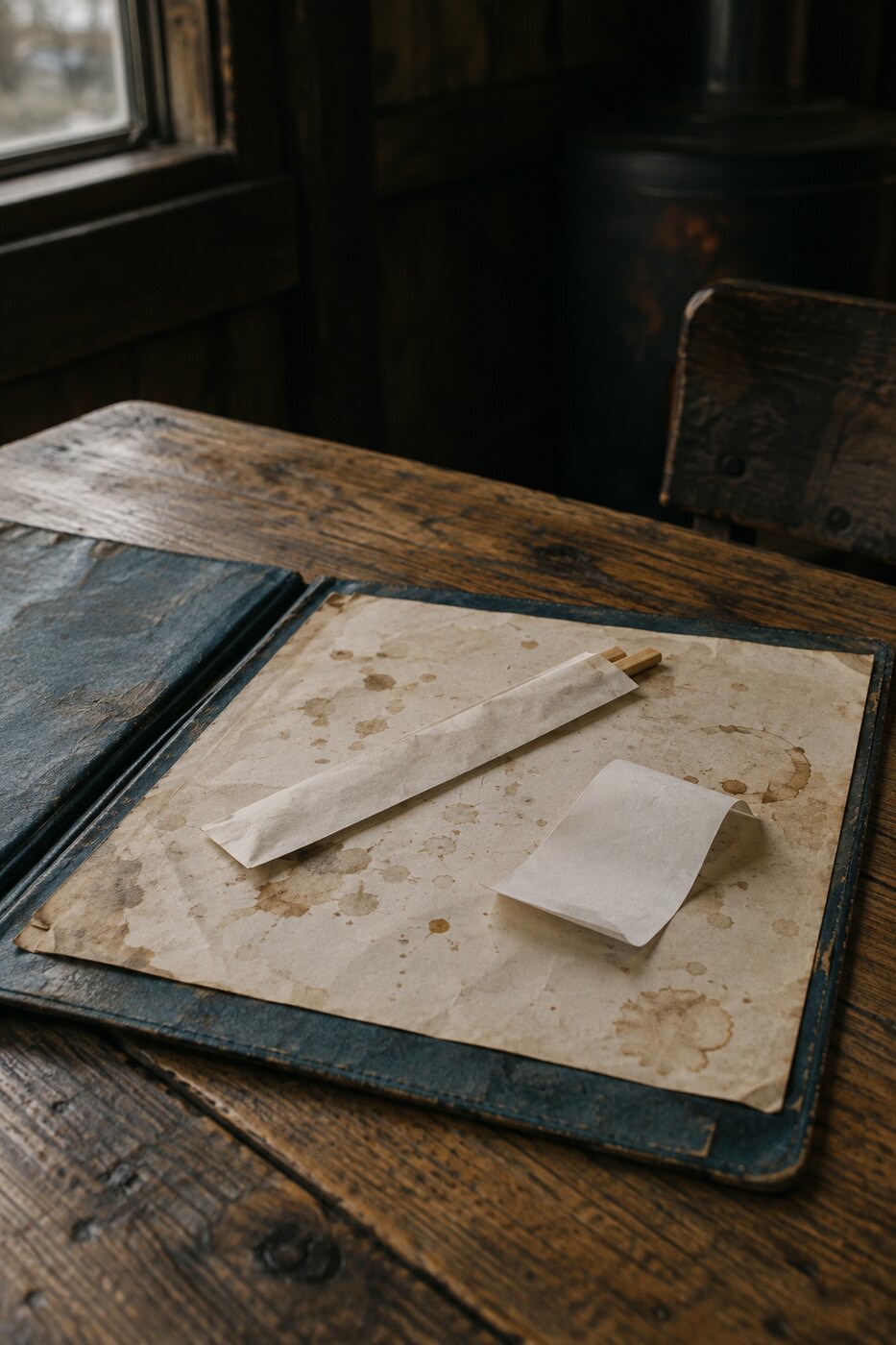
The placemats are the big pages. Paper ones, printed with a map of the county or a maze for a child or the diner’s own drawing of itself looking busier than it was. They came home folded in quarters in a coat pocket and they carry a ring where the water glass sweated, and near the ring a smaller ring where the coffee went, and a grease shadow at the corner where the plate sat. The map is still readable under the stains. You can find the county. You cannot find the meal, which is not on any map.
Napkins do not travel well, so few of them made it, and the ones that did are the sturdier kind, printed at a corner with a name and sometimes a phone number with too few digits to still work. One has a lipstick blot, not mine, that I did not put there and did not wash out, because it was already part of the object when the object became mine to keep. It is someone’s mouth, once, pressed to paper and left. I filed the stranger with the napkin.
Receipts are the spine of the folder. They say what was eaten, which the placemats never do. Two of a thing, one of another, a total, a tip figured in a hurry. The thermal ones are fading, going the pale brown that thermal goes, so the meal is disappearing off its own receipt line by line, and soon a few of them will just say a date and a total for a dinner that no longer lists its dishes. The ink lets the food go first and keeps the money longest, which tells you what the machine thought was important.
There is a pie-case label in here, peeled off the plastic of a rotating case, that says the kind of pie and a price with a decimal in an old place. And a chopstick sleeve, slit down the side where I broke the chopsticks out, flattened, the printing on it a small drawing of a mountain that has nothing to do with the town I ate in. The sleeve held the sticks and the sticks held the food and the food is gone, so the sleeve is two removes from the meal now, and I kept it anyway, filed at two removes.
The folder is not a record of good meals. It is not sorted for quality. Some of these were bad, a rushed bad coffee, a diner where the map was the best thing on the table. Quality was never the filing rule. The rule was: did the meal leave a paper, and did the paper come home with me. Most did not. What is in the folder is the small fraction that survived the coat pocket and the wash-check and the impulse to throw it out, and it survives now as proof that the eating happened — that on such a date, in such a town, at a table with a sweating glass, a person sat and was fed and stood up and left, and the table’s paperwork rode home in a pocket.
I added a placemat last month, folded in quarters, a diner’s own map of itself. It has one ring already, water, drying to a pale outline as I pressed it flat into the folder. The coffee ring had not set yet when I left; it may or may not be there when I open it next. I closed the folder on it damp, which you are not supposed to do, and the damp will find the pages under it, and something on the next placemat down will lift a little where the wet reaches it.