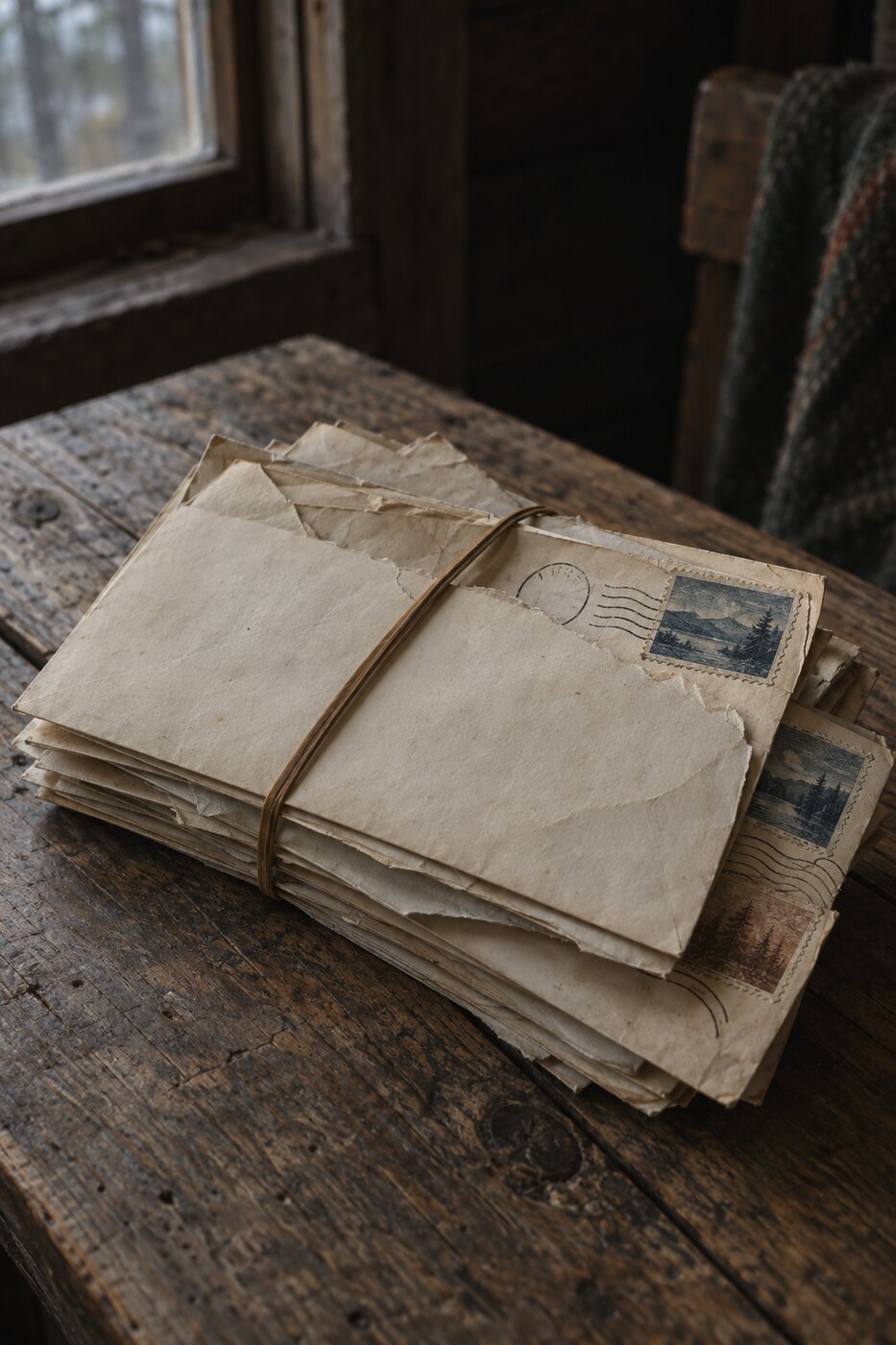
I kept the envelopes. Not always the letters. This confuses people when it comes up, which is rarely, because it is not a thing you volunteer.
The letter is the message, and the message did its work when I read it, and after that the words are in me and the paper is just the paper. But the envelope is the part that traveled. It has the postmark, the ink circle stamped down at some counter in some town on some day, smeared where the machine hit it wet. It has the stamp, licked and stuck by a hand, canceled by a wavy line so it cannot be used again. It has the route printed on it in the language of the post office, which is a language of handling.
I file them by the front, postmark up. The postmarks are the truest thing on them. A town, a date, proof that on that day this paper was in that place, held by a clerk, thrown in a bag, driven or flown to me. The message could be a lie. The postmark cannot. It is a machine’s flat testimony that the object existed at that coordinate at that time, and the machine had no feelings about it, which is why I trust it.
Return addresses in the top left corner, some printed, some in the hand of the person, and the hand is the part I look at. A stamp says a country. A postmark says a town. But the return address in someone’s own writing says a house, a specific door where a specific person sat and wrote their own street from memory because it was their street. Some of those doors are closed now. The address stays open in the corner of the envelope, still directing mail to a place the mail should no longer go.
The weather is on some of them. A corner gone soft and brown where an envelope sat in a wet mailbox before I got to it, the ink of the address blurring outward like it was trying to leave. One has a ring where something set down on it. One went through a machine that ate the corner and taped it back with the post office’s own apologetic tape, we damaged this in handling, which is the post office keeping its own kind of receipt.
A gift tag is in here that does not belong, tucked into an envelope because it came inside one, a small folded card that said whose the gift was and rode along and got kept along. And a note that was tucked into a coat pocket and mailed folded, the crease still sharp, filed with the letters because I did not have a category for a note that was not quite a letter and did not want to make one.
What I kept, then, is the surround. The message left; the surround stayed. And I have come to think the surround is the more honest record, because the message was written to be read a certain way, arranged by the person sending it, and the envelope was not. Nobody arranges a postmark. Nobody poses a weather stain. The handling just happened, town to town, hand to bag to hand, and the envelope came out the far end carrying the marks of a passage nobody meant to document. That is the part I trust to still be telling the truth.
I take the rubber band off the stack sometimes, when I am looking for a date. It has gone brittle and it snaps eventually, and I replace it, and the envelopes stay in their order, postmarks up, a run of towns and days. I read the fronts. I rarely go inside. The insides said their piece.
I banded a new one on last week, a corner already soft from a wet box, the postmark smeared enough that I had to tilt it to the light to read the town. It read, once I found the angle. A town, a date. I set it on top, front up, and rolled the band around the stack, and the band held, this time, though it is drying out and I can feel the give in it, the next snap already somewhere in the rubber, waiting.