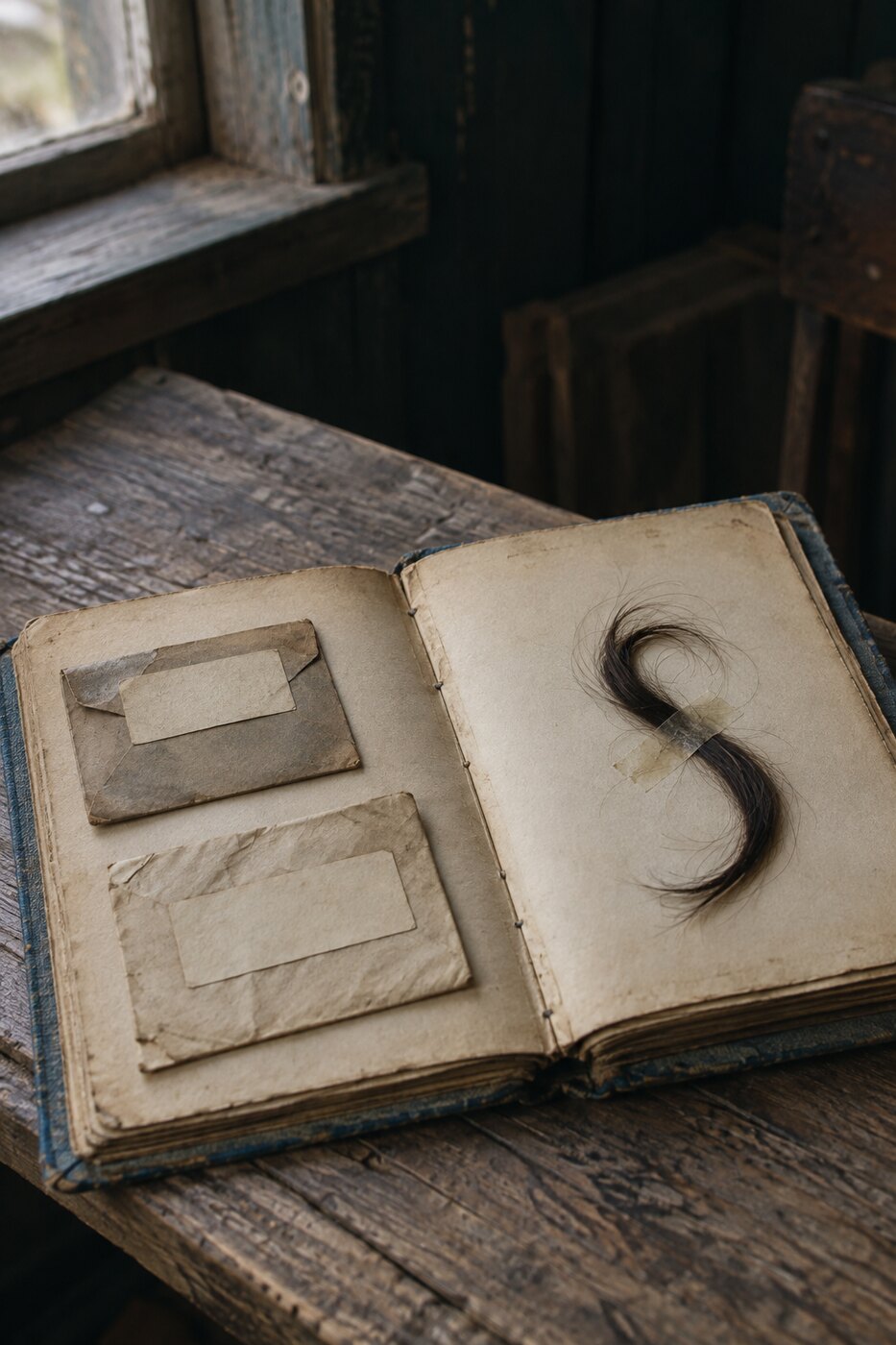
Each haircut gets an envelope. The envelope gets a date. The lock goes inside, taped once at the cut end so it does not spill, and the envelope goes in the album in order. There is no other system. The system is the date and nothing else.
The early pages are pale. Baby hair is not really a colour, it is the absence of the colours that come later, and the first envelopes hold a wisp so fine it has almost no weight, a curl you could lose in a fold of the paper. I taped these carefully. They are the ones most likely to become nothing.
Then the colour arrives, page by page. You cannot see it move any more than you can watch a shadow cross a floor, but lay the envelopes out in a row and the shift is there, undeniable, a slow darkening from the baby wisp to a brown that means business. The album makes visible a change that happened too slowly to watch. That is most of what the album is for.
I labelled them the way you label anything you might need to sort later. Date. Sometimes a word. The clinical part is deliberate. Hair off a head is a strange material to hold, and the strangeness gets worse the longer you look, so I do not look long. I write the date. I tape the cut end. I close the envelope. The restraint is not coldness. The restraint is how you handle a thing that would otherwise handle you.
The tape is its own small record. The early envelopes used a tape that has yellowed and let go, so those locks are loose in their paper now, sliding to one corner when I lift them, and I have learned to open those flat. The later ones hold. You can date the filing almost as well by the tape as by the writing — which glue was in the drawer that year, which roll I was working through. The archive keeps a second calendar in its own adhesive, under the one I wrote down.
Because it is the body’s own stuff, filed. Not a photograph of the body, not a thing the body used — the actual material, keratin that grew out of a person on a schedule and got cut off and kept. It is closer than a receipt. A receipt says you were there. This was you, the outer inch of you, the part the scissors could reach. And it does not decay the way the rest of the body will. It sits in its envelope unchanged while the head it came from goes on changing, so that the album is always more current than the hair in it. Every lock is out of date the moment it is filed.
The colour keeps shifting toward the back of the album, and then, in the last envelopes, it starts to go the other way. Not pale like the baby wisp. A different pale, threaded through the brown, a few strands the colour of nothing again, coming back around. The album has a shape now that it did not have when I started it. It goes out from nothing and it is turning, at the far end, back toward nothing, and the envelopes chart it in the flattest possible language: a date, a lock, a fold.
I do not show anyone the album. It is not for showing. It is for the fact of it — that the material passed through my hands on all those dates and I did not sweep it up. Most people sweep it up. It is the most ordinary thing to sweep up, hair on a floor, the definition of what gets thrown away. I taped it to envelopes instead, and I cannot fully tell you why, except that it kept being me, cut off and lying there, and the broom felt like a decision I did not have the standing to make.
I added an envelope last month. Dated it. Taped the cut end. The lock in it has more of the nothing-colour strands than the one before, enough that I noticed while I was taping, though I did not stop to count them. I wrote the date and closed it and slid it in at the back, where the album is still open, still taking pages, the tape holding, the colour on its way to somewhere I have already seen it go once.