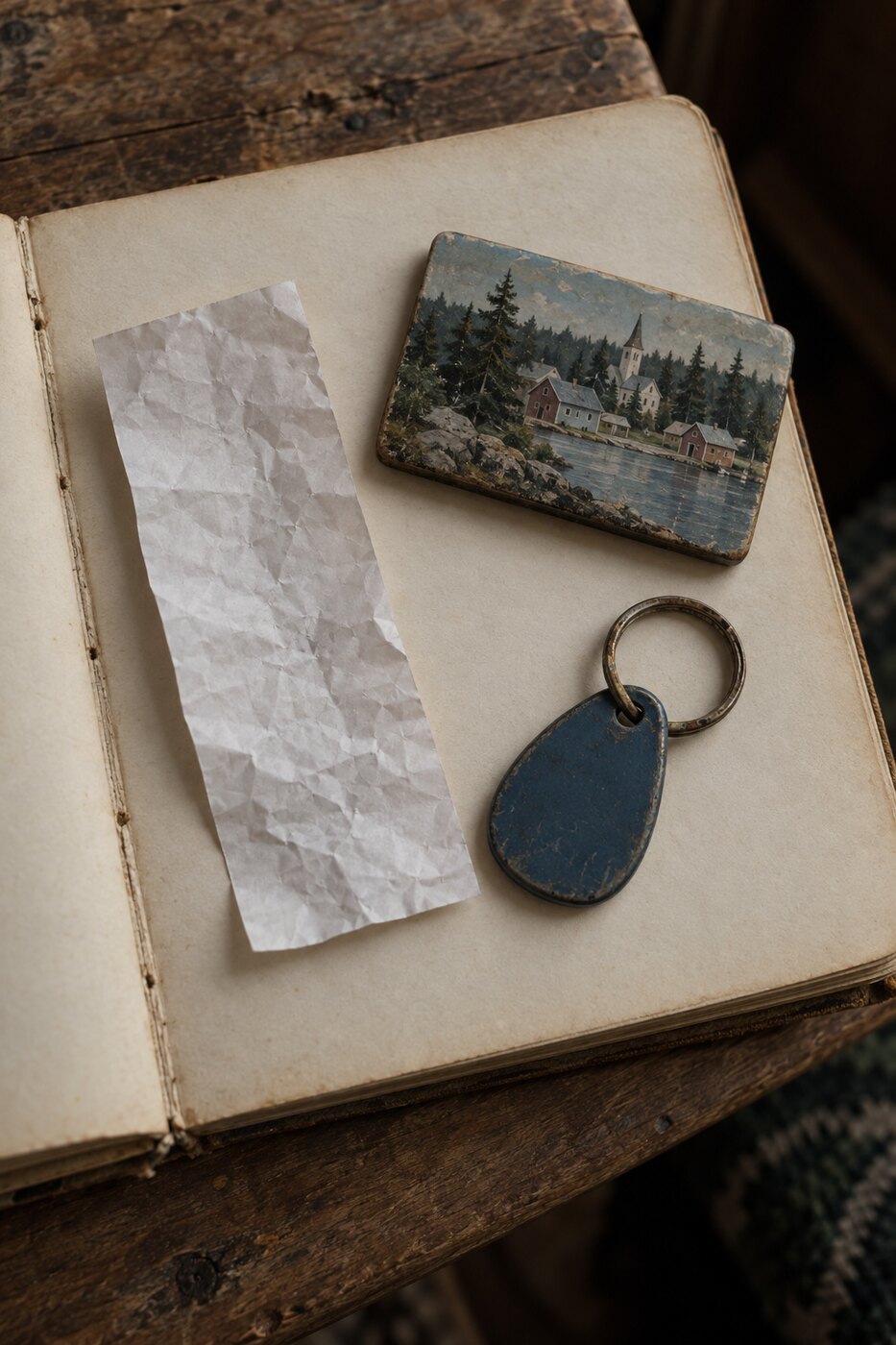
The album is thin because the stops were short. A page can hold a whole town if the town was only a pump and a bathroom key on a hubcap and eleven minutes of your life.
The pump receipts are first, in a sleeve, because they are the truest of it. Gallons, price, a town name, a time stamp in the middle of some afternoon. I never chose these towns. The tank chose them. The needle came down past a quarter somewhere between two places I did want to be, and the next name on the road became the name on the receipt. Geography by accident. I could show you the towns I have been to and never seen, a list built entirely by fuel range.
The magnets came from the racks by the register, the ones that spin. A town in raised letters over a picture of a thing the town is known for, which I did not stay to look at. A waterfall I did not walk to. A big chair I did not sit in. A fish. I bought the magnet in the four minutes the pump was running, because buying it was faster than deciding not to, and because the rack was there and the town was scrolling past and this was the only handshake I was going to get with the place.
One keychain, a town enamel gone chipped on a split ring that never held a key. It rode loose in the door pocket for a year, clicking, before I filed it. The enamel names a place I could not find again on purpose if I tried. I would have to run the tank down to a quarter in the right stretch of nowhere and let the needle take me back.
There is a matchbook too, from a stop that still had a diner attached to the pumps, the striker rough down one edge and the matches never struck. It says the town and a phone number that has since lost a digit somewhere in the rewiring of the country. I did not smoke and I did not eat there. I took the matchbook off a dish by the register because it was free and it named the place, and free naming is the whole economy of a gas stop, the rack and the dish and the bin of them by the door.
This is not travel. I want to be clear with the drawer about that. Travel is when the place is the point. This was the place being in the way of the point, the point being somewhere else, always somewhere else, and the town being the friction between here and there — a pump, a fluorescent aisle, a windshield I squeegeed with gray water and a squeegee worn to the frame. The bugs on the glass were more local than I was. They at least had lived there.
And yet I kept the proof. That is the part I turn over. If the town did not matter, why is it filed? Because it did happen. I was there, briefly, counted by the pump, charged for the fuel, present in the town’s day for eleven minutes as a car and a bladder and a transaction. The receipt insists on it. On such an afternoon a person stood at this pump in this town and put in this many gallons. The magnet insists harder. Someone in this town watched me buy the waterfall I would not walk to. The keychain just clicks.
I think what I am keeping is evidence of the in-between, which usually keeps no evidence. The destinations I remember. Nobody has to file the place they meant to go. It is the accidental towns that vanish, the ones you pass through with your mind already at the far end of the drive, and so those are the ones I pinned down, on the theory that the unremarkable needs the help.
I laid a new receipt in the sleeve last week. A town I have already lost the name of, though it is right there in gray thermal print, going pale. Gallons, price, time. I could not tell you one building in it. The magnet from that stop is a moose. There is no moose. There was a rack and a pump and a squeegee and then the road again, and now there is a moose in the album, filed under a place I only stopped for gas, chipping already at the corner where the ring rubs.