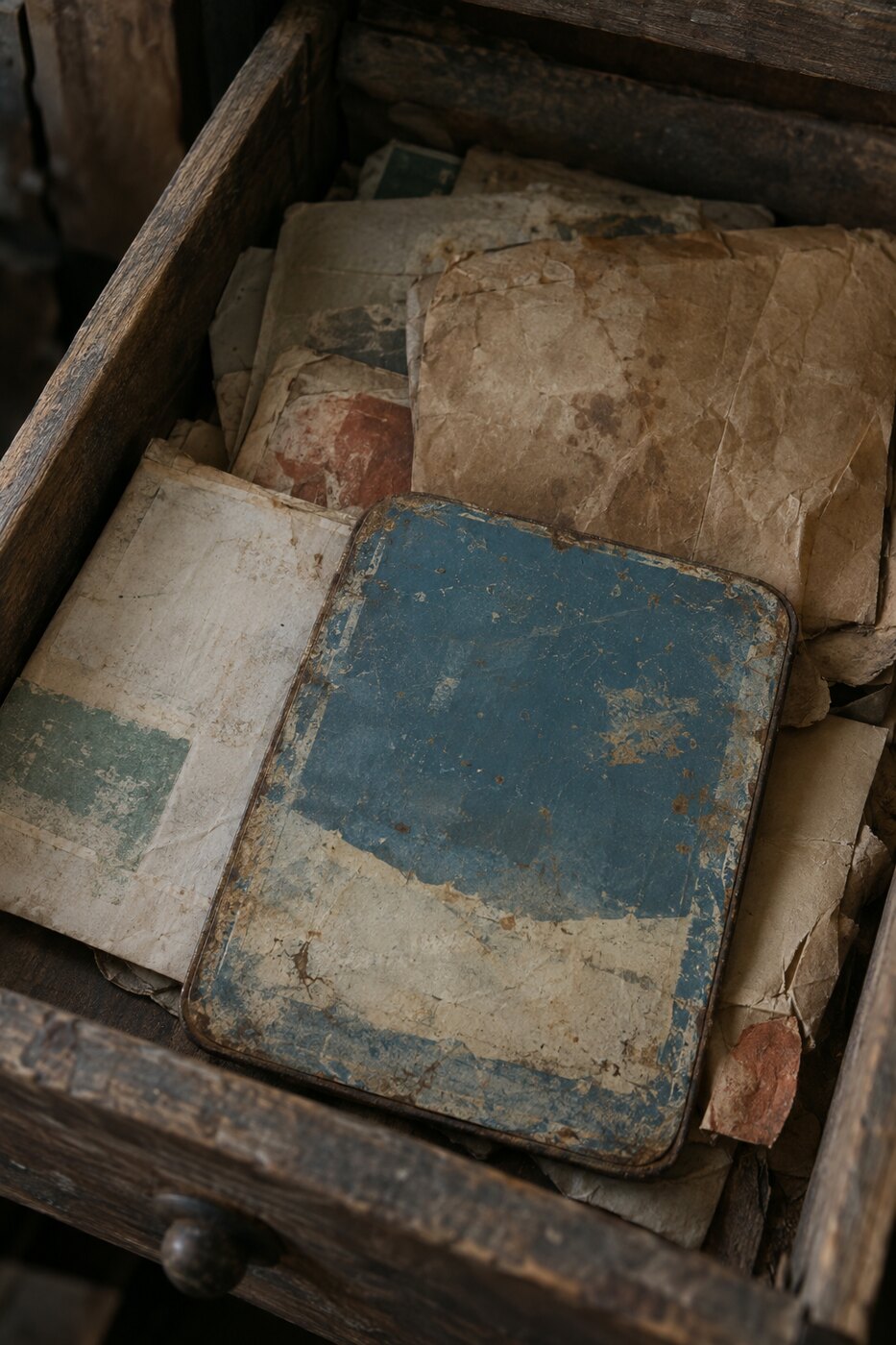
The drawer sticks on the left runner, so you have to pull it square or it binds. Inside is the packaging that outlived the food. Nothing in here fed anyone. All of it was once the outside of something that did.
The flour-bag labels are the oldest. Paper, not the woven cotton the very old ones had, but old enough that the paste has let go at the corners and they lie flat now without curling. The flour is decades of loaves ago. What is left is the printed pound weight and a mill town and a picture of wheat that no longer stands anywhere. I flattened them under a board and they took the flatness and kept it.
Butcher paper folds differently than it wraps. Wrapped, it holds a shape and a cold and a faint red where the meat leaned on it. Folded and filed, it goes soft along the creases, and the red goes brown, a stain the shape of a cut that was eaten so long ago I could not tell you the animal. The grease made a translucent window in the paper. Hold it to the light and the window still passes light, the fat of some Sunday still in the fiber, doing the one thing it can still do.
Tea-tin fronts I cut off with scissors when the tin went to hold screws. The tin is more useful empty; the front was the part that said what it was. So the tin is out in the shop full of hardware and the label is in here, saying tea, pointing at a tin that no longer agrees.
Coffee bags are the loudest thing in the drawer. Foil-lined, they never quite give up the smell. Flattened, the air pressed out, folded to a square, and still when you open the drawer there is a low brown note of coffee under everything else, coming off bags that held their last grounds years back. The smell is the label the printing can’t manage. It says coffee better than the word does, and it is fading slower than I expected, which I did not expect to mind.
Jar labels I soaked off whole when I wanted the jar. Pickle, jam, a mustard with a farm on it. They came off wet and I dried them on the window glass, where they stuck flat until dry and then fell into my hand stiff as a leaf. The paste behind them was still faintly sticky when they came free, and one or two lifted a skin of the glass’s dust with them, so they are grimed on the back in a way that dates them without a date. The jars went on to hold bread tags and buttons and nails. The labels went in here, a small stack of what the jars used to be willing to admit.
The waxed paper is the frailest of it. It came off a stick of something and held the print of the block for a while, a greased rectangle of translucence, and it does not fold so much as crumple, so I never got it flat. It lies in the drawer half crushed, a wrinkle of near-glass that has gone brittle enough to crack if you press it, keeping nothing now but the memory of having been cold.
Bread clips are in a corner of the drawer in their own small envelope, the notched plastic squares, because they belong to two categories and I could not decide. They wrapped nothing. They only closed. But they were the outside of the food long enough to count, so here they are, filed under a heading they only half fit.
None of this decorates anything. You could not show it to a guest. It is not that kind of keeping. It is that every one of these was the boundary between the food and the world, the last thing the food touched before it became a meal and then became gone, and the boundary is the only part that stayed. The meal is a closed fact. The wrapper is an open one. It still says the pound weight, the mill, the roast, the farm. It still passes light through the grease window. It still smells like coffee.
I pulled the drawer square this morning, added a bag of flour’s paper label to the flat stack, and pressed the drawer shut. It bound on the left runner, half an inch out, the way it always does, and I left it there, not quite closed, the brown note of coffee coming through the gap.