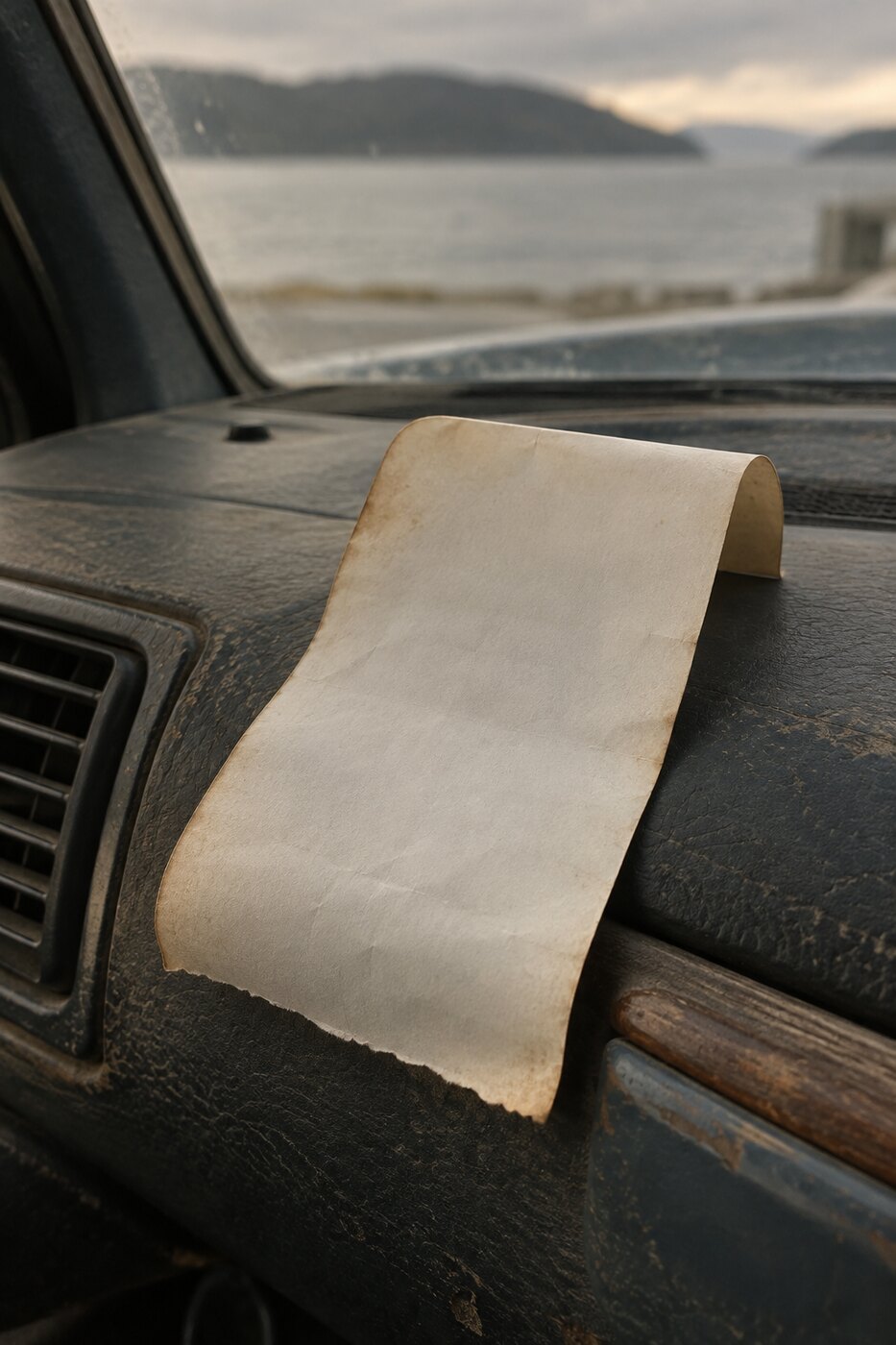
The receipt was thermal paper, the kind that comes off the roll warm and starts dying the moment it meets the air. It had curled into a loose tube on the dash by the time we docked, and I flattened it under my thumb against the vinyl to read it.
Ferry. Vehicle under twenty feet, one. Passengers, so many. A time in the morning. A dollar figure that has since stopped meaning what it meant. The name of the crossing, which I already knew, printed there anyway as if the machine needed to tell me where I was.
The crossing itself is not a thing you can keep. It was water under a steel deck, a vibration in the floor plates, the smell of diesel and cold salt coming up the stairwell. The boat went from one shore to another shore and the water closed behind it and left nothing. That is what water does. There is no seam in it afterward. You cannot go back and find the line the hull drew. The trip happened and the trip erased its own road as it went.
The paper is the part that did not erase. Or has not yet.
I put it in the glovebox first, under the manual, where receipts go to be forgotten. It rode there for a while. Every so often I opened the box for the registration and the ferry receipt would slide out with it, browner each time, the ink going the pale brown of weak tea. Thermal print does that. It is not made to last. It is made to be legible at the counter and then to fade, so that the record lives in the company’s ledger and not in your hand. The company keeps the real proof. What you get is a copy printed in a medium designed to give up.
That is the part I could not throw away. The paper is trying to forget the crossing on a schedule. It is losing the numbers a little at a time, from the edges in, the way a bruise leaves. I have watched the dollar figure go soft. The name of the crossing is still there, darker than the rest, because it was printed heavier or because it sat out of the light, I don’t know which. The time in the morning is nearly gone. Soon it will be a blank slip that once said something, a receipt for a crossing you have to take on faith.
I moved it to the folder eventually. Flattened it between two heavier papers so the curl would train out of it, and it mostly did, though one corner still lifts. Filed under the trips, with the toll stubs and the one pressed penny that came out oval. Not because the day was special. It was not. It was a car on a boat on a gray morning, a thing thousands of cars do, a line item. That is exactly the point. The receipt does not certify a beautiful day. It certifies a counted one. The vehicle was measured, under twenty feet, and tallied, one of a deckful, and charged, and this slip is the tally’s shadow.
I have wondered what it is I am holding onto. It is not the view from the deck, which I have and don’t need paper for. It is the fact of having been counted. Somewhere there was a manifest. The boat could not leave until it knew its load, and the load included us, our weight and our fare and our place in the count, and for the length of the crossing we were an entry in a document that had to balance. The receipt is my end of that. Proof that on such a morning the car was on the water and the water knew its number.
The ink keeps leaving. That is the trouble with keeping a thing whose whole medium is designed to disappear. I flattened it, I filed it, I did everything you do to preserve a paper, and none of it matters, because the print is chemical and the chemistry is finished with it. In a few more years I will have a blank curl of thermal stock that I can prove nothing with. I will know it is the ferry receipt because it is filed under the ferry, in my hand, in my order. The paper will testify by being where I put it, saying nothing, having said it already and let it fade.
I took it out again last week, to see how much was left. The vehicle line is holding. Under twenty feet, one. The rest is going. I held it up to the window and the low sun came through the thin paper and lit it from behind, and I could see, faint, the ghost of the numbers the machine had burned in that morning, browner than the paper, sinking.
Then I put it back between its two heavy neighbors, corner still lifting, and closed the folder. It will go on fading in the dark, which is slower than in the light, but not stopped. Nothing stops it. I only made it take longer.
The crossing is gone. The water closed. The receipt is the width of a boat and getting harder to read, and it says, still, that the car was counted on the morning it went over.