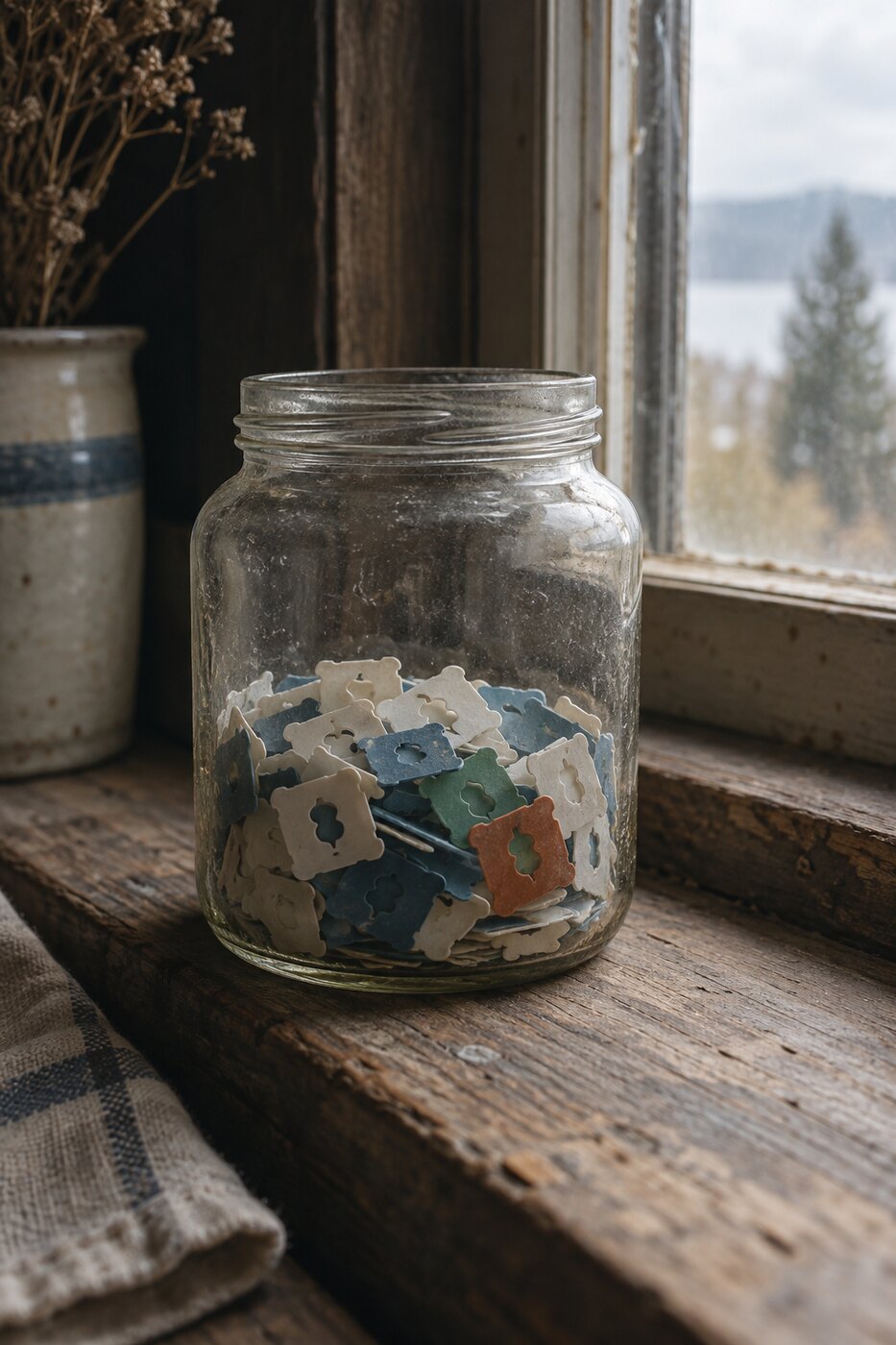
The jar had been a pickle jar first. The smell never fully left the lid, a faint brine under the rubber ring, so I knew what it used to hold even after it stopped holding it. Now it held bread tags. Two hundred of them, maybe more. I never counted. Counting would have made it a collection, and it was not that.
A bread tag is a small notched square of plastic. It pinches the twisted neck of a bag shut, and most people thumb it off and drop it and never think of it again. I thumbed mine off the same way. Then I flattened the pinch back open with a thumbnail and set the tag on the windowsill above the sink, where it stayed until there were enough of them to bother moving. Then they went in the jar.
They are not the same. That is the first thing you learn if you keep them. There is a bakery logic to the colour, a code the store trusts you not to read. Blue for one day of the week, yellow for another, and so on around a wheel nobody hands you. The stockers know it. The tag knows it. You are supposed to only know this bag is soft or this bag is not, and to throw the rest of the knowledge away with the tag.
Some of them carry a date, stamped small in the plastic where the print die bit down. A best-by that has long since gone by. The bread that wore this one was stale years ago, then gone, eaten across a table on a morning I could not reconstruct if you paid me. The tag does not care that I can’t. It still says the date. It still holds the shape of the neck it pinched, a faint oval memory pressed into the notch, softer than when it was new but there.
I turned a handful of them out into my palm once, to see. They had gone slightly greasy from the air over the stove, the way plastic does in a kitchen, taking on a film you only notice when you touch a hundred at once. They clicked against each other, a dry small sound like fingernails. Blue, blue, yellow, a white one gone cream. One had a corner snapped off from being worked too hard against a stiff bag. I set that one apart, then put it back. Sorting felt like a thing I would regret.
What I keep, I keep because it keeps saying something after the thing it belonged to has stopped. The loaf is a fact that has closed. You cannot check it. But the tag was there for the closing of the bag, every night, my hand doing the twist and the pinch in the near-dark of a kitchen winding down, and the tag came away with the residue of that on it. Not a feeling. A film. The oval. The date. Evidence that the twisting happened, over and over, for years, and that someone bothered.
People throw these away because they are the part that is not the bread. That is exactly why I did not. The bread was the point and the bread is gone. What is left is the part that was never the point, the closure, the small manufactured tab whose whole job was to be undone and discarded. It did its job. It got undone. And then it did not get discarded, which is a job nobody assigns it and which it turns out to be good at.
I moved the jar once, cleaning the sill. The tags shifted inside with a slither and a click, settling lower, and a little drift of plastic dust had gathered at the bottom of the glass, ground off the edges by years of small collisions. Pale grit, almost nothing. The jar was making powder out of the tags the way water makes sand out of stone, slowly, from the friction of them being kept together. I had not known that keeping a thing could also be a way of wearing it down.
I thought about pouring them out and starting the count. I got as far as tipping the jar over a dish towel. The first dozen slid out and lay there, notched squares in no order, some face up with their dates, some face down, and I could not find a reason to number them that was better than the reason not to. A number would be a claim. Two hundred and eleven bread tags. It would sound like I had lost something. What I had was a jar that testified: the bags came home, the bags got opened, the bags got closed, the bread got eaten, and every single night the small last gesture of the day was a twist and a pinch that nobody would ever ask me about.
I swept them back in with the side of my hand. One skidded off the counter and went under the stove, where I could not reach it, and I left it there. It is under there now, blue or yellow, dated some year, holding the shape of a bag that is gone, in the dark with the other things that go under a stove and stay.
The jar went back on the sill. In the right light the tags glow a little, a low stained-glass of nothing, and you can see the drift of pale dust at the bottom where they are quietly grinding each other down.
I still take them off the bags one at a time. I still flatten the pinch with my thumbnail. There is a new one on the sill this morning, cream-white, no date I can find, waiting for enough of its kind to be worth the walk to the jar.