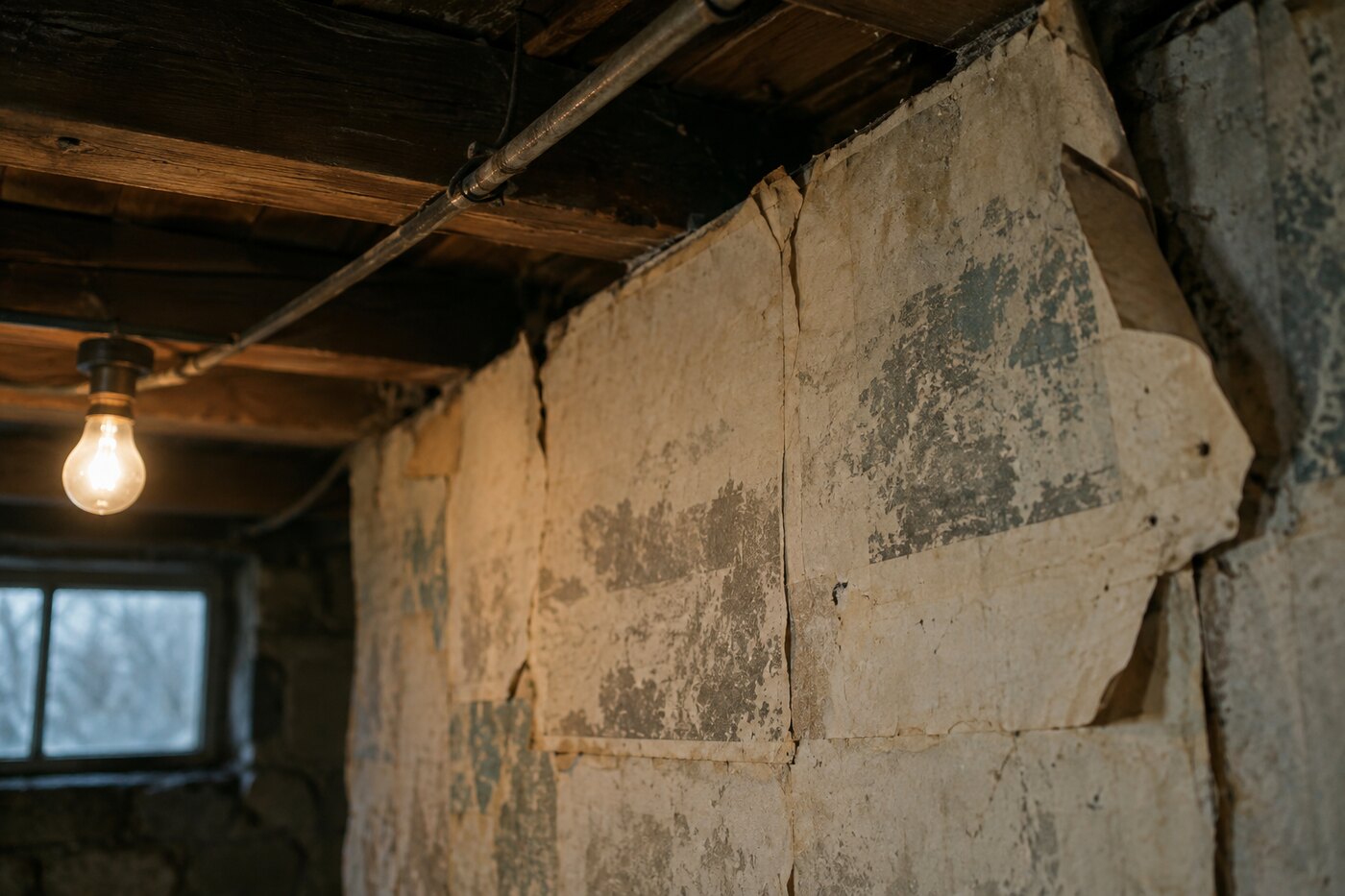
The oldest sheets are the ones near the joists. They went up first, when the wall was mostly bare block and I was still deciding whether this was a thing I did or a thing I had done once. That was several winters ago. They have been up there through all of them, close to the ceiling where the heat pools and the one high window lets in an afternoon hour of real light, and they have taken on a color. Yellow, going toward tan at the edges. The color of old tape, of a paperback left in a car.
I did not set out to age anything. The aging happened while I was looking at the newer sheets down below. But the top of the wall has become a kind of record, and the record is legible in the paper more than in the words. The words are almost gone. The toner up there has faded to a soft gray and then flaked, so a scam that once shouted about my account now whispers it in patches, whole lines dropped out where the ink let go and drifted down as dust. You can still tell what kind of lie it was. Not what it said exactly. The shape of it. The bold line where the number went. The blank rectangle where the button used to be.
The paper has gone brittle up there. Down low the sheets are soft, damp from the slab, and they lie flat and heavy. Up top it is the opposite. The heat has dried them past softness into something like a dead leaf. The corners curl hard and stay curled, and when I brushed one last week reaching for a cobweb, it did not bend. It cracked. A triangle of a sheet, a corner that had once been urgent about something, snapped off clean and fell, and it was so light it did not drop so much as tip, sliding down the face of the wall past all the newer years to the floor.
I picked it up. It was the corner of a message about a fortune, or a fine, or a final notice — the toner was too far gone to say. It weighed nothing. It had the stiffness of a communion wafer and the color of a nicotine ceiling, and it had a faint smell when I brought it close, not of anything, just of old paper, of dust that had been dust a long time. I did not know where to put it. It had come off the wall but it was still, somehow, of the wall. I set it on the workbench. It is still there.
This is what I did not expect: that doing the weird thing long enough would give it sediment. The wall is not flat in time. It is layered. Newest at the bottom by the floor, pale and soft and damp, this winter’s fresh gray sheets still stiff and legible and loud. Then a middle band, a year or two back, the paper settling, the toner holding, the corners just beginning to lift. Then the top, the deep years, yellow and brittle and quiet, the words faded to shapes, the whole loud panic of them cooked out by heat and time into a color and a texture and nothing else.
I read the bottom of the wall. I do not read the top anymore. There is nothing left up there to read. But I look at it, the way you look at a waterline on a piling, at the ring inside an old pot. It tells me how long. Several winters of somebody, somewhere, being sure they had selected me. Several winters of the same twenty-four hours running out over and over and never once running out. The urgency did not survive. The paper did, mostly, and the paper is going the way paper goes, up the wall, from white to gray to yellow to the brown crumble at the very top where it meets the joist and the dust of it collects on the ledge of the block.
The boiler ran while I stood there. The high window went gray, then dark. The bulb took over and made the yellow sheets yellower. Up at the top, along the joist, a hairline of curled paper had lifted from the block, held by a single rusted tack, and behind it the old crack of foundation the whole wall had started out to cover was showing through again, a thin dark line the width of a pin, letting in the cold.