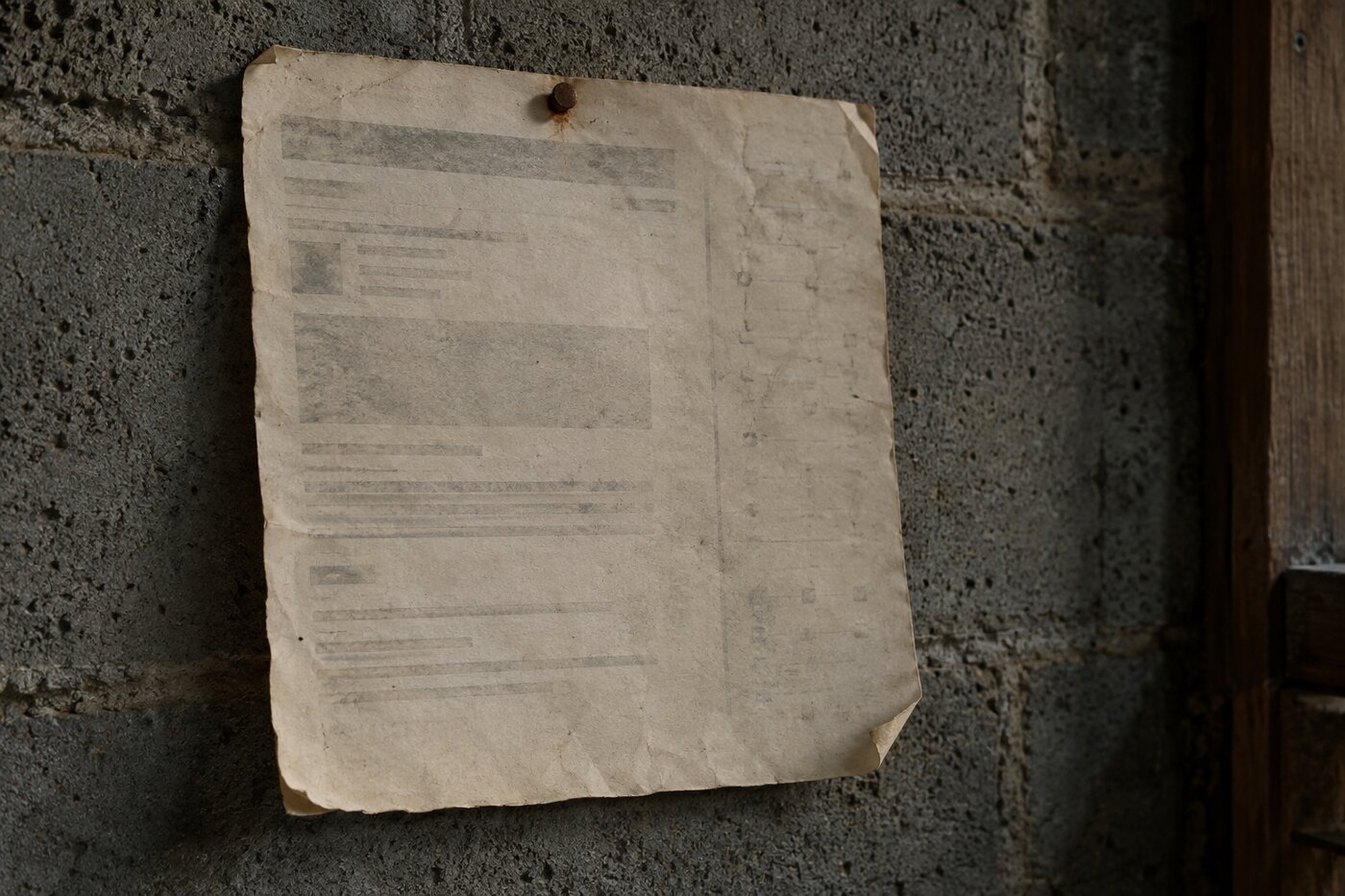
I print on the blank sides of things. The paper does not come clean and new. It comes from the drawer where the used sheets go, printed on one face and empty on the other, and I run it through with the empty face up. So every sheet on the wall has two things on it. The lie I put there, and whatever was there first.
You see the first thing as a ghost. Toner and ink do not sit thick enough to hide what is behind them, and the basement bulb throws a flat light that finds the faint gray shape bleeding through from the far side. A miracle cure for the joints, printed over the ghost of a child’s long division, the little penciled columns showing through the promise. A warning about my compromised password, backed by the pale grid of a ruled notebook and half a grocery list. Milk. Onions. Something crossed out. A message from a stranger who had chosen me, of all people, to receive her fortune, printed over the reversed ghost of a warranty card for a toaster.
The ghosts are honest. That is the difference I keep noticing and keep not saying. The homework was real homework. Somebody did the division and got it right or got it wrong and moved on. The grocery list was a real errand, milk and onions, a real Tuesday. The warranty covered a real toaster that browned real bread. The paper carried a true thing once. It did its work in the world and got used up and came to the drawer honestly, one life spent.
The lie on the other side never had a life. It was written once, if it was written at all, and then sent out by the hundred thousand, the same false widow to a hundred thousand inboxes, the same suspended account, the same twenty-four hours running out simultaneously in a hundred thousand places for people who were all, apparently, uniquely selected. The message is reuse of a different kind. Not a thing used up and passed on, but a thing that was never once and always many, copied without cost, arriving worn out on the day it was born.
So the sheets are doubled. Paper honestly reused, carrying a lie endlessly reused, the two of them held together by one pushpin against the cold block. I did not plan the meeting. It is just what happens when you print junk on the back of used paper. But I lean in under the bulb sometimes and read them together, the ghost and the lie, the long division and the miracle cure, and they seem to belong on the same sheet more than either belongs to me.
The recycled stock is thinner than fresh paper. It has been through the mill more times. It takes the damp faster and goes soft sooner, and it lets more of the ghost through, so the older recycled sheets are the ones where you can almost read both sides at once. A whole faint conversation between a math worksheet and a compromised password, neither one aware of the other, both of them fading at their own speed.
I keep printing this way partly to save paper and partly because the wall would not be the wall if the pages were clean. A clean sheet is only the lie. A used sheet is the lie and a life, and the life is the part that holds. When the toner flakes off in gray dust, and it does, up near the ceiling where the heat gets at it, the ghost stays longer than the lie does. The scam goes first. The long division underneath it is still there when the promise has powdered away.
I put up four this week. A lottery I had won in a country I have never entered, over the ghost of a field trip permission slip. A debt I did not owe, over a recipe for something with cabbage. A love from a woman I had never met, over the reversed shape of an oil-change reminder, five thousand miles or three months, whichever came first. I pinned them low, on the last bare run of block by the floor, and the fresh recycled paper was already soft in my fingers, already letting its two faces show at once.
The bulb hung close. Behind the newest sheet, faint and backward through the thin stock, the oil-change reminder said the mileage was almost up.