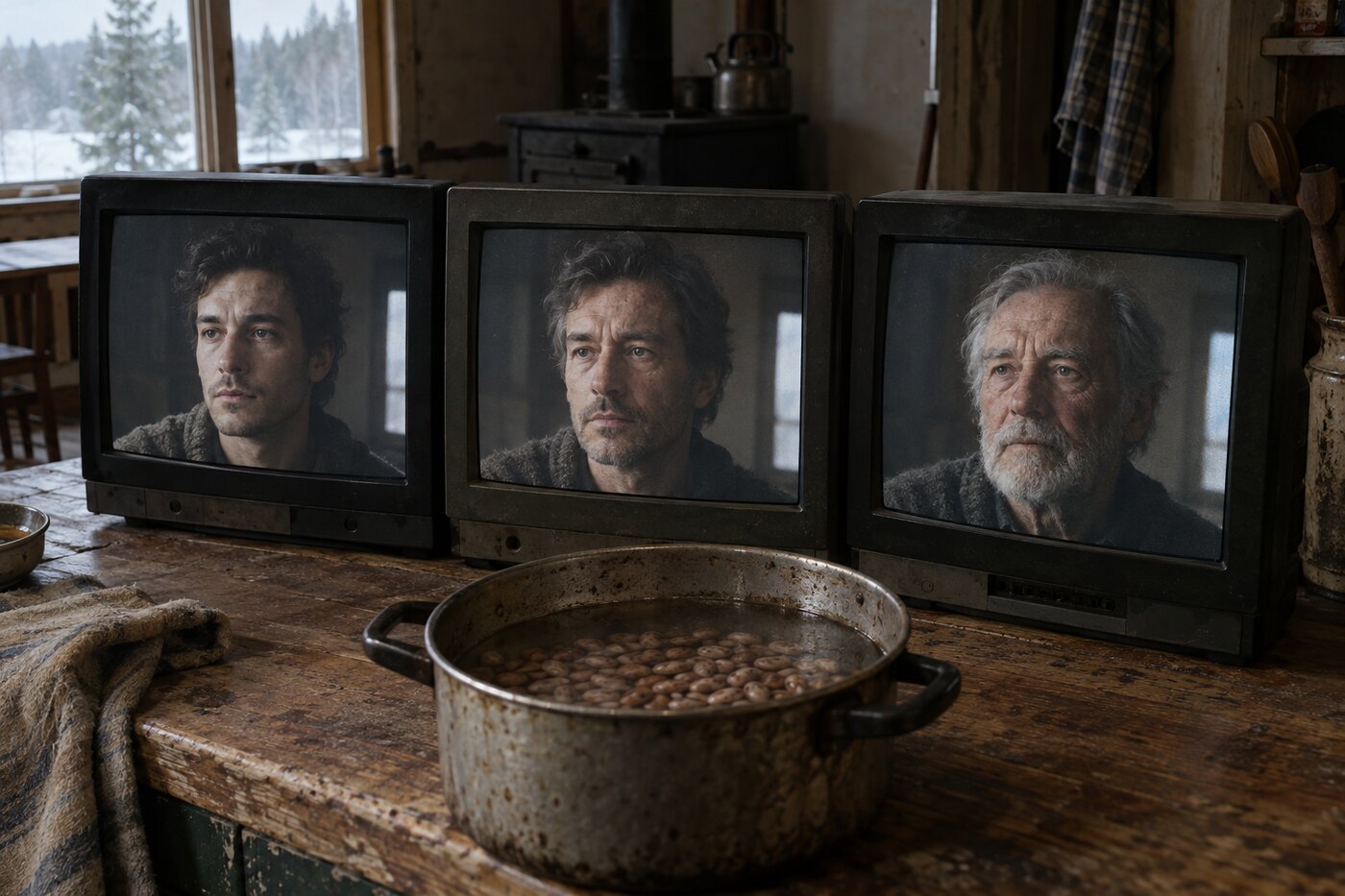
The beans went in to soak the night before. You forget how much they drink. A cup of hard dry navy beans in a bowl of water, and by morning they have swelled up soft and doubled and pushed against the sides, and the water has gone cloudy and thick with what came off them. You pour that off. You rinse them in the colander and they knock against the plastic, a dull wooden sound, nothing like the hard rattle they made going in.
Then the pot. Water, the beans, an onion halved, whatever piece of pork is in the bottom of the drawer. It comes up to a boil and then down to almost nothing, a surface that barely moves, and it sits like that for hours. Beans are not a thing you cook. They are a thing you keep company with while they cook themselves. You are in the room, is all. You check the water. You are present at it.
So I was present at it, and the wall was running, and on three of the screens it happened to be the same man.
Not the same scene. The screens never agree. But the same face, three times, at three different distances from the end of himself. On the left he was young, or younger, the jaw still clean, the grin still doing all the work. In the middle he had thickened. Gray coming in at the sides, the grin gone flatter, more teeth in it and less light. On the right he was old, or the show’s idea of old, heavy in the jowl, the eyes gone small and patient the way eyes do when a man has learned exactly how much he can take from you.
All three of him were arguing. Different arguments, different rooms, different years, but the hands moved the same. The finger came up the same. I stood at the counter with the wooden spoon and watched one man dispute himself across a decade and a half, none of the three willing to give ground, and the beans ticked over so quiet you had to lean in to hear them.
I did not follow what any of the three was saying. I stopped following the words years ago. The words are not the point and were never the point. What came across the room was the shape of the thing, a man holding a room by insisting, and the fact of it happening three times at once, the same insistence wearing three ages of the same face. It should have been strange. Standing there over the pot I found it was not strange at all. It was the most ordinary thing in the house. Of course a man is three ages at once. Of course they argue. You carry every version of yourself into the kitchen and none of them agree about anything and you feed all of them the same beans.
The pot needed water around the second hour. Beans will drink from the pot the way they drank from the bowl, quietly, faster than you expect, and if you turn your back too long the top layer goes dry and splits its skin. I added a cup from the kettle. The surface came back up. The steam went across the room and hit the wall and for a second the middle screen, the gray one, fogged very slightly at the bottom edge, the man’s argument going soft at the knees behind a film of my supper.
He came back clear when the steam passed. He always does. The wall does not hold anything I put on it. The heat off the beans, the smell off the onion, the water in the air — it drifts over and touches the glass and slides off and the men keep arguing exactly as hard as before, untouched, three ages deep, in an evening that is not this evening.
That is the rhyme I built the wall to get. Not the show. The doubling. Standing over a slow pot the way I stood over slow pots years ago, with a room full of the same trouble running behind me, and the trouble not aging while I age, or aging sideways, all its years available at once on a board on the wall. My hands are older than the young one on the left screen. They are younger than the old one on the right. I am somewhere in the middle panel with the gray coming in, keeping company with a pot, present at something that cooks itself.
The beans came soft near the third hour. You know by taking one out and pressing it against the roof of your mouth with your tongue. It should give with no argument. This one gave. The skin came away and the inside had gone to that pale floury softness that means done, or close enough to done that the rest is just the pot cooling.
I turned off the heat. The three men kept on. I ladled a bowl and sat where I could not see the wall, only hear it, which is how I have always taken it. There was a single hard bean left at the bottom of the pot, one that never gave, still holding its shape in the cooling water, and I left it there rather than fish it out, because the water was too hot yet to reach into and I had already decided I was done cooking.