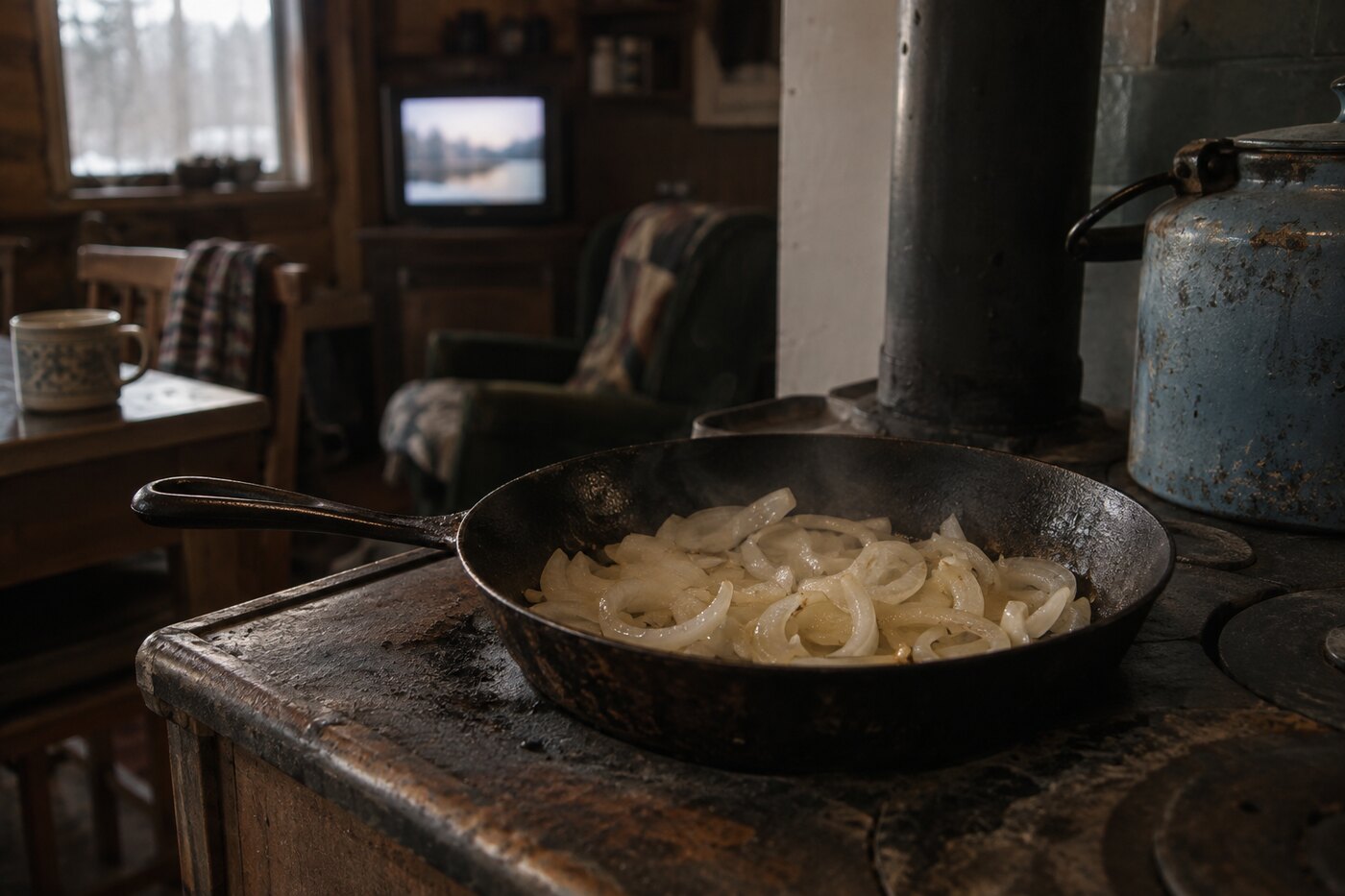
It starts with the onion, not the wall. You have to cut it first. A yellow onion, dry skin that comes away in papery scraps and clings to your wrist. Root end left on so it holds together while you slice. Then the halves down flat and the knife going through, and the smell arriving before the pan is even hot, sharp enough to lift water into your eyes over nothing.
I did this every evening for a lot of years. Come in the door, coat still on sometimes, and put the reruns on the little set in the corner. Not to watch. I want to be honest about that, because it matters to what the wall is. I never once sat down and watched. The set faced the room and I faced the stove, and the show ran at my back the whole time I cooked.
The pan first. A film of oil, then the onions in before the oil was properly hot, which is wrong, everyone says it is wrong, but it is what I did. They went in cold and loud and then quieted down. That is the part I was after, though I did not know it then. The loud sizzle settling into the low one. The onion letting go of its water, going soft and clear, the edges giving up their shape. You push them with a wooden spoon worn flat on one side. You wait. Softening an onion is mostly waiting with your hand on the spoon.
And behind me, the other room. Men in suits in an office bigger than my whole apartment, arguing about oil and money and each other. A woman crossing a marble floor. The theme music that came up like weather at the top of the hour. I did not follow it. The words ran together into the general sound of a household that had more rooms than mine and trouble in all of them. It was company. It was the noise of somewhere occupied. I stood in my small kitchen inside the sound of a big one, and the onions went soft, and that was the evening. That was the whole of it. I did not know I was keeping it.
The oil would start to catch the onion sugar. The pan smell would go browner, sweeter. Sometimes I let them go too far and they caught at the edges, dark flecks I scraped up with the rest. Whatever I was making went on top of them, or was just them, some nights, onions and bread when the week had run out. It did not matter much. The cooking was the reason to stand there. The standing was the reason.
Then the years did what years do. The set died. The apartment changed. I stopped putting the show on because there was no set to put it on, and then because I had a newer set that did not get those channels, and then because the evenings had gone a different shape and I did not think of it. The sound left the house. I did not mark the day. You never mark the day a background leaves. It is not there to say goodbye. It is just, one winter, that you notice the kitchen has gone quiet enough to hear the refrigerator, and you stand there with an onion on the board and the quiet is wrong and you cannot say why.
That is where the wall came from. Not fandom. I have to keep saying it because it is the thing people reach for and it is not the thing. I was not trying to see the show again. I was trying to get back inside a temperature. The particular heat of a small kitchen with the pan going and a bigger, louder house talking somewhere behind me. I could rebuild the kitchen. I could rebuild the pan. What I could not rebuild was the other room, the sound of it, the sense of being pleasantly outnumbered by people I would never meet.
So I started putting the monitors up. One, then two, then a row. Different episodes on each because the sound I remembered was never one clean scene, it was overlap, several evenings’ worth laid down over years until it was just texture. One screen was too thin. It sounded like watching. Several screens, out of sync, none agreeing, came closer to the thing. That was the sound at my back. Not a show. A room full of rooms.
Now I cook in front of it on purpose. I put the pan on and cut the onion and turn my back to the wall, and for a while the kitchen has the right amount of company in it again. The onions go soft the same as they ever did. The waiting is the same waiting. My hand knows the flat side of the spoon.
The wall runs hot. Eleven panels give off more heat than you would think, and it drifts across the room and meets the heat off the stove, and the two settle somewhere over the counter. Some evenings I cannot tell which warmth is which.
There is an onion on the board tonight that I cut before I decided I was not hungry. Half of it went in the pan out of habit. The other half is still there, cut face down against the wood, drying at the edges, and I have not decided yet whether to wrap it or cook it or throw it out.