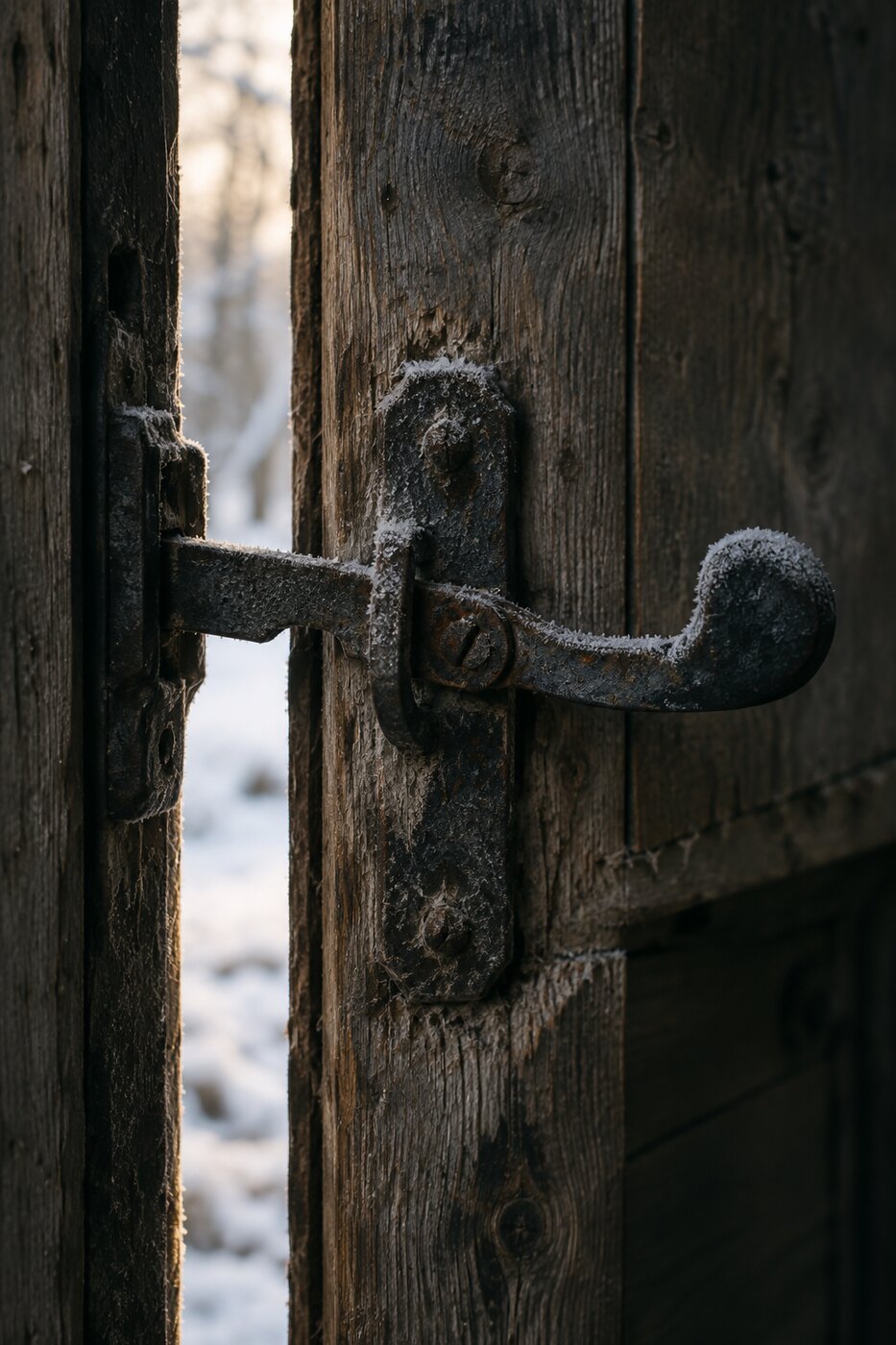
In summer the latch is nothing. You don’t see it. Your thumb finds the worn thumb-piece without looking, presses down, the bar lifts inside, the door swings, and none of it rises to the level of a thought. It’s the most solved problem in the house. A hundred times a day the hand does it and the mind is somewhere else entirely, and that’s exactly the mark of a thing working — it has disappeared. All summer the latch is a verb, not an object. You don’t latch a thought at a thing you never notice.
Then January leans on it and the object comes back.
It starts as a stiffness. A morning where the thumb-piece presses down a little harder than it should, a little more travel needed before the bar lifts, a hesitation in the middle of the stroke that wasn’t there in July. You override it and go through and forget it. But the cold deepens and the stiffness deepens with it, and there comes a morning — a real one, the kind where the air has edges — when you press the thumb-piece and nothing happens. It doesn’t drop. It gives a quarter inch and stops against something that wasn’t there yesterday, and the door stays shut, and the latch is suddenly, aggressively, an object again.
Two things have happened to it and they conspire. The metal has contracted — iron shrinks in the cold, everything shrinks, and all the small clearances the mechanism needs, the gaps that let the bar ride and the thumb-piece pivot, have closed up a hair, gone tight, so the parts bind where they used to slide. And moisture has gotten into the works and frozen. There’s always a little damp in a latch, breath and thaw and the wet of a hand, and in deep cold it turns to ice in exactly the places the ice does the most harm, filming the pivot, gluing the bar in its keeper. Contracted and iced. The summer verb has become a winter negotiation.
So there’s a ritual, and I know it the way you know the stairs of your own house in the dark. First the hip. You set your shoulder and hip to the door and give it a bump, not to open it but to shock the frame, to break whatever skin of ice has formed between door and jamb and to jar the bar in its seat. Sometimes the bump alone frees it and the thumb-piece drops with a crack and you’re through. Often it doesn’t.
Then the bare hand, which you shouldn’t use and use anyway. You know the metal is cold enough to take skin if it’s wet, cold enough that a damp finger will stick and tear, and you use the bare hand regardless because gloves can’t feel the tooth, and the whole thing is about the tooth. You wrap your bare fingers around the thumb-piece and the cold of it goes straight up the bones, and you work it — press and release, press and release, small strokes, feeling for the exact point where the bar catches on the ice, that one tooth of resistance, and worrying at it, pressing right up against it and easing off, letting the friction of the moving metal do a little melting.
And when that fails there’s the palm. You cup your bare palm over the whole works, over the latch plate and the pivot, and you just hold it there and give it your heat. A minute, more. You can feel your own warmth going out of you into the iron, and you can feel the iron slowly, grudgingly, taking it — the ice at the pivot going from solid to slick, the metal easing by some fraction of a fraction as it comes up off its worst cold. It’s a strange intimacy, warming a door latch with your hand like warming a small cold animal, standing there in the entry breathing steam, waiting for a machine to accept your body heat so it will let you leave the house.
There’s a lesson in it I don’t want to overstate, so I’ll understate it: every object has a season it becomes a problem in, and it’s rarely a random season. The latch fails in January, and January is precisely when a door matters most — when the difference between inside and outside is the difference that runs the whole house, when getting the door shut and latched against the cold is the entire point of having a latch at all. The thing breaks down exactly in the conditions that make it necessary. It’s fine all the months you could leave the door open anyway. It argues only when the argument counts.
This morning it took the hip and the tooth and a long minute of palm before it gave. When it gave it gave all at once — the thumb-piece dropped with a hard flat crack, the bar lifted, the door came free of its frozen seat with a small tearing sound, and cold poured in around my ankles. I went through and pulled it to behind me and heard the latch fall home.
It’ll freeze again by morning. That’s the part the ritual can’t fix. The same damp is already in there, the same cold is coming back tonight harder than today, and whatever heat I gave the works is gone the moment my hand left it. The latch is shut and holding now, iced back solid in the seat I just fought it out of, waiting to be argued with at first light.