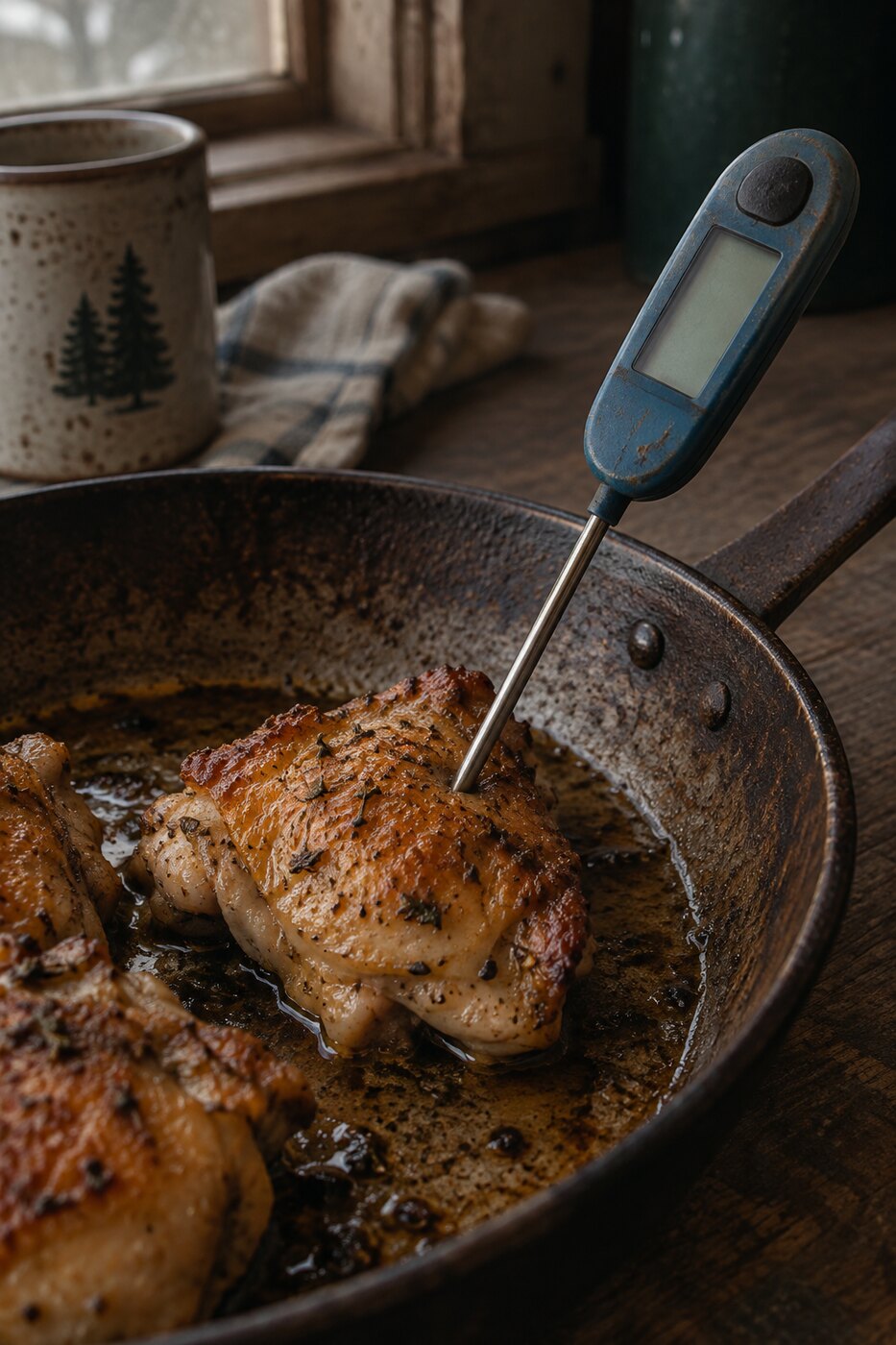
The chicken looked done. That was the whole trouble. It had the color, the skin gone gold and tight and crackled in places, the smell filling the kitchen the way a finished bird’s smell does, and when I pressed the thickest part of the thigh with a fingertip it gave back a firmness that my hand read, immediately and with total confidence, as ready. Done. Off it comes. The hand has done this a thousand times. The hand is sure.
The hand was wrong.
I know this because for once I checked. The thermometer was in the drawer where it usually stays, under the spatulas, its battery good more by luck than by maintenance, and I’d told myself before I started that I’d use it this time instead of going by feel, because the last bird I’d done by feel had let me down in a way I hadn’t forgotten. So I took it out and pressed the button and it woke up with a number, room temperature, and I slid the probe into the thickest part of the thigh, angling for the center, not touching bone, because bone throws it off, reads hotter than the meat around it and tells you a comfortable lie.
The number climbed and then stopped. It stopped forty degrees below where it needed to be.
Forty degrees. Not close. Not a matter of another minute or two. The bird that my hand had pronounced finished, that looked finished, that smelled finished, was raw at the center, the kind of raw that puts people in bed for three days, and I would have pulled it and carved it and served it and been the reason, because my instinct was so certain and my instinct was so far off.
There’s a story people like to tell about cooking, that the real cook doesn’t need the tools, that the hand knows, that your grandmother never owned a thermometer and everyone survived. And some of that is true and some of it is just survivorship talking, the people who got sick left out of the telling. The hand does know things. The hand knows a lot. But the hand knows the outside of the meat — the color, the give, the surface — and the outside of the meat is exactly the part that lies, because the outside cooks first. A bird can be beautifully done on its skin and cold in its middle and there is no fingertip on earth that reads the middle through the skin. You’re feeling the part that’s ready and guessing about the part that isn’t.
So I put it back. It hurt a little, sliding the pan back into the oven, admitting to the room that I’d been about to be wrong, but the alternative was worse and the number didn’t argue. I shut the door and set the timer short and went back in.
The second reading was closer but still not there. That’s the other thing the thermometer teaches you that the hand can’t: how slow the last stretch is, how the temperature crawls the final ten degrees, how a bird that’s ninety percent done can sit there for another quarter hour taking its time about the rest. By feel I’d have pulled it three times over in that stretch, each time more sure than the last, each time wrong by less but still wrong. The probe just sat in the meat and told the truth, patient, unbothered, forty then thirty then twenty then ten, no opinion about how hungry anyone was.
The old instinct kept talking the whole time. It looks done. It’s been in forever. You’re overcooking it now, you’re drying it out, pull it. And there’s a version of that voice that’s right — you can overcook a bird, chase the number too hard and end up with something safe and dry and stringy, meat that gives up its juice at the first cut. The thermometer doesn’t save you from that. It only tells you the temperature; what you do at that temperature is still yours. But the voice telling me to pull it early wasn’t the wisdom of experience. It was impatience wearing experience’s coat. The two sound identical and only one of them has a number behind it.
I pulled it when the probe said so, not before, not after. And this is the part that stung a little: it was fine. Better than fine. Juicy at the center, the thigh meat pulling clean off the bone, no pink where pink shouldn’t be, no rubber where the middle had finally caught up to the edges. Everything the hand had promised at the wrong time the bird actually delivered at the right one. The instinct hadn’t been stupid. It had just been early, reading a true sign forty degrees too soon.
I’ve thought about why the feel-test fails, and I think it’s that the hand learns on one bird and applies to all of them, and birds aren’t the same. This one was bigger than my hand’s average. Colder going in, maybe, straight from the fridge, dense at the joint. The hand’s instinct is a memory of the average bird, and any particular bird is not the average, and the difference between them is exactly the forty degrees that would’ve made someone sick. The probe doesn’t remember other birds. It reads this one.
I left the thermometer on the counter next to the pan while the bird rested, and the probe still held some of the meat’s heat, the number slowly falling as it cooled, sixteen-eight, sixteen-two, drifting down toward the room while a thin bead of juice from the pierced thigh ran down the metal shaft and collected at the base where the display met the steel, sitting there, not yet dry.