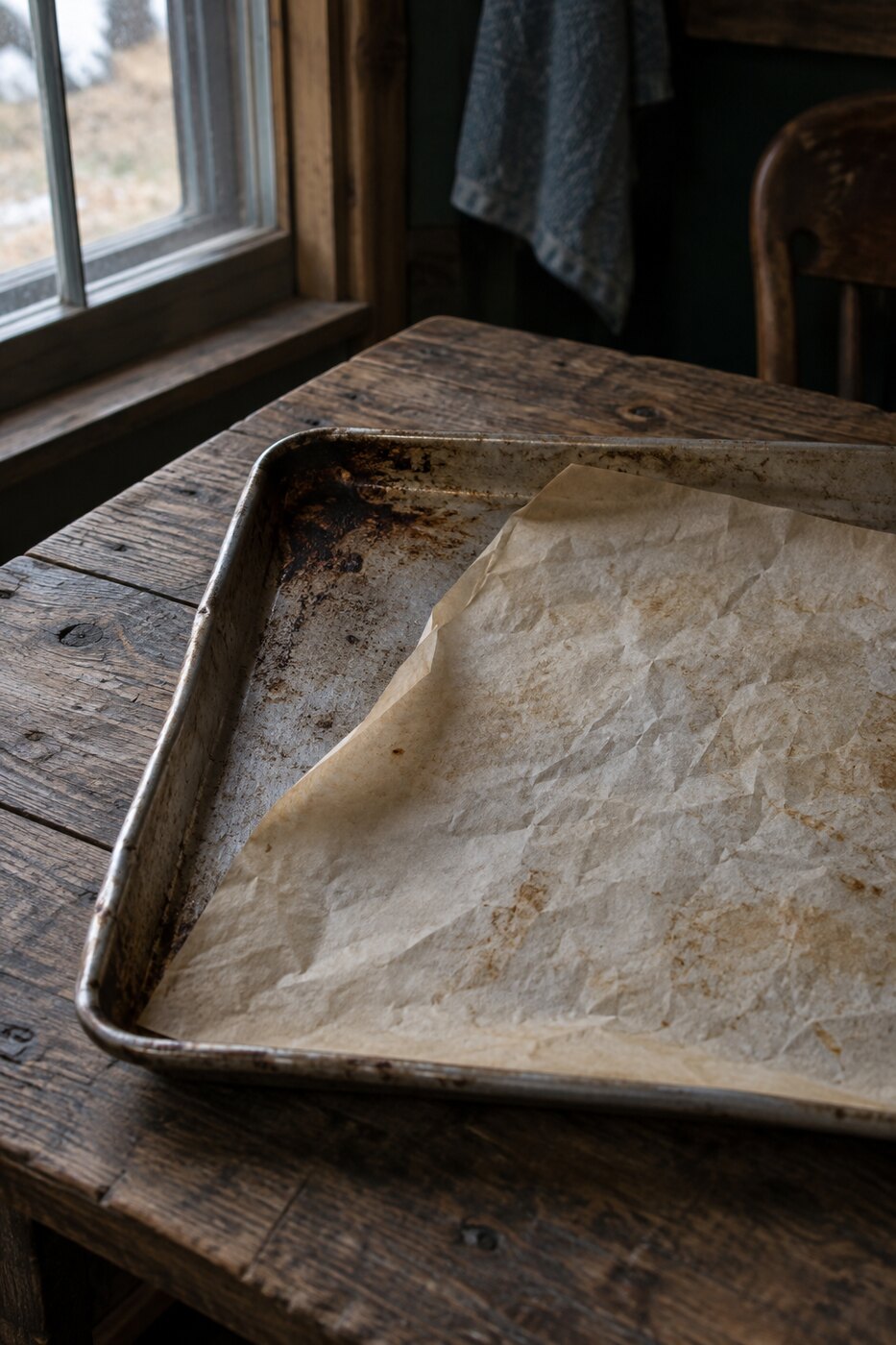
The pan came out of the drawer with a bang, the way it always does, because it doesn’t lie flat anymore and the bottom of it drums against whatever it touches. It’s aluminum, or was, once shiny and now the color of a nickel left outside, gone matte and mottled with a hundred roastings baked into the surface in rings and shadows that no scrubbing takes off. There’s a dent near the back left, a low place where something heavy landed on it years ago, and the whole pan has a gentle warp so that when you set it on the counter it rocks, tips, settles on three points and leaves the fourth in the air.
That fourth corner is the one that burns.
I don’t know the physics of it exactly. Something about the warp lifting that corner closer to the element, or the metal being thinner there from the dent, or just the way this particular oven throws its heat, hotter on the right, hotter at the back, the way ovens do. The dial says one temperature. The oven has opinions. And where the pan’s bad corner meets the oven’s hot spot, there is a place maybe four inches square where anything I put will be done before the rest of it has decided to start.
I learned this the way you learn everything about a pan, which is by ruining food on it. The first few times I didn’t know. I’d spread potatoes across the whole surface, even, careful, and pull the pan out to find one corner black and smoking and shrunk to bitter little coals while the far corner sat pale and limp and steaming, half-raw, greasy, not browned at all. One pan, two failures, at opposite ends. I’d stand there with the oven mitt and look at it and think the oven was broken, and it wasn’t. The oven was just being itself. I hadn’t learned to read it yet.
Every kitchen is like this. Every oven has a personality problem and every pan has a history and the two of them together make a map, and the map is not on any label. You get it by cooking. You get it by burning one corner enough times that your hands start to know, before the food goes in, which part of the pan is the dangerous part.
So now I cook the geography.
If it’s something delicate, something that can’t take the heat — a tray of soft rolls, a sheet of cookies that want to come out pale and chewy — I turn the pan halfway through. Open the oven in the middle of the bake, pull the rack out on its runners, and spin the pan front to back so the corner that was closest to the fire is now farthest, and the pale side gets its turn in the hot spot. It evens out. Not perfectly. Nothing about this pan is perfect. But it drags the whole tray toward the same doneness instead of letting the corners fight it out.
And if it’s something tough, something that wants the heat, then I don’t fight the corner at all. I use it. The densest potato, the thickest wedge of squash, the piece that’s slower than the rest — that one goes in the hot corner on purpose, put there because it can take what that corner does. The corner that ruins the delicate thing is exactly the corner the stubborn thing needs. You stop thinking of it as the bad corner and start thinking of it as the fast one, and then it’s not a flaw, it’s a tool, the one hot burner on a flat pan.
Tonight it was vegetables, cut rough, tossed in oil in the bowl until every piece had a sheen and then tipped out onto the pan in a clatter. I spread them with my hand, and I didn’t spread them even. The carrots, which are dense and take forever, went to the hot corner and the dent, crowded into the four fast inches. The soft stuff, the peppers, the onion that would go from golden to ash in the time it takes to answer the phone, I kept to the front left, the cool corner, the slow one, where the pan rides low and lazy and forgiving. The parchment I’d laid down curled up at the edges immediately in the heat and I pressed it flat with the back of a spoon and it curled again.
Into the oven, and then the waiting, which for me is never really waiting because I don’t trust it. I checked at ten minutes. The hot corner was already talking, the carrots there taking on color at the tips, a little char starting where they touched the metal, right on schedule. The cool corner was still just warming up, the onion barely translucent. Exactly the spread I’d planted. I turned the delicate front edge in toward the middle, just to keep the softest onion from sitting too long in one place, and shut the door.
You could buy a new pan. I’ve thought about it in the store, standing in front of the flat, bright, unwarped ones stacked up, every corner the same as every other corner, a pan with no opinions and no map. And I’ve picked one up and put it back, because a new pan is a pan you don’t know yet, a stranger, and it would have its own hot corner within a month, its own dent coming, its own slow warp, and I’d have to learn the whole geography again from the first burned tray. Better the devil whose corners I’ve memorized.
The carrots came out dark and blistered and sweet in the hot corner, the way I’d aimed them, and the onions in the cool corner came out just soft, just gold, saved by being put where the pan is weak. I scraped it all together with the spoon into one heap in the middle, where the pan neither burns nor spares, and the dent held a small puddle of oil that wouldn’t pour out no matter how I tipped it, sitting there in the low place, going cloudy as it cooled.