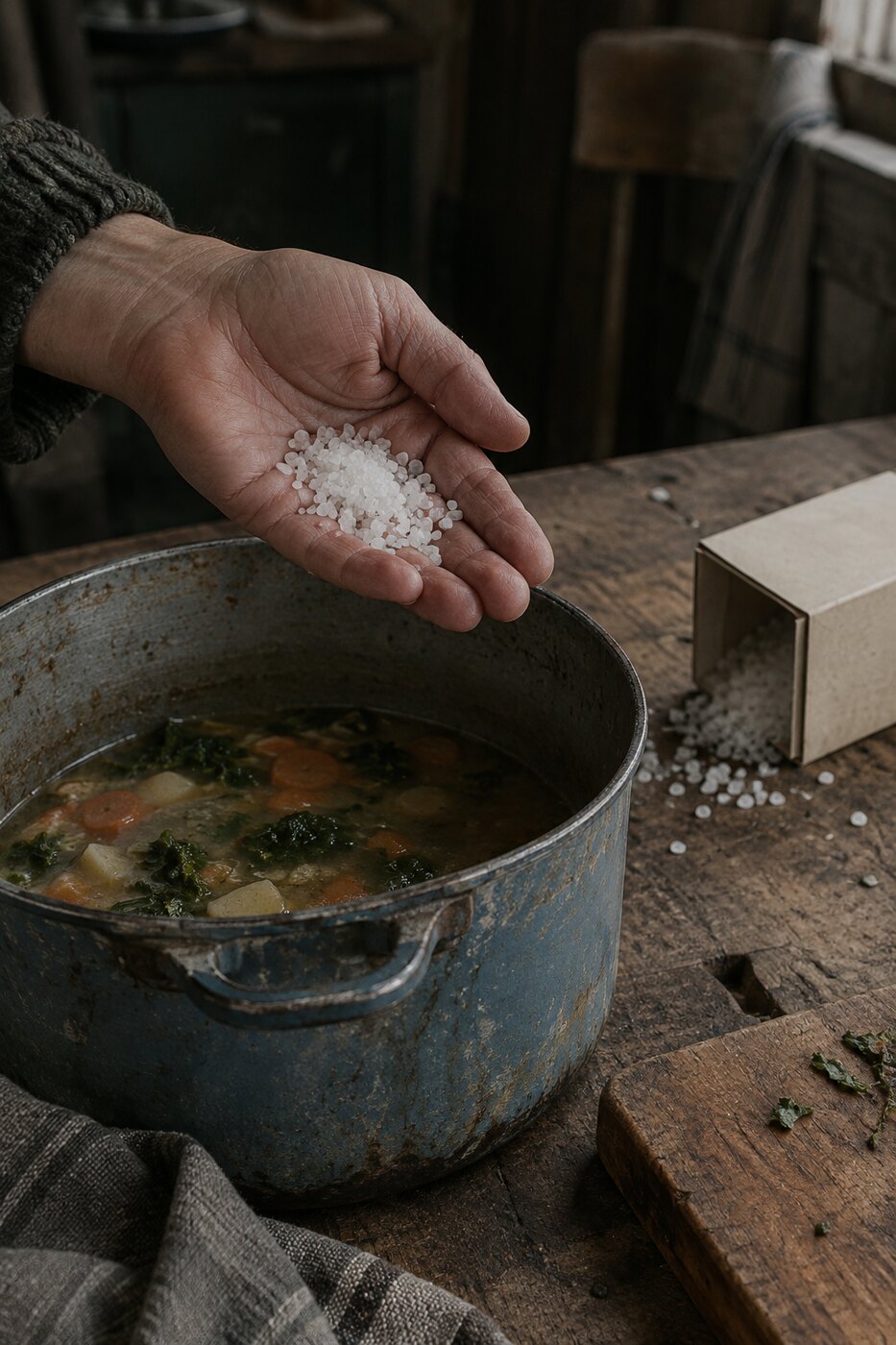
The salt came out of the box in a rush when I tipped it too far, more than I wanted, a small hard hill of it in the cup of my palm. Coarse stuff, kosher, the flakes big enough to feel individually against the skin, cool at first and then not, warming to my hand the way anything does if you hold it long enough. I let a little run off between my fingers back into the box, thinning the pile down to what I meant to take. Then I stood over the pot and threw.
Not a pinch. A pinch is for the top of a finished thing, a correction, a garnish of salt. This was a handful, and it went in from a height, scattered off the fingertips with a small motion of the wrist so it spread instead of landing in one salty clot at the center. You throw from up high so it falls even. That much I know without thinking about it. The salt hit the water and disappeared, and the water took a second to know it was there.
People will tell you to measure. And they’re not wrong, exactly. A teaspoon is a teaspoon and it doesn’t lie and it doesn’t have a bad day, and if you’re baking, where salt is chemistry and not seasoning, you should use the spoon and level it with a knife and not trust anybody’s hand, including your own. I’m not against the spoon. The spoon is a good tool for the things the spoon is good for.
But there’s another kind of knowing, and it lives in the hand, and it’s not magic and it’s not old-timey wisdom and it’s not better because it’s older. It’s better, when it’s better, because it’s been wrong. That’s the whole of it. My hand knows how much salt to throw because my hand has thrown too much, many times, into many pots, and stood by while the results were eaten in silence or not eaten at all.
I have oversalted soup so badly it couldn’t be saved. I’ve done the thing you’re supposed to do, dropped in a peeled potato to draw some out, added water to dilute it, and ended up with a bigger pot of something that was still too salty and now also thin, weak, and stretched, an insult twice as large as the original. I’ve watched someone take one careful spoonful of a stew I was proud of and set the spoon down and reach for their water glass, and known, from that one motion, exactly what I’d done. You learn salt from the far side of it. From having gone past.
So the hand that throws the salt now is not a confident hand. It’s a corrected one. Every handful has that history folded into it, the pull-back at the last second, the little that runs off between the fingers, the throwing from a height so no one spot gets it all. The hand has a memory the spoon can’t have, because the spoon has never regretted anything.
The trick they don’t tell you is that the hand also knows the salt. This box was flaky and coarse and light, and a palmful of it was less salt than a palmful of the fine stuff would be, the fine stuff that packs dense and dissolves fast and punishes you in half the time. When I switch salts I have to recalibrate, and I get it wrong for a day or two, throwing the old amount of a new thing, until the hand catches up. The hand isn’t measuring salt. It’s measuring this salt, in this weather, into this pot, which is the sort of thing no spoon in the drawer was built to do.
I tasted the water. This is the part the hand can’t skip, the part that keeps the hand honest. You throw by feel and then you check by tongue, because the feel is a guess and the tongue is the judge, and a cook who trusts the hand and never tastes is just a person being wrong with confidence. I lifted a little on a spoon and blew on it and touched it to my lip. Under. On purpose. You salt toward the target, not at it, because you can always add and you cannot subtract, and the whole reason the hand pulls back is that it has learned there is no undo.
Another small throw, less than half the first. Taste again. Closer. The water tasted like the sea now, or nearly, which is the strange rule for pasta water and for the salting of anything that will lose salt to draining — season the water hard because most of it goes down the sink, and only a little stays behind in the thing you’re cooking. That much salt tastes alarming on a spoon and correct on a plate. The hand had to learn that too, had to learn to throw an amount that would scare you tasted straight, and to trust the draining to take the fear back out.
The pot came up to a boil and the salted water rolled and I put the food in and turned my attention to other things, and the salt was gone now, part of it, invisible, doing its work in the dark under the boil where you can’t check it anymore. That’s the last thing the hand has to make peace with. At some point the seasoning is decided and the pot is closed to argument and you find out at the table whether the hand remembered right.
The box of salt sat open on the counter where I’d left it, tipped, a few coarse flakes scattered on the wood around its mouth. I pressed one flat with a fingertip, out of habit, the way you press a crumb, and it stuck to my skin, damp already from the steam, dissolving slowly against the whorl of the print without me deciding to taste it or not.