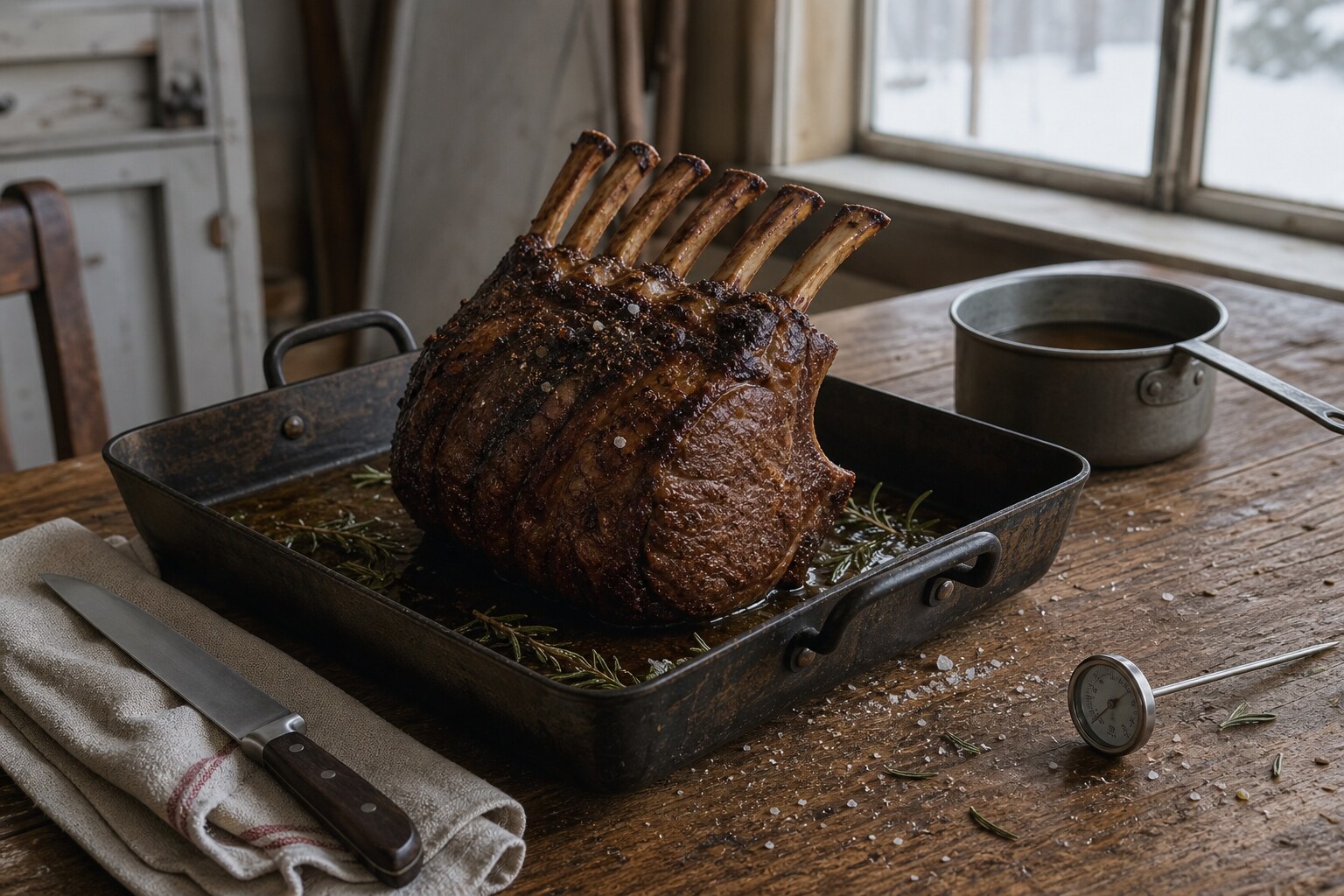
The roast came out of the oven the color of a saddle, dark where the fat had rendered and rubbed against the pan, paler on the underside where it had sat in its own liquid. I lifted it with two forks jabbed into the ends and the whole thing sagged in the middle, heavier than it looked, sending a slick of hot fat sliding to one corner of the pan. It hissed where it hit the cooler metal. I moved it onto the board and set the pan back on the stove and turned off the oven and stood there with the forks still in my hands, doing nothing, which is the hardest part.
Because now you wait.
Meat off the heat is not done. It only looks done. Inside it there is a thing happening that you can’t see and can’t rush, muscle fibers clenched tight from the heat, holding their juice the way a fist holds water, and if you cut into that fist right now it opens and everything you cooked the meat for runs out onto the board in a pink flood and pools around the base and there is no getting it back. You’ll have a dry roast in a puddle of its own dinner. The plate tells on you. Everyone at the table is polite about it and everyone knows.
So there’s a law, and the law is: leave it there.
I know the number people say. Ten minutes. Fifteen for something big. But it isn’t really about the number. It’s about the muscle doing the slow unclenching, letting go by degrees, drawing the juice back into itself and holding it there until it’s part of the meat again instead of just passing through. You can’t feel it happening. You just have to believe it’s happening and stay out of the way, which for me is the whole trouble, because the roast is done and it smells done and the kitchen is full of it and the people are hungry and I am standing there guarding a piece of meat from myself.
I laid a piece of foil over it. Not tight. Tight and you trap the steam and the crust you worked for goes soft and damp, all that dark surface turning to something you could’ve gotten from a slow cooker. Loose, tented, just enough to keep the top from going cold while the inside settles. The foil crackled as I draped it and then held its shape, one corner lifting in the heat coming off the meat.
I have not always obeyed this law. There was a time I cut a roast the second it came out, standing at the counter, hungry and impatient and sure that the rules were for other people’s meat. The knife went through it easy, too easy, and the juice came out ahead of the blade, and by the time I’d cut three slices there was a lake on the board and the slices themselves had gone from pink to a tired gray-brown as I watched, the color draining out of them. They tasted like the memory of a roast. I ate them anyway. That’s the cost, and you only have to pay it once to learn it, though I’ve paid it more than once, because knowing the law and keeping it are different muscles.
While it rested I made the rest of it wait too. This is the other half. Resting the meat only works if the table respects it, and a hungry table does not respect anything. So I kept my back to them and stirred things that didn’t need stirring and answered the question about whether it was ready with the same word each time. Almost. The roast sat under its foil and I could see, at the edge of the board, the first thin line of juice beginning to seep out on its own — not because I’d cut it, but because it had reached the point where it was ready to give a little back. That seep is the sign. When the board starts to bead at the base of the meat, unhurried, the fist has opened on its own time.
The board I use has a shallow groove cut around the rim, a trench for exactly this, and I’ve come to think of that groove as the whole argument made in wood. Someone, long before me, cutting a roast, watching the juice run off the edge and onto the counter and onto the floor, thought: I will carve a small ditch to catch what I lose. The groove is an admission that meat leaks. That no matter how long you wait, some of it comes out when the knife goes in, and the wise thing is not to pretend otherwise but to build a place for it to go.
When I finally cut, I cut against the grain, which is its own small law, the fibers running one way and the knife going the other so the pieces come apart short instead of long and stringy. The first slice fell away and stood up on its cut face, dark rim, rosy center, holding its color this time, holding it. A little juice came, but only a little, and it ran into the groove and stayed there, a thin dark line following the wood, not a flood. The meat had kept most of what it had. That’s the difference the waiting makes. You can’t see it going in and you can only just see it coming out, in what doesn’t spill.
I carved the rest and laid the slices overlapping on the warm plate and carried it to the table where the waiting had gone quiet.
On the board, in the groove, the juice I hadn’t lost to impatience sat cooling and beginning to set, going tacky at the edges, darkening toward the color it would be by the time I came back to wash the board and found it there, waiting, a thin brown seam in the wood that a sponge would not entirely take out.