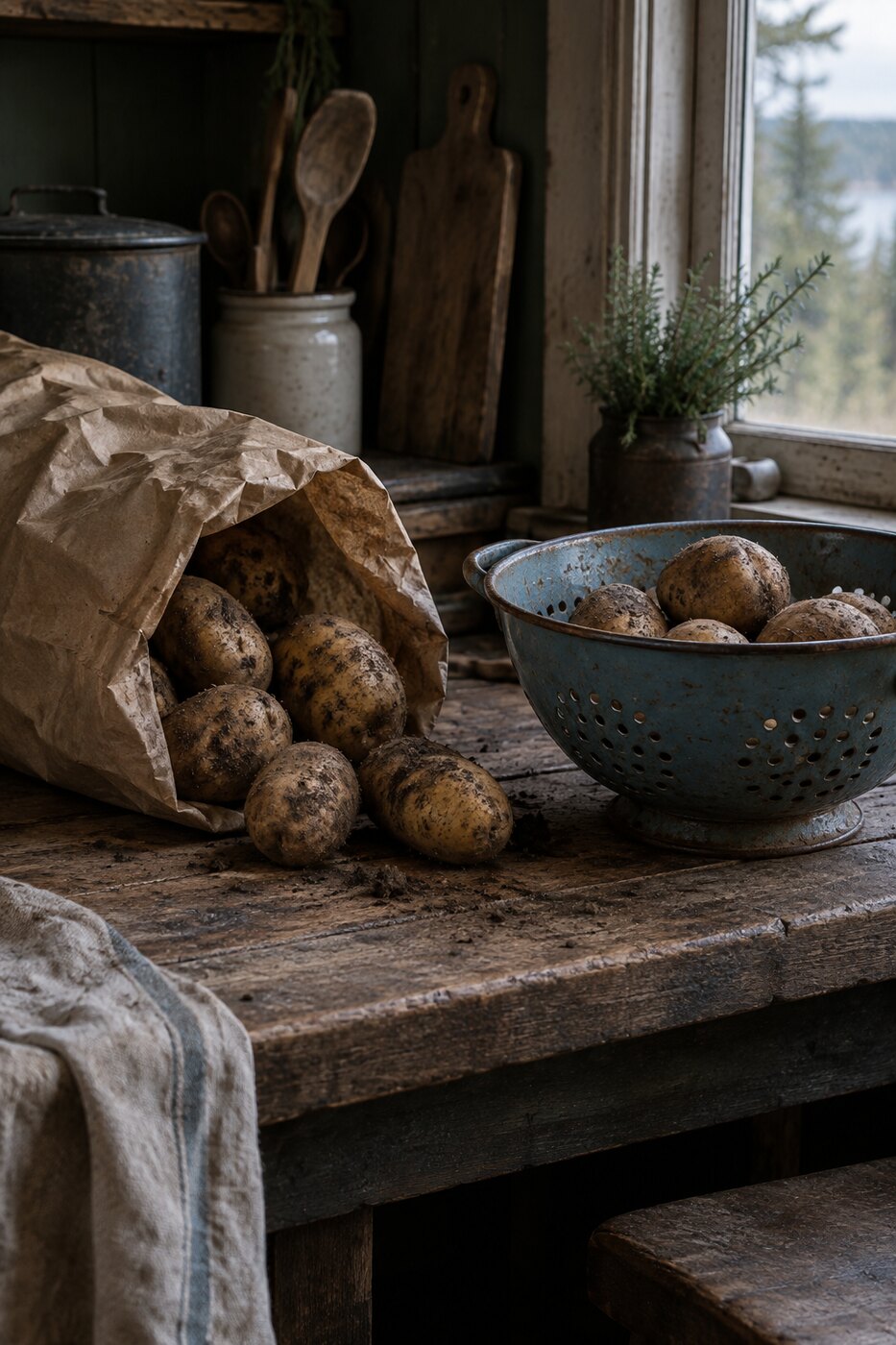
The bag was down to the last third. I could tell by the weight when I lifted it off the floor of the pantry, the way the potatoes shifted to one side and then settled, dry paper rasping against them. Some had gone soft where they’d touched the bottom. A couple had put out pale sprouts in the dark, feeling for a season that wasn’t coming. I set the sack on its side on the counter and let it spill what it wanted to spill.
I don’t measure potatoes. I count them into my hand.
The first one was a good size, heavy, cool from the pantry floor, the skin loose in one spot where it had started to give. I brushed the dirt off with my thumb and it came away in a dry smear. One for me. The next was smaller, so I took two to make up the difference, and that is the whole arithmetic of it — not the number of potatoes but the amount of potato, weighed against the pot and against the people and against a memory of every supper that had come up short.
There is a math you learn by running out. I have run out. I have stood at the stove with the pot already going and done the count again in my head and known, cold, that I was one potato light and there was no fixing it now. So the hand overcorrects. The hand has a bias built into it, a small permanent lean toward too many, put there by the specific quiet of a table where someone takes the last of something and you say you’re full.
Four for the two who eat like it’s work. That’s honest. They come in from the cold and they mean it. Two more for me, because I pick while I cook and I’d rather not resent the pot later. Then the one.
The one is for the person who says they’re not hungry.
You know this person. Every kitchen has one. He stands in the doorway with his coat still half on and says he ate late, he’s fine, don’t do extra on his account. And you nod, and you do extra on his account, because the coat comes off eventually and the smell gets into him and by the time the pot is draining he is standing closer than he was, not saying anything, just closer. He will take a small amount to be polite. Then he will take more. The extra potato is not for the hunger he admits to. It’s for the one he’ll discover.
So the hand takes one more. Cool, oblong, a scab of dirt near the eye. I turned it once and set it with the others, and that was the count.
I ran them under the tap and the water came off brown, then tan, then almost clear. The dirt collected in the strainer in a little silt. A few skins had bruises under them, gray-green blooms that I cut out with the tip of the knife, digging a shallow crater and flicking the piece into the compost bowl. One potato had a soft spot that went deeper than it looked. I pressed and my thumb went in like it was pressing a bruise on fruit, and the smell came up, sweetish and wrong, and I threw the whole thing out and took another from the sack to keep the count whole. The bag was thinner now. Next week’s problem, standing in line behind this one.
I didn’t peel them. I never peel them for this. I cut them into chunks that were roughly even, which is to say not even at all, some too big and some too small, because a potato does not divide into fairness. The big pieces would still have a firm center when the small ones had gone to mush at the edges, and I knew that, and I did it anyway, because I like a supper that has both. The chunks went into cold water in the pot as I cut, so they wouldn’t go pink and then gray in the air, sitting there oxidizing while I worked. The water clouded up starchy and pale around them.
Salt in the water. Enough to remember. The pot went onto the big burner and the flame caught blue and I waited for the shudder of the boil, that first roll where the potatoes lift and turn over each other like they’ve decided something.
They take longer than you think and then they’re done all at once. You test with a knife. The blade goes in and there’s resistance, a firmness at the core that says not yet, and you wait, and you test again, and this time the knife goes through and the piece nearly falls off the point of its own weight. That’s the window. It’s not a wide window. A minute past it and the outsides start to slough, the water goes thick, and you’re draining a pot of edges and losing the middles down the sink in a pale gritty slurry. I drained them a little early, on purpose, because carryover heat is real and a potato keeps cooking after you think you’ve stopped it, holding its temperature the way a stone does.
The steam came up off them in the colander in a hard white cloud that fogged the window over the sink. I shook them once, twice, to rough up the outsides, and they knocked around dry and hot and a little broken at the corners.
Then I counted the pot. Habit. Seven potatoes’ worth, more or less, though they’d stopped being potatoes and become a heap you couldn’t number anymore.
The one for the man who wasn’t hungry had disappeared into the rest of them. That’s how it works. You can’t point to it. It’s just that the pile is a little higher than the admitted appetite in the house, sitting there steaming, waiting for the coat to come off.