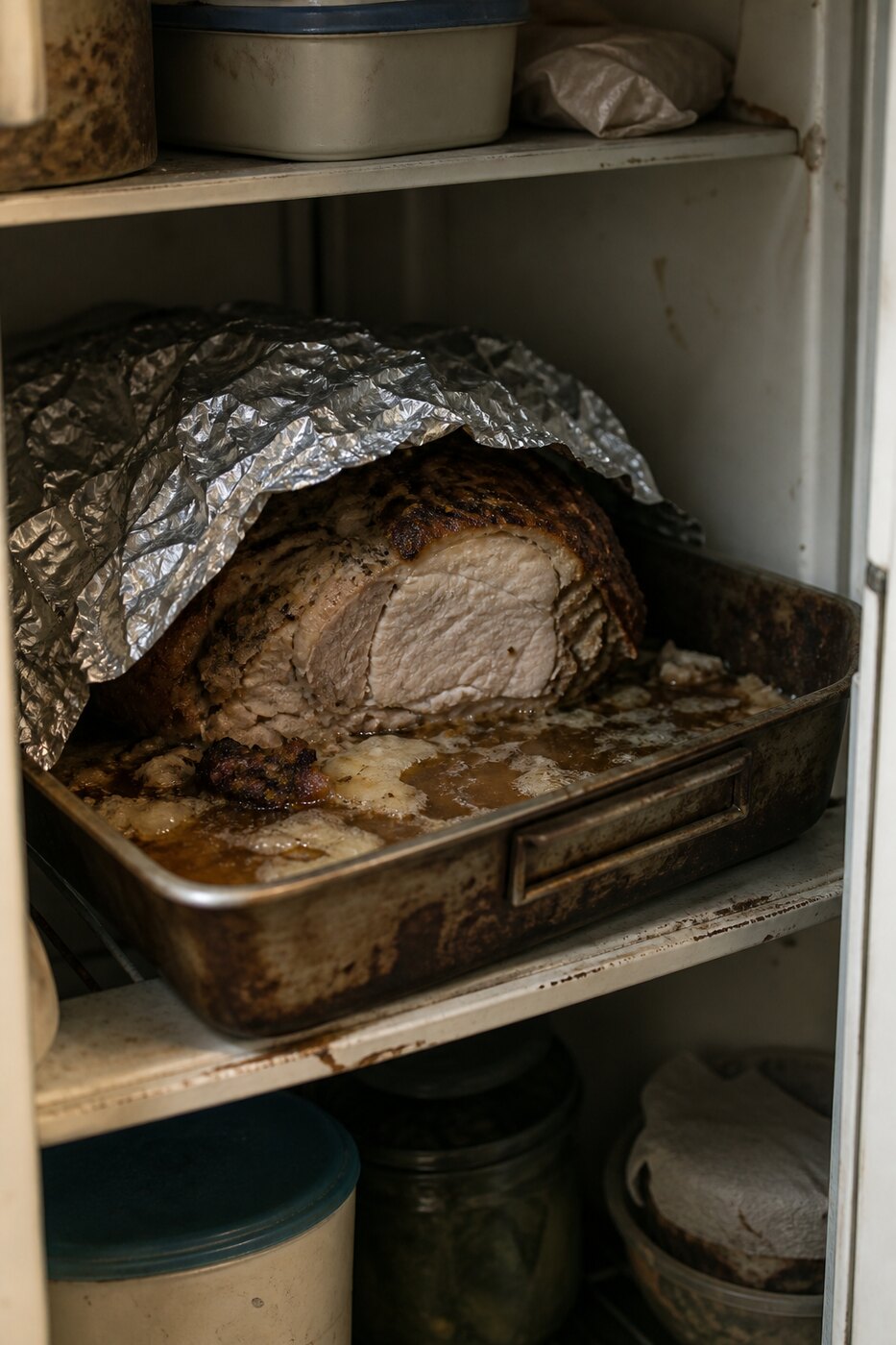
The roast came out of the oven Sunday whole and left the table Sunday a wreck. One side carved down to the bone, the other still high and intact, the whole thing collapsed a little as it cooled, the juices setting into a brown gel in the bottom of the pan. I put it in the fridge under foil without carving the rest. Leftover roast is not a sad thing. Leftover roast is a roast with plans.
By Monday morning the fat had gone white and firm, a pale cap over the meat, and the gel underneath had set hard enough to hold the shape of the pan. This is the roast telling you what it has become. Warm, it was dinner. Cold and firm, it is a material now, and a material has uses, and the uses are better organized than the dinner ever was.
Cold slices first, because those do not wait for a plan. Standing at the open fridge with the door pushing cold at my knees, I cut a slab off the intact side with the paring knife that lives in the door and ate it there, no plate. Cold roast is a different food from hot roast. The fat is firm instead of running, the meat is dense, the flavor closed up and concentrated and a little metallic in a way that is not bad, just serious. You eat it fast and standing because sitting down would make it a meal and it is not a meal, it is a raid.
The sandwiches were Monday’s lunch and Monday’s whole reason for not finishing the roast on Sunday. Cold meat sliced thin — thin matters, a thick slab of cold roast on bread just falls out the sides when you bite — laid on with butter and salt and nothing else that would compete. The bread does more work than people admit. It holds the cold fat in place and lets it warm against your mouth instead of the plate.
The hash was Tuesday. This is where the roast stops being roast and becomes a means. You dice it, the last of the good side, the dense cold meat that cubes clean, and you get the pan hot, hotter than feels right, oil to a shine, and you put the meat and diced potato down and then you leave it alone. That is the whole trick and it is the hardest one. You want a crust, a brown welded surface, and a crust needs contact and time and stillness. Stir it early and you get gray steamed cubes and no crust at all, the meat toughening and drying instead of browning. So you leave it, and it sticks, and you let it stick, and then it releases on its own when the crust is ready, and you turn it once. The kitchen fills with a smell that is nothing like Sunday’s roast. Sharper. Browner. The same reaction the roast got in the oven, run again, harder, on food already cooked once.
Some of it caught past brown into black at the edges, the way hash does, little bitter carbon flecks, and I ate those too because they are part of it. A hash with no burnt edges was not cooked hot enough to be a hash.
Then there was the bone, which is the last plan and the longest. By the time the meat was gone the bone still had work in it, the knuckle, the marrow, the scraps too close to it to carve. That went in a pot with water and an onion and the carrot ends and the celery going limp in the drawer, and it sat on the back of the stove barely moving, a low mutter of a simmer, all afternoon. You do not boil a stock hard. Boil it and the fat emulsifies into the water and it goes cloudy and greasy and never clears. You keep it just under, a wrinkle crossing the surface now and then, a single lazy bubble finding its way up, and you skim the gray foam off the top as it rises and let the bone give up what it has slowly.
The stock was Wednesday, and it would become soup, and the soup would probably outlast my interest in it and end up in the freezer in a bag with a marker word on it, and the circle would close the way it always does. But that was days off. That afternoon it was a pot going quietly on the back burner, the bone paling in the water, the smell of it thin and clean and different again from the hash and the sandwich and the cold slab at the fridge, each one the same roast wearing a different set of manners.
The Sunday roast is the nervous one. Will it be done, will it be dry, will it carve clean in front of everyone. By Monday it had nothing to prove. It knew what it was. It just lay in the fridge, cold and firm and organized, waiting to be told which of its plans was happening today.
The pan the roast had cooked in was still in the sink, the brown gel gone up the sides and dried there overnight into a hard glaze, and it would not come off under the tap, so I filled it with water and left it to soak and turned away before I could see whether it was going to give.