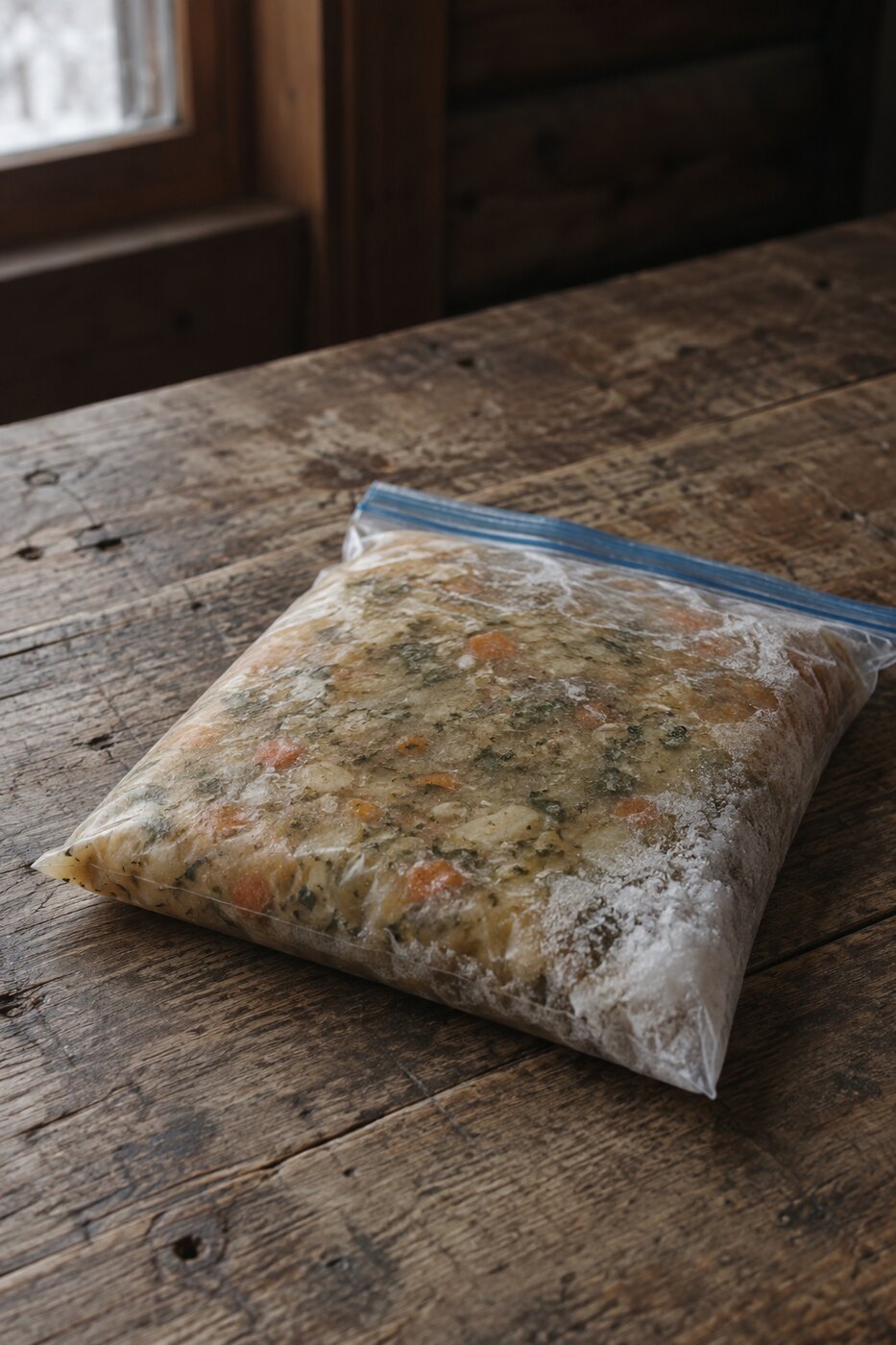
The bag was at the bottom, under the peas gone to a single frozen brick and the heel of bread nobody was going to eat. Flat, the way soup freezes when you lay the bag down before it sets, a hard tan slab maybe an inch thick, the contents locked in whatever shape the bag was in when it went stiff. Freezer-burned at one corner, gone pale and crystalline where the seal had not quite held.
On the front, in marker, in my own hand: soup? With the question mark. I had written it. I had no memory of writing it, but it was my seven, my crossed way of making a question mark, and there was nobody else it could have been.
The question mark is the honest part. You freeze something in a hurry, you write on the bag with the marker that lives in the drawer, and you mean to be specific. Chicken and rice, or that lentil thing, or the ham stock from Christmas. But sometimes you are not sure even as you write it. Sometimes it is the last of three different pots scraped together, or it started as one soup and became another over two days of adding to it, and the honest label is not a name. The honest label is soup, and then, because you are not even sure of that, the question mark.
The freezer is full of this kind of testimony. There is a bag that says beef?? with two of them, which is a deeper uncertainty than one. There is a container marked good — do not throw out, which tells you nothing about what it is, only how I felt about it at the time, a message from a version of me who knew and did not write it down. There is a foil brick with no label at all, which is the freezer’s way of saying some things are beyond questioning. The inventory, if you could call it that, is mostly fiction. You do not know what you have. You have shapes, and hunches, and handwriting.
It was a Tuesday and there was nothing else and the roast plans had fallen through, so the question mark became dinner. I ran the bag under hot water at the sink until the slab cracked loose from the plastic — it comes away with a sound like ice off a windshield — and dropped the frozen block into a pot. It sat there, a solid tan lozenge, sweating, not melting, refusing for a long time to be anything but a shape.
Frozen soup thaws from the outside in and it lies to you the whole way. The edges go first, a slick of liquid forming around the block, and you think it is coming, and then you stir and the center is still a fist of ice that will not give. You cannot rush it with high heat or the thawed part at the bottom scorches before the middle is even soft, a burnt smell coming up off a pot that is still mostly frozen, which is a particular kind of failure. So low heat, and a spoon, and patience, and the block turning slowly in the loosening liquid like something surfacing.
It came apart in pieces. First a broth, cloudy, tan, ordinary. Then things in the broth, freed as the ice let them go. Barley — so it had barley in it, that was a fact now, that narrowed it. Carrot, gone soft and dark at the edges the way carrots do after freezing, the cell walls broken so they would never be firm again, just sweet and mushy. Something that might have been chicken and might have been pork, shredded, pale, past telling apart once it has been frozen and thawed and had all its texture rearranged. A bay leaf, whole, which meant I had meant it as a real soup, once, with intentions.
I tasted it off the spoon. It was salty, and under the salt it was fine. A soup, definitely a soup, the question mark answered in the only way it could be, which is that it was soup, still, whatever else it had been. It needed water. It had cooked down before freezing and then lost more to the freezer, so it had gone concentrated, almost a paste at the bottom. I added water until the spoon moved right through it and let it come back up to heat.
Whatever it had been on the day I made it, it was Tuesday’s dinner now. That is the thing the freezer does. It stops time on the food but not on you, and when the two of you meet again you have both changed, and neither of you remembers the occasion. The soup did not know it was Christmas stock or the end of three pots. It only knew how to be hot and salty and full of soft barley, and that turned out to be enough.
I ate it standing at the counter out of the pot, which is the correct way to eat a soup you cannot name. The bag lay in the sink, turned inside out, the marker word backward through the plastic now, still legible, still asking.
There was a rime of it left in the pot when I was done, a tan skin drying on the metal above the waterline, already starting to set into something a spoon would have to scrape.