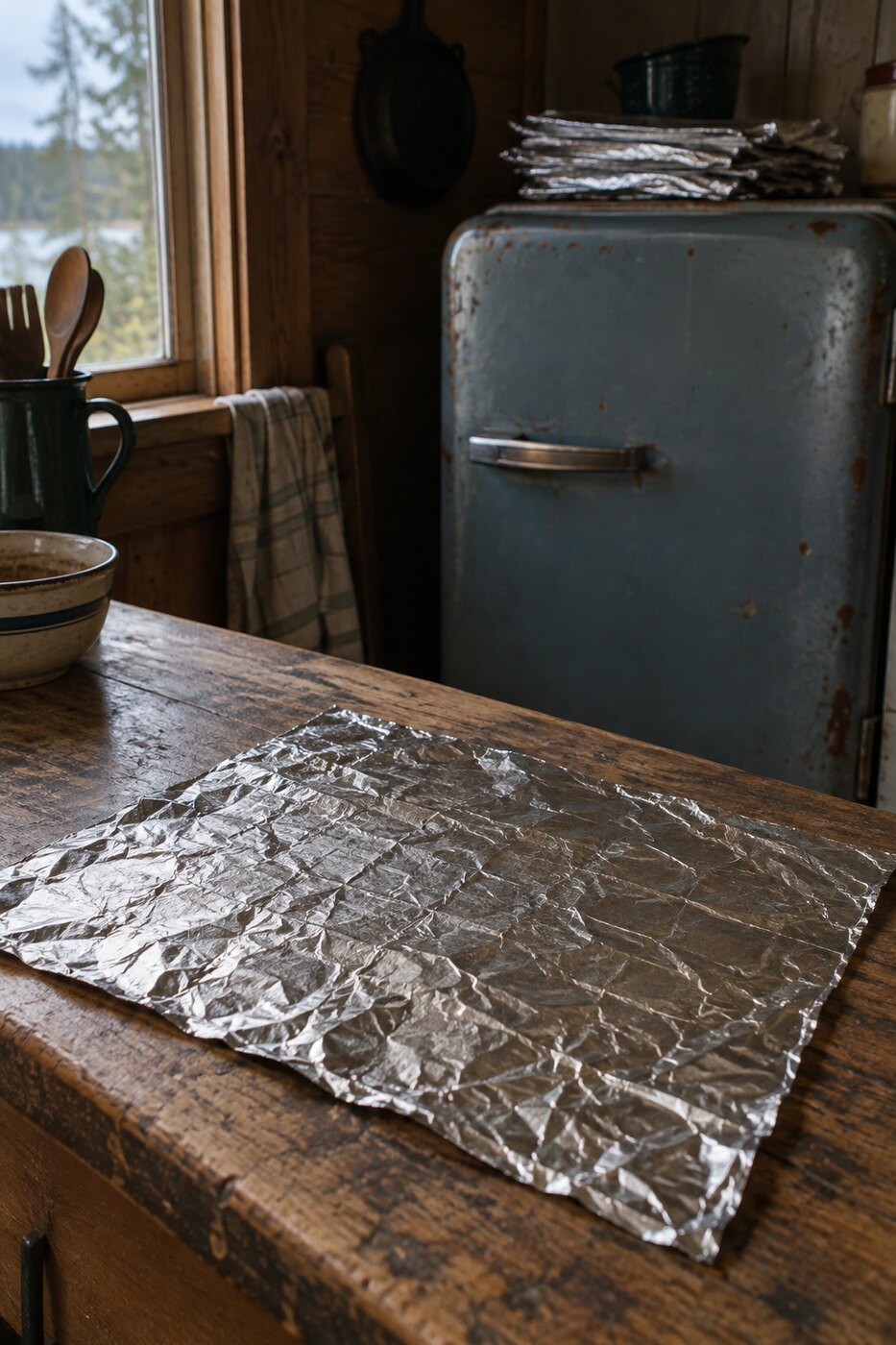
The foil came off the ham in one piece, which is the first thing you check. A sheet that tears when you lift it is done. It has given its life to one job and you ball it up and it is finished. This one lifted clean, one big rumpled rectangle, greasy on the inside where it had sat against the meat, dull on the outside where the oven had been at it.
I did not throw it away. I do not, not automatically, and it is not about being careful with money, or not only. It is that a thing that still works is still a thing, and foil that comes off in one piece has not stopped working. It is just dirty and bent.
So I took it to the sink. Hot water first, over the greasy side, and the fat came off in a cloudy film, going gray and sliding down the drain. Foil does not mind water. It does not rust, does not swell, does not take on a smell the way plastic does. You put it under the tap and it comes back to being what it was, more or less. A finger of dish soap on the worst of the grease, a rub with the pad of my thumb — you cannot scrub foil hard, it tears where you press a nail — and the shine came back through the film in patches.
Then the drying and the smoothing, which is the real work. A wet sheet of foil is a crumpled map of everywhere it has been. Every fold it took around the ham is printed in it, a whole topography of creases catching the light in a hundred little ridges. You lay it flat on the counter and smooth it with the flat of your hand, working from the middle out, pressing the wrinkles toward the edges the way you would smooth a sheet on a bed.
Some creases come out. The big soft folds flatten back to almost nothing, a ghost of a line you can see if you tilt it but cannot feel. Other creases do not. Where the foil folded hard, doubled over on itself and got pressed, the metal has fatigued — that is the word for it, the same word they use for the wing of a plane — and it will not lie down again. It stands up in a sharp little ridge, and if you push it flat it just cracks along the top, a hairline split opening in the crease, and then that sheet has a hole, and a hole means it leaks, and a leaking sheet is done.
So the smoothing is really a test. You are not fixing the foil. You are finding out how much of it survived. You run your hand across and feel for the give. The parts that flatten are still foil, still going to hold gravy without letting it through, still going to seal around a pan. The parts that resist and crack are the boundary of what is left.
This sheet held. It smoothed down to something you could nearly see your own reflection in, dull and pocked but whole, one hairline crack near a corner that I folded away. You fold the failed part under and out of the working area, and now it is a slightly smaller sheet than it was, and still good.
I do not know why this satisfies me and throwing out a fork would not. A fork you keep without thinking. Foil you are supposed to use once. That is the deal the box makes with you, the little serrated edge that says tear off a fresh length, use it, discard it, come back for more. The box wants you to use it up. But the foil itself makes no such argument. The foil, smoothed out on the counter, still answers back correctly. Press it and it presses back. Fold it and it holds the fold. It has not become garbage just because it has been used. It has only been used.
There is a real line, though, and I have hit it. Some foil comes off a thing already dead, torn in the lifting, shredded where a fork went through, so thin in the pressed spots that it comes apart into flakes when you touch it, little silver confetti stuck to your wet fingers. That foil is done and no amount of smoothing brings it back. You learn the difference by feel. A sheet that still has a life in it holds together under your hand. A dead one comes apart and gets on everything.
This one I folded loosely, not sharp — sharp folds are what kill it — into a soft square, and set it on top of the fridge where the used-but-good foil lives, on the little stack of previous survivors. Each one a slightly different size, each one folded around the wound where it failed last time, each one waiting for the next thing that needs covering and does not care that its cover has a history.
The stack was maybe six sheets deep now. The top one, the ham one, had not fully dried in the deep creases, and a bead of water sat in one of them, holding its shape, not soaking in, because foil does not soak. It just holds the water on its surface until the air takes it, or your hand does.